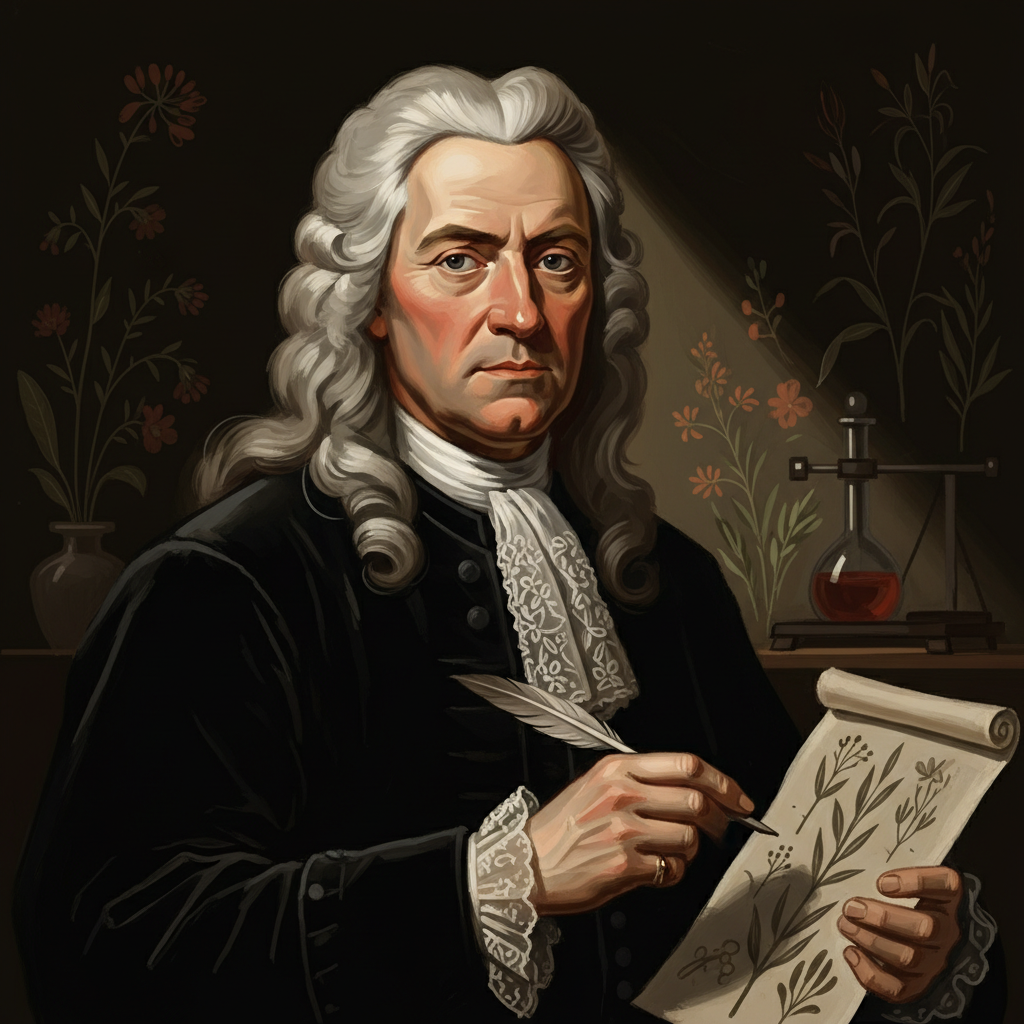
Carl Linnaeus — "I was born on a farm, and I have always loved the countryside."
I was born on a farm, and I have always loved the countryside.
I was born on a farm, and I have always loved the countryside.
Click any product to generate a realistic preview. Up to 3 at a time.
* Initial load can take up to 90 seconds — revising the preview in another color is nearly instant.
"The more I collect and examine, the more I marvel at the infinite wisdom of the Creator."
"Nature has been kind to me, and I have repaid her by being her faithful interpreter."
"Man is the measure of all things, but the Creator is the measure of man."
"It is not the business of a botanist to know all the plants, but to know how to find out what they are."
"I have established a new era in natural history."
Swedish botanist and the father of modern taxonomy whose Systema Naturae (1735) introduced binomial nomenclature for naming all species. Closely associated with Joseph Banks (British naturalist who carried Linnaean classification on Cook's voyages). For an intellectual contrast, see Comte de Buffon, French naturalist and Histoire Naturelle author (1749-1788) — Buffon explicitly attacked Linnaean fixed-categories taxonomy as artificial and rejected the binomial system; his gradualist, environment-shaped natural history was the explicit alternative. Anticipates the fixed-species-vs-evolution debate Darwin would later resolve.
A personal statement about his origins and enduring connection to nature.
Date: Uncertain (attributed)
WisdomFound in 1 providers: gemini
1 source checked
The speaker expresses a deep, lifelong connection to rural life and the natural world. Growing up on a farm instilled an enduring affinity for open land, seasons, soil, and living things. This bond with the countryside is not merely nostalgic but foundational to identity, shaping how one sees and engages with the world throughout life.
Linnaeus was born in 1707 in Råshult, rural Sweden, where his father was a pastor who cultivated an extensive garden. That early immersion in plants and countryside directly ignited his passion for botany. His famous Systema Naturae and Species Plantarum emerged from a mind formed by hands-on observation of nature, making this rural origin genuinely inseparable from his scientific legacy.
In early 18th-century Europe, most people lived agrarian lives, yet natural philosophy was urbanizing through academies and universities. Linnaeus bridged these worlds, bringing rigorous rural observation into formal science. Sweden's agricultural economy and Lutheran culture also prized land stewardship, giving countryside roots social dignity. His era saw Enlightenment thinkers increasingly systematizing natural knowledge drawn from just such provincial, field-based observation.
AI-generated insights based on extensive research and information for context. Factual errors? Email [email protected].
Your cart is empty