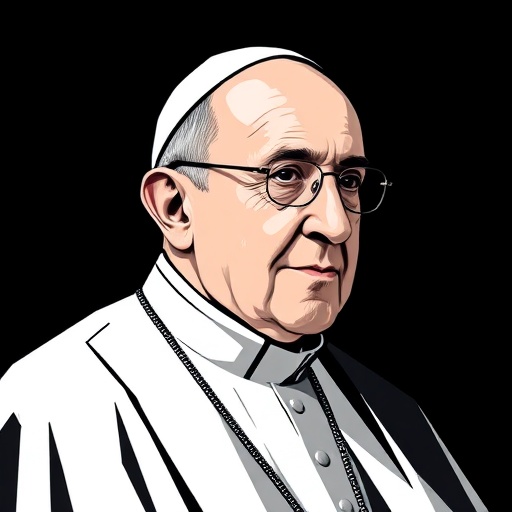
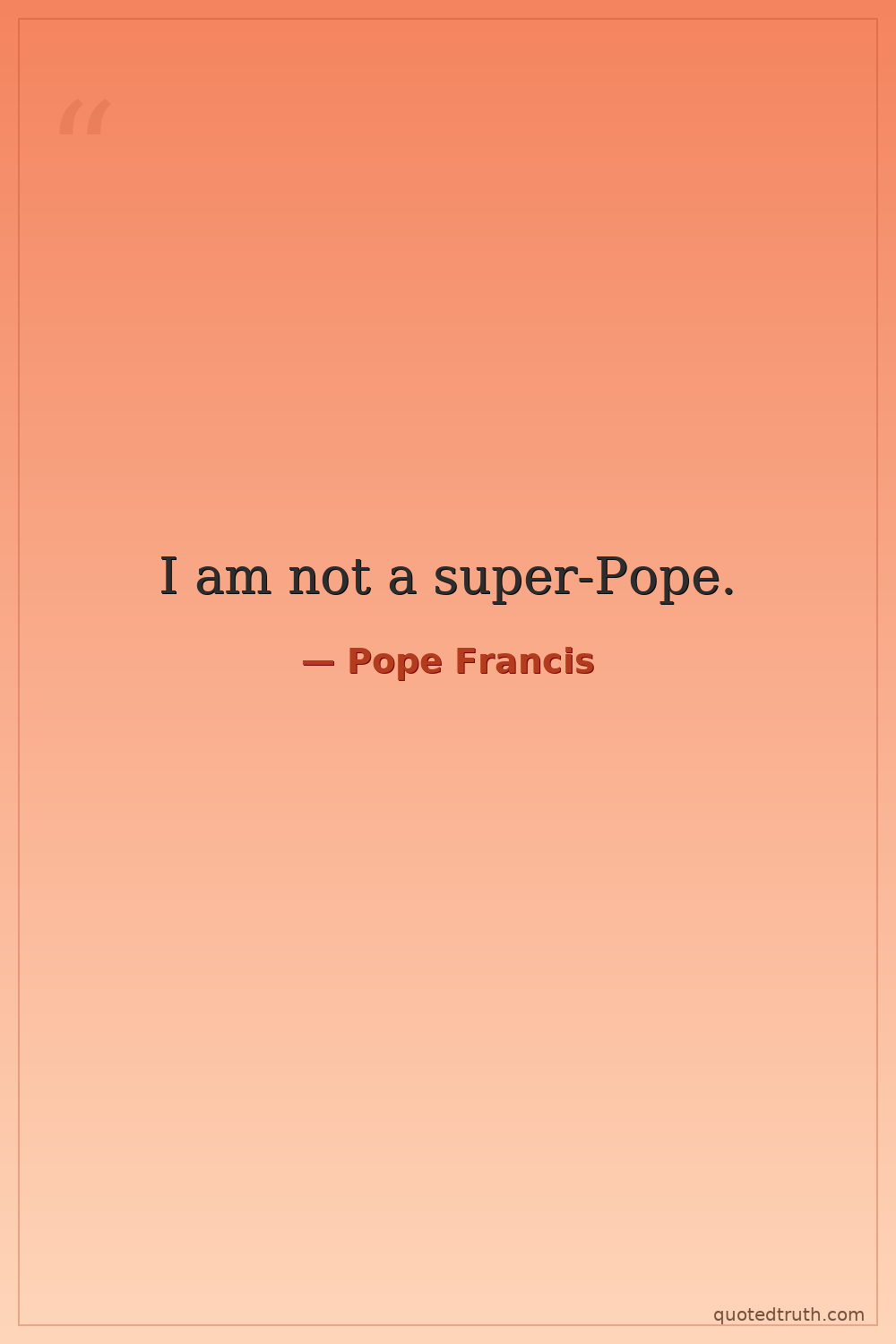
Pope Francis — "I am not a super-Pope."
I am not a super-Pope.
I am not a super-Pope.
Click any product to generate a realistic preview. Up to 3 at a time.
* Initial load can take up to 90 seconds — revising the preview in another color is nearly instant.
"A little bit of mercy makes the world less cold and more just."
"The Lord is always with us, even when we are sinners."
"The world cannot be understood without the poor. The poor are the treasure of the Church."
"The biggest problem is that we don’t feel the problems of others."
"To be a Christian is to be a revolutionary."
First Latin American and Jesuit pope (2013-), who has steered the Catholic Church toward pastoral inclusion on LGBTQ pastoral care, divorced Catholics, and climate. Closely associated with Pope John XXIII (the Vatican II reformer pope) and Cardinal Walter Kasper (his theological ally on pastoral reform). For an intellectual contrast, see Cardinal Raymond Burke, American traditionalist cardinal, former head of the Vatican Apostolic Signatura — Burke is the public face of Catholic traditionalism that views Francis's pastoral approach as doctrinally dangerous — he has formally challenged Amoris Laetitia and other Francis reforms.
Found in 1 providers: grok
1 source checked
A direct rejection of inflated expectations placed on leadership. Francis acknowledges he is human — fallible, limited, unable to single-handedly solve every problem the Church or world faces. It pushes back against treating the papacy as a messianic office where one figure transforms centuries-old institutions overnight. The statement calls for realistic expectations and shared responsibility rather than dependence on any single man's will or power.
Francis chose his name from the humble Saint of Assisi, refused the Apostolic Palace for a guesthouse, and washed prisoners' feet. Trained as a Jesuit — an order emphasizing communal discernment over top-down hierarchy — he consistently deflates papal grandeur. His reform agenda pushes authority outward to bishops and laypeople rather than centralizing it, making this statement a lived principle embedded in every symbolic choice of his papacy.
Francis became Pope in 2013 after Benedict XVI's unprecedented resignation, inheriting a Church rocked by global clergy abuse scandals and Vatican financial corruption. Progressive Catholics projected sweeping transformation onto him while conservatives feared radical rupture. Simultaneously, global politics was trending toward strongman savior-figure expectations. His statement directly rejects that cultural frame, arriving precisely when institutional crisis made outsized papal expectations both understandable and uniquely dangerous.
AI-generated insights based on extensive research and information for context. Factual errors? Email [email protected].
Your cart is empty