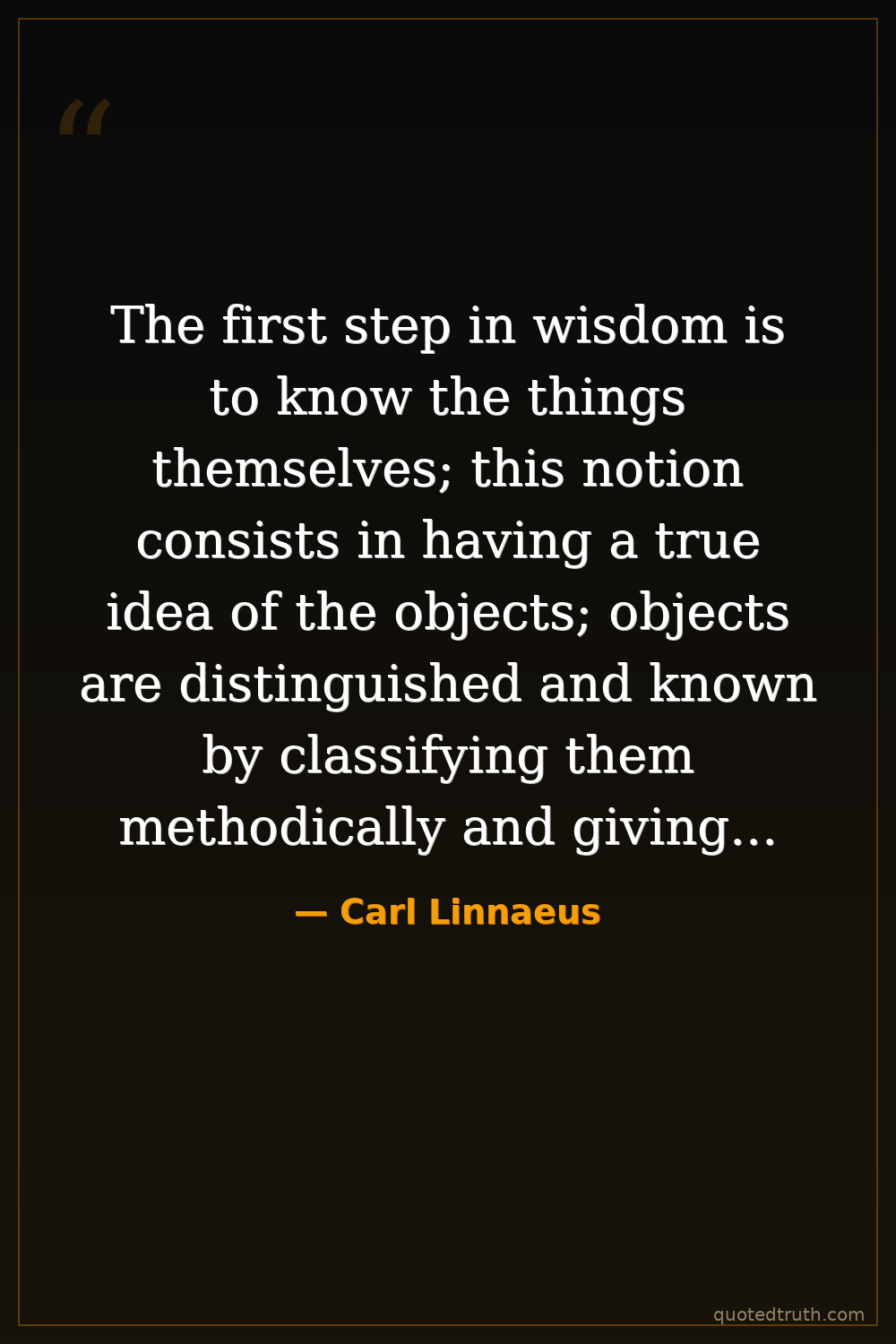
Carl Linnaeus — "The first step in wisdom is to know the things themselves; this notion consists …"

The first step in wisdom is to know the things themselves; this notion consists in having a true idea of the objects; objects are distinguished and known by classifying them methodically and giving them appropriate names.
Carl Linnaeus — Carl Linnaeus Early Modern · Biological taxonomy

Get This Quote & Author's Image Illustrated On:

Click any product to generate a realistic preview. Up to 3 at a time.
* Initial load can take up to 90 seconds — revising the preview in another color is nearly instant.

Kitchen

Apparel

Other

About Carl Linnaeus (1707-1778)

Swedish botanist and the father of modern taxonomy whose Systema Naturae (1735) introduced binomial nomenclature for naming all species. Closely associated with Joseph Banks (British naturalist who carried Linnaean classification on Cook's voyages). For an intellectual contrast, see Comte de Buffon, French naturalist and Histoire Naturelle author (1749-1788) — Buffon explicitly attacked Linnaean fixed-categories taxonomy as artificial and rejected the binomial system; his gradualist, environment-shaped natural history was the explicit alternative. Anticipates the fixed-species-vs-evolution debate Darwin would later resolve.

Details

From 'Philosophia Botanica', outlining his approach to taxonomy.

Date: 1751

Shocking

Verification

Unverifiable

Found in 1 providers: grok

1 source checked

Understanding this quote

What it means

True wisdom begins with accurate knowledge of things as they actually are. To understand the world, you must organize objects into clear categories and assign them precise names. Without systematic classification and proper naming, knowledge becomes confused and unreliable. Methodology and accurate terminology are not bureaucratic formalities but the essential foundation upon which all genuine understanding is built.

Relevance to Carl Linnaeus

Linnaeus spent his life creating the binomial nomenclature system still used today, naming over 12,000 species. His Systema Naturae (1735) imposed order on chaotic natural history. This quote is essentially his professional manifesto — he genuinely believed taxonomy was the gateway to all biological knowledge, and his career was the direct embodiment of that conviction.

The era

In the early modern period, natural history was a disorganized flood of specimens, folk names, and contradictory descriptions from global exploration. Explorers brought back thousands of unknown plants and animals with no unified naming system. Linnaeus worked amid this chaos, when European science desperately needed standardization to make sense of the natural world being revealed through colonial voyages and scientific expeditions.

AI-generated insights based on extensive research and information for context. Factual errors? Email [email protected].
Your Cart

Your cart is empty