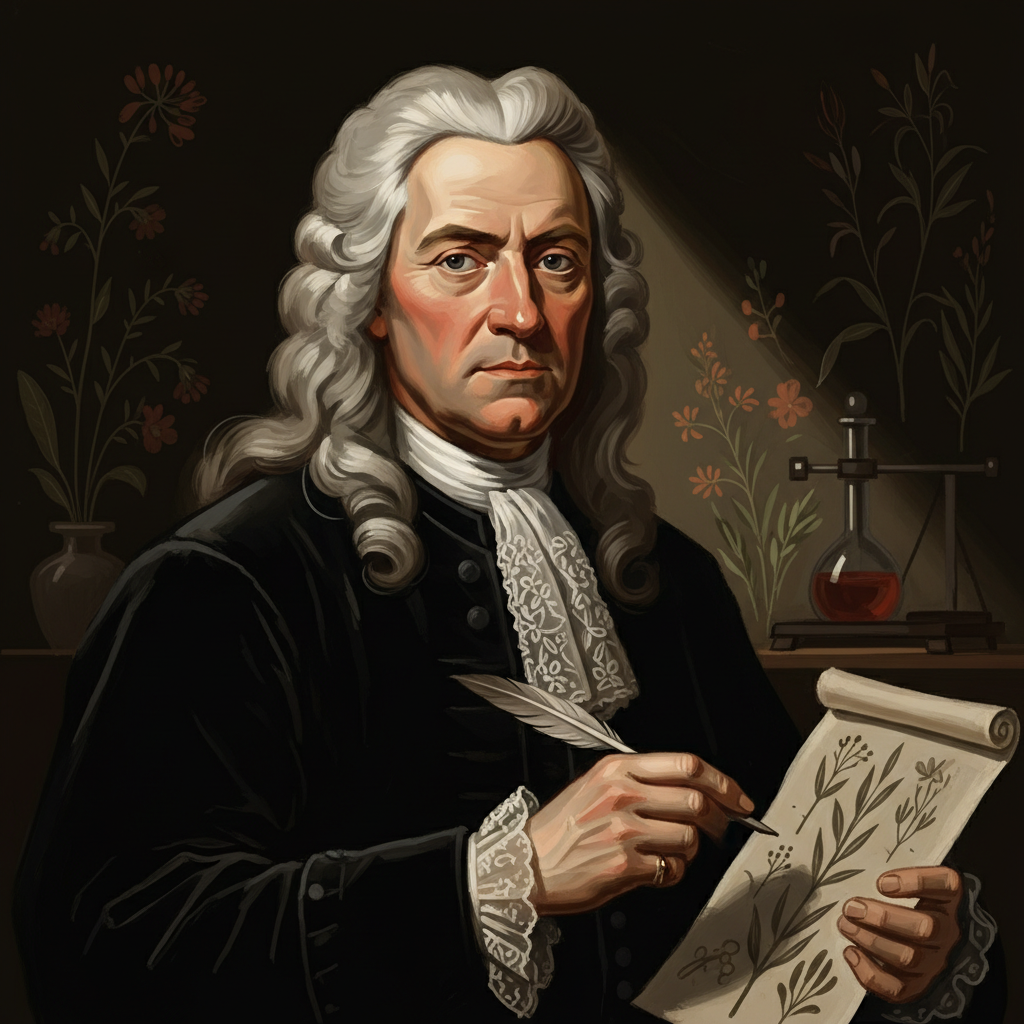
Carl Linnaeus — "I have created order out of chaos."
I have created order out of chaos.
I have created order out of chaos.
Click any product to generate a realistic preview. Up to 3 at a time.
* Initial load can take up to 90 seconds — revising the preview in another color is nearly instant.
"The only true knowledge is that which is acquired through the senses."
"Yet man does recognise himself [as an animal]. But I ask you and the whole world for a generic differentia between man and ape which conforms to the principles of natural history, I certainly know of …"
"Every country has its own plants, and every plant has its own country."
"The greatest pleasure is to be found in the smallest things."
"The Asiatic is haughty, greedy, and governed by opinions."
Swedish botanist and the father of modern taxonomy whose Systema Naturae (1735) introduced binomial nomenclature for naming all species. Closely associated with Joseph Banks (British naturalist who carried Linnaean classification on Cook's voyages). For an intellectual contrast, see Comte de Buffon, French naturalist and Histoire Naturelle author (1749-1788) — Buffon explicitly attacked Linnaean fixed-categories taxonomy as artificial and rejected the binomial system; his gradualist, environment-shaped natural history was the explicit alternative. Anticipates the fixed-species-vs-evolution debate Darwin would later resolve.
Summarizing his achievement in bringing systematic classification to biology.
Date: c. 1770s
ShockingFound in 1 providers: grok
1 source checked
The claim declares that one person imposed a coherent system on an overwhelming, disorganized mass of information. Before such work, knowledge was fragmented—different names, no universal rules, no reliable way to compare findings across regions or languages. By building a single logical framework, the speaker made it possible for everyone, everywhere, to communicate precisely about the same things. It is a claim of intellectual mastery over complexity itself.
Linnaeus spent his career doing exactly this. Before his binomial nomenclature—genus and species, like Homo sapiens—naturalists used inconsistent, often unwieldy names for the same organisms. His Systema Naturae (1735) and Species Plantarum (1753) classified thousands of plants and animals into a universal hierarchy. He was famously confident, even arrogant, about his system's importance, once writing that God created nature but Linnaeus arranged it.
Linnaeus worked during the 18th-century Enlightenment, when European explorers returned from the Americas, Asia, and Africa with thousands of undescribed species, overwhelming natural history. Botanical gardens, trading companies, and physicians needed reliable ways to identify medicinal plants and commercial goods. The scientific community had no universal naming standard—the same plant might carry a dozen names across countries. Rational classification carried direct medical and economic stakes, not merely academic ones.
AI-generated insights based on extensive research and information for context. Factual errors? Email [email protected].
Your cart is empty