Carl Linnaeus — "Every plant is a book, which, if we want to understand, we must learn its langua…"
Every plant is a book, which, if we want to understand, we must learn its language.
Every plant is a book, which, if we want to understand, we must learn its language.
Click any product to generate a realistic preview. Up to 3 at a time.
* Initial load can take up to 90 seconds — revising the preview in another color is nearly instant.
"There are as many species as the infinite being created diverse forms in the beginning, which, following the laws of generation, produced many others, but always similar to them: therefore there are a…"
"God created, Linnaeus arranged. It is astonishing how many new species are discovered every day."
"The greatest pleasure in life is to be able to do what you love."
"The classification of plants is the most difficult of all tasks."
"The most beautiful flower is the one that is most accurately drawn."
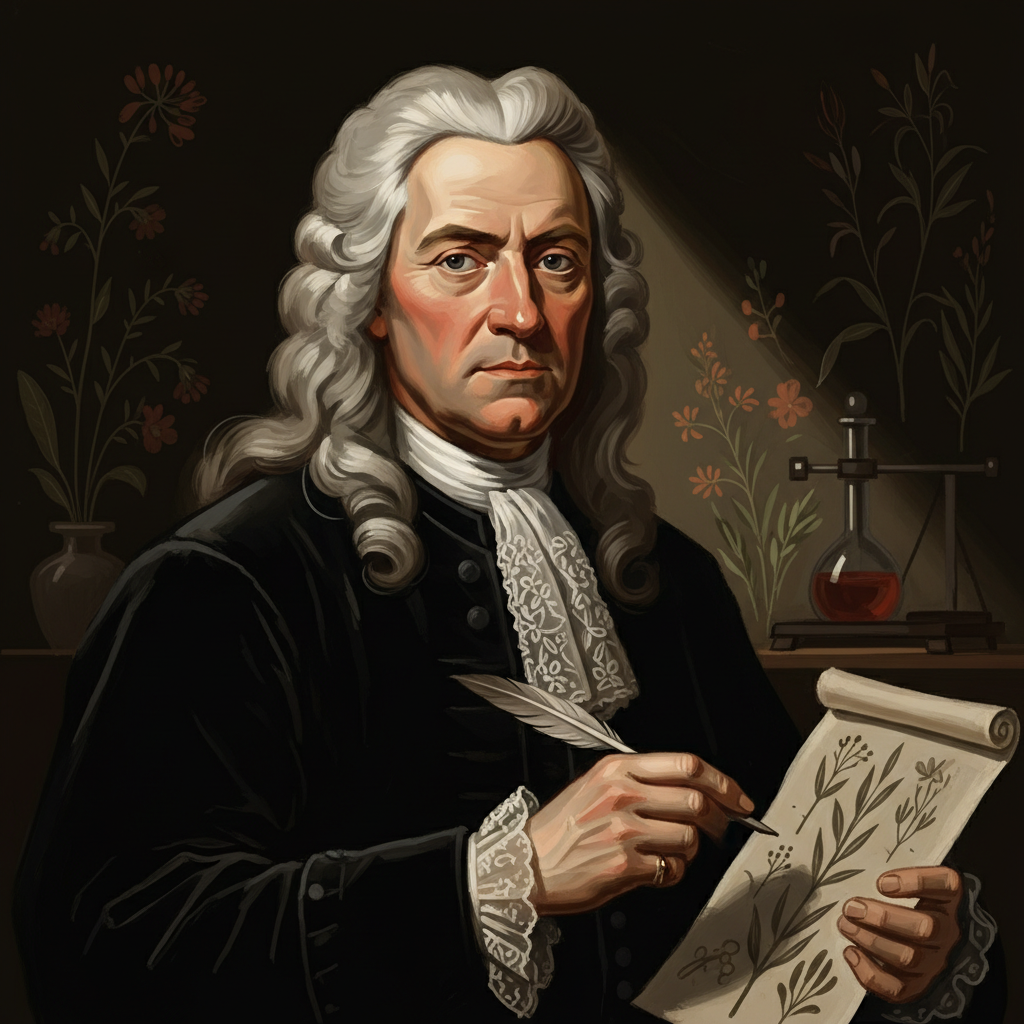
Swedish botanist and the father of modern taxonomy whose Systema Naturae (1735) introduced binomial nomenclature for naming all species. Closely associated with Joseph Banks (British naturalist who carried Linnaean classification on Cook's voyages). For an intellectual contrast, see Comte de Buffon, French naturalist and Histoire Naturelle author (1749-1788) — Buffon explicitly attacked Linnaean fixed-categories taxonomy as artificial and rejected the binomial system; his gradualist, environment-shaped natural history was the explicit alternative. Anticipates the fixed-species-vs-evolution debate Darwin would later resolve.
Found in 1 providers: grok
1 source checked
Nature contains hidden information that requires systematic study to decode. Plants aren't just objects — they carry details about structure, relationships, and function. To truly understand them, you must master a disciplined framework: their morphology, their naming, their place in a larger order. Knowledge doesn't come from casual observation but from learning the vocabulary and grammar embedded in the natural world itself.
Linnaeus spent his life constructing exactly that language — binomial nomenclature gave every plant a two-part Latin name within a hierarchical system. He catalogued thousands of species in Species Plantarum (1753) and trained disciples called 'apostles' to gather specimens worldwide. His conviction that nature was divinely ordered and therefore readable drove him to build the classificatory framework still foundational to biology today.
The 18th century was Europe's Age of Exploration and Enlightenment. Ships returning from the Americas, Asia, and Africa carried thousands of unknown species, creating chaos in natural history — no standard naming system existed. Scholars used inconsistent, lengthy Latin descriptions. Enlightenment thinking simultaneously held that nature was rational and orderly, lending scientific legitimacy to the belief that the living world could be decoded systematically, like learning to read a book.
AI-generated insights based on extensive research and information for context. Factual errors? Email [email protected].
Your cart is empty