What it means
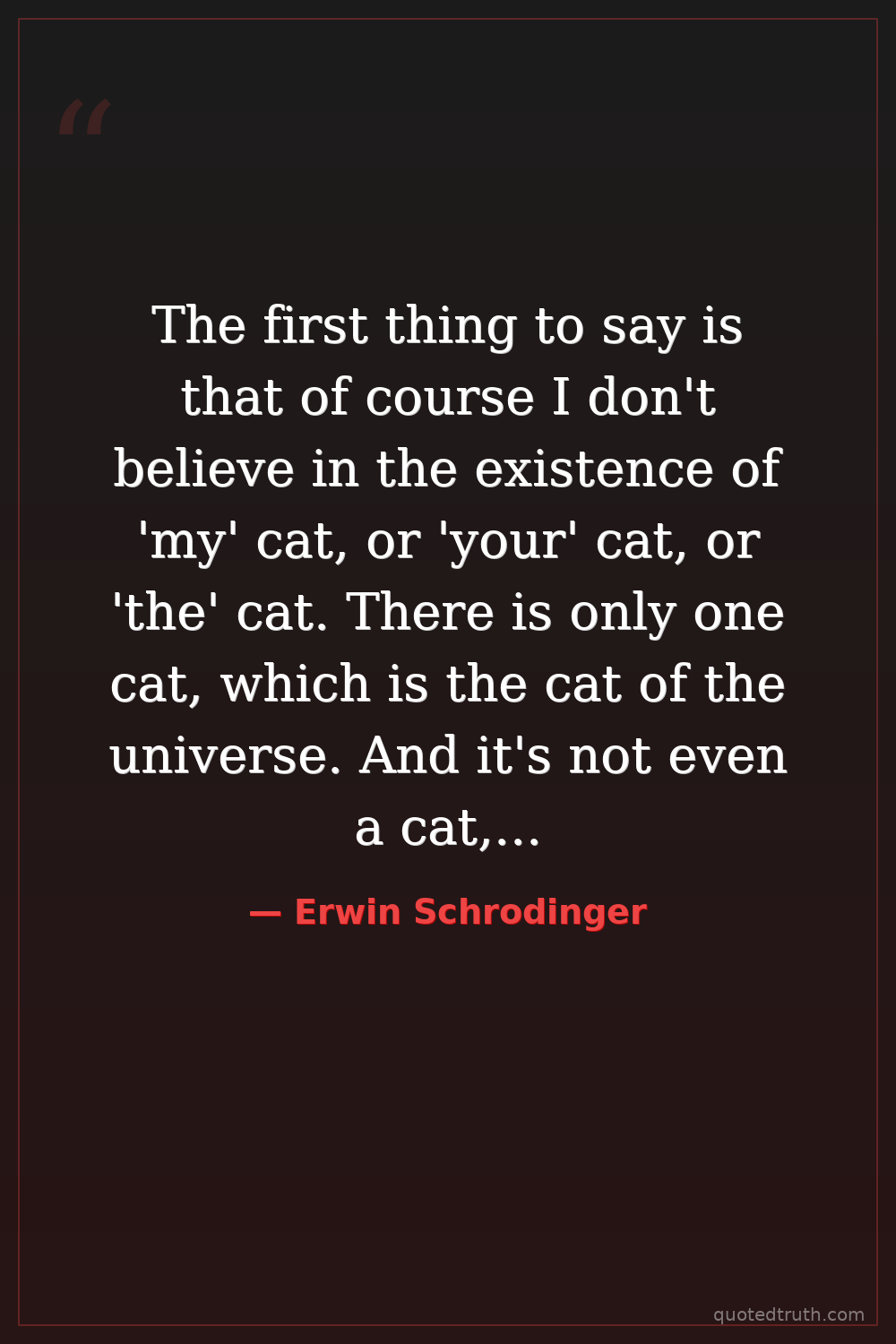
Individual cats—'mine,' 'yours,' 'the'—are labels humans impose on an undivided quantum reality. There is no discrete object called 'a cat'; there is only a universal wave function encoding all possible configurations simultaneously. Personal ownership and physical boundaries are classical-physics conveniences, not fundamental truths. At the deepest level, what we call things are probability distributions, not objects with fixed, separate identities.
Relevance to Erwin Schrodinger
Schrödinger's 1935 cat paradox was designed to expose the absurdity of quantum superposition at macroscopic scales. This quote inverts that logic: rather than vindicating the classical cat, he dissolves it into the very formalism he pioneered. His 1926 wave equation earned the 1933 Nobel Prize and made wave functions central to physics. His book What Is Life? reveals a lifelong drive to unify physics with deeper ontological reality.
The era
Quantum mechanics emerged in the 1920s–30s, shattering Newtonian certainty. The Copenhagen Interpretation held that particles lack definite properties until measured—a claim disturbing to Einstein ('God does not play dice') and Schrödinger alike. His 1935 cat paradox ridiculed superposition applied to everyday objects. Yet here he accepts the wave-function worldview fully, reflecting physics' gradual consensus that reality at every scale is probabilistic, not classically solid.
AI-generated insights based on extensive research and information for context. Factual errors? Email [email protected].