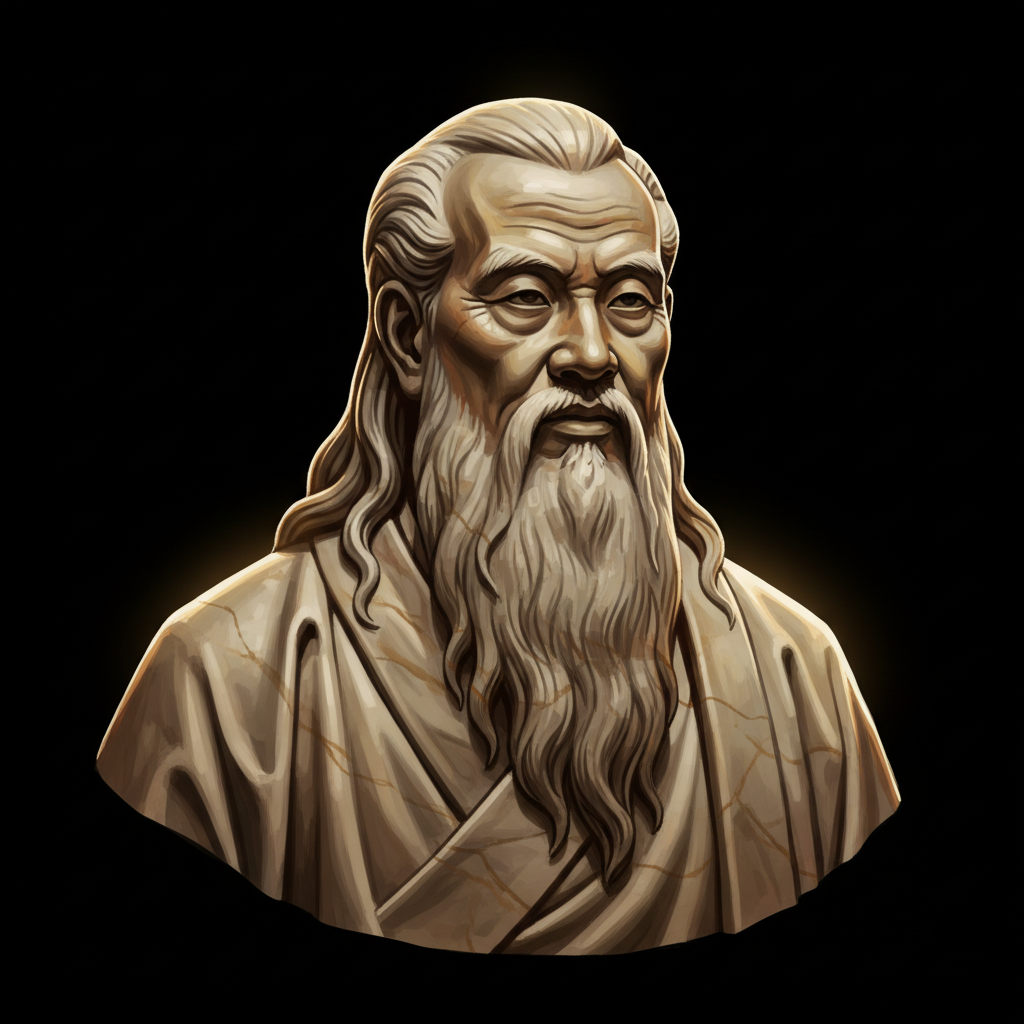
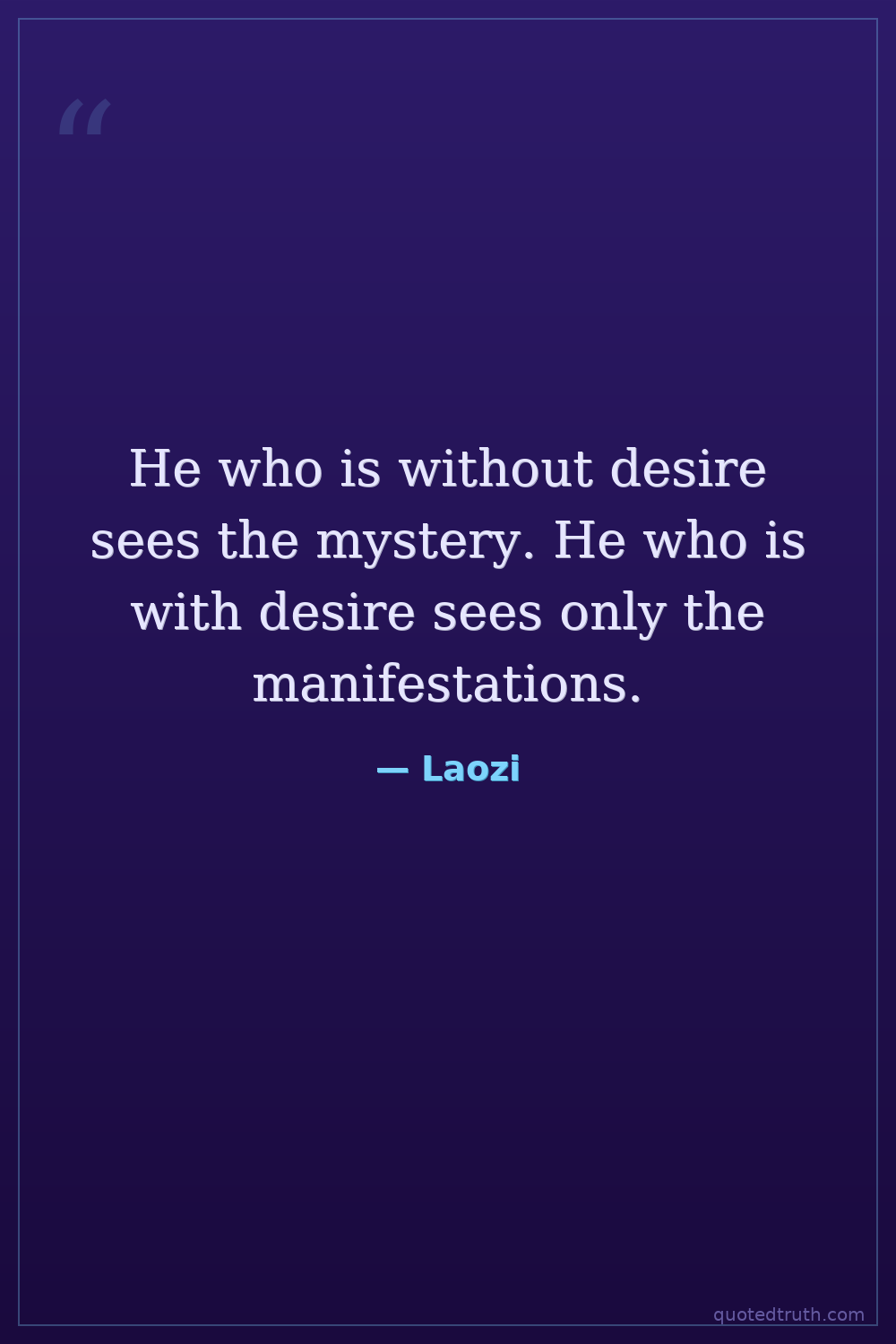
Laozi — "He who is without desire sees the mystery. He who is with desire sees only the m…"
He who is without desire sees the mystery. He who is with desire sees only the manifestations.
He who is without desire sees the mystery. He who is with desire sees only the manifestations.
Click any product to generate a realistic preview. Up to 3 at a time.
* Initial load can take up to 90 seconds — revising the preview in another color is nearly instant.
"The Sage manages affairs without doing anything, and spreads doctrines without speaking."
"When people see some things as beautiful, other things become ugly. When people see some things as good, other things become bad."
"If you do not change direction, you may end up where you are heading."
"One who makes promises rashly rarely keeps good faith; One who is in the habit of considering things easy meets with frequent difficulties."
"If you realize that all things change, there is nothing you will try to hold on to."
Reputed founder of Taoism and author of the Tao Te Ching, whose wu wei (effortless action) shaped East Asian philosophy. Closely associated with Zhuangzi (later Taoist who extended Laozi's framework). For an intellectual contrast, see Confucius, near-contemporary Chinese sage of social ritual and duty — Confucius systematized social order through ritual and hierarchy; Laozi argued that all such systems were the disease, not the cure — the two founding poles of Chinese moral philosophy.
Found in 2 providers: gemini,grok
2 sources checked
When you stop chasing goals and clinging to outcomes, you can perceive the deeper reality behind things—the hidden pattern, the underlying source. But when you approach the world driven by wants and agendas, you only see surfaces: objects to acquire, problems to solve, tools to use. Desire narrows attention to what serves it, filtering out everything else. Letting go of that filter opens perception to what was always there but invisible to a grasping mind.
Laozi taught wu wei, effortless action aligned with the Tao, and warned that striving distorts understanding. As the reputed author of the Tao Te Ching, he repeatedly urged emptying the mind and reducing wants to perceive reality's deeper current. Legend says he served as a royal archivist before withdrawing from court life, disillusioned with ambition and ceremony. This saying captures his central conviction: clarity comes from stillness and non-attachment, not from pursuit, a principle he lived by abandoning office entirely.
Laozi lived during the late Zhou dynasty (6th century BCE), as feudal order collapsed into the Warring States period's chaos. Rival lords schemed for power, Confucian scholars pushed ritual and hierarchy, and ambition consumed the elite. Against this grasping culture, Taoism offered a radical alternative: retreat, simplicity, and alignment with nature's spontaneous flow. The saying challenged an era obsessed with strategy and conquest by suggesting that the desiring mind itself was the obstacle to wisdom, not the solution.
AI-generated insights based on extensive research and information for context. Factual errors? Email [email protected].
Your cart is empty