What it means
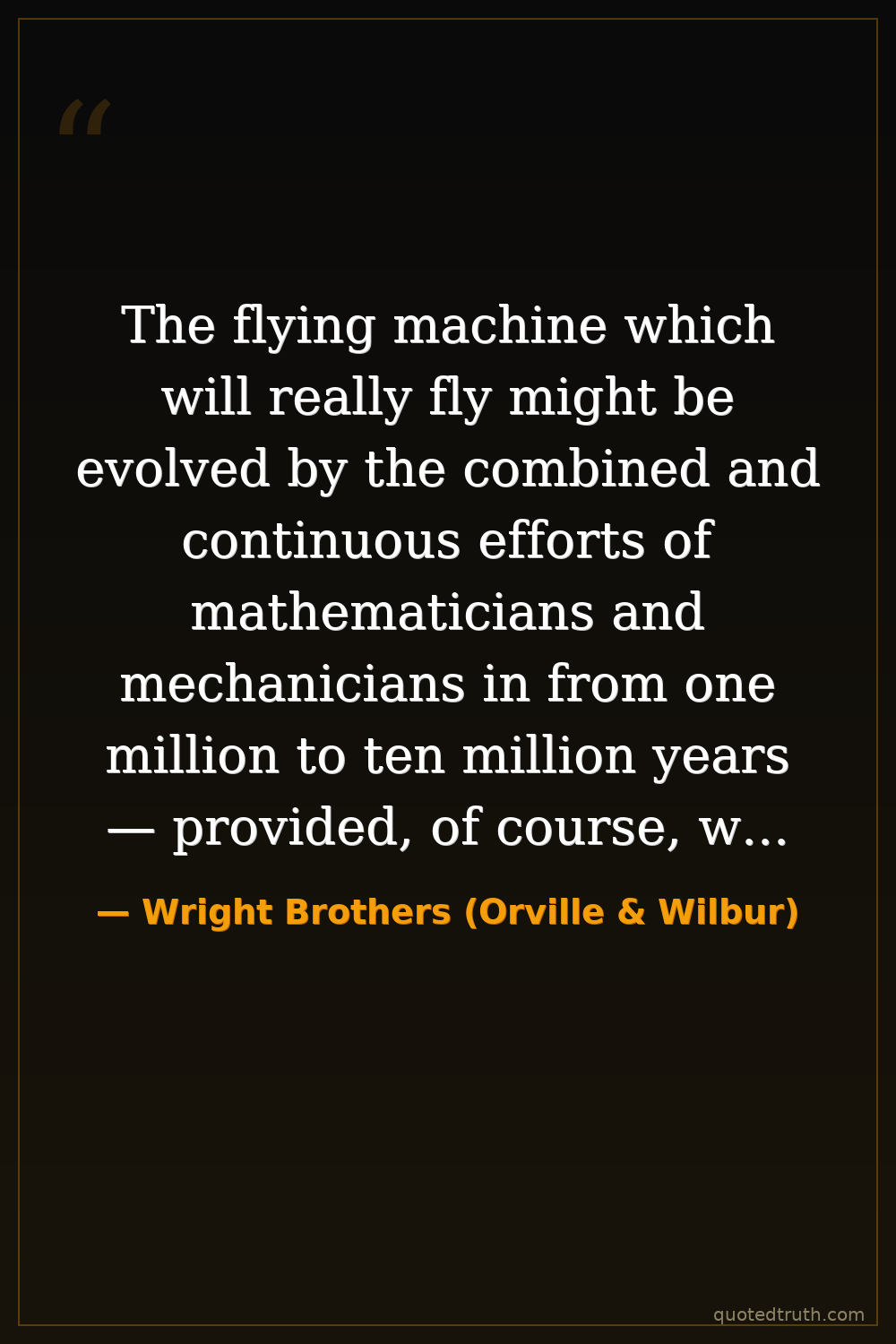
Powered flight is so far beyond current engineering that it might take one to ten million years of combined work by mathematicians and engineers to achieve, and only if someone first solves the unsolvable problem of materials being either too heavy or too weak. The writer concedes the puzzle fascinates specialists but suggests ordinary people would find their time better spent on almost anything else.
Relevance to Wright Brothers (Orville & Wilbur)
The Wright Brothers achieved powered flight on December 17, 1903, roughly a decade after the New York Times published this dismissal in 1903 — weeks, in fact, before Kitty Hawk. Two bicycle mechanics from Dayton, Ohio, without university degrees or government funding, solved the exact weight-to-strength and control problems the writer called impossible. Their methodical wind-tunnel tests and propeller calculations embodied the 'mathematicians and mechanicians' approach, just compressed from ten million years into four.
The era
In 1903, respected scientists and newspapers routinely declared heavier-than-air flight impossible. Samuel Langley's government-funded aerodrome had just crashed into the Potomac days before Kitty Hawk, reinforcing public skepticism. Gas-powered engines were new, aluminum was expensive, and aeronautics was seen as crankery alongside perpetual motion. The New York Times editorial captured mainstream opinion: serious men should pursue railroads, electricity, or steel — not chase birds. The Wrights worked in deliberate obscurity partly because of this ridicule.
AI-generated insights based on extensive research and information for context. Factual errors? Email [email protected].