What it means
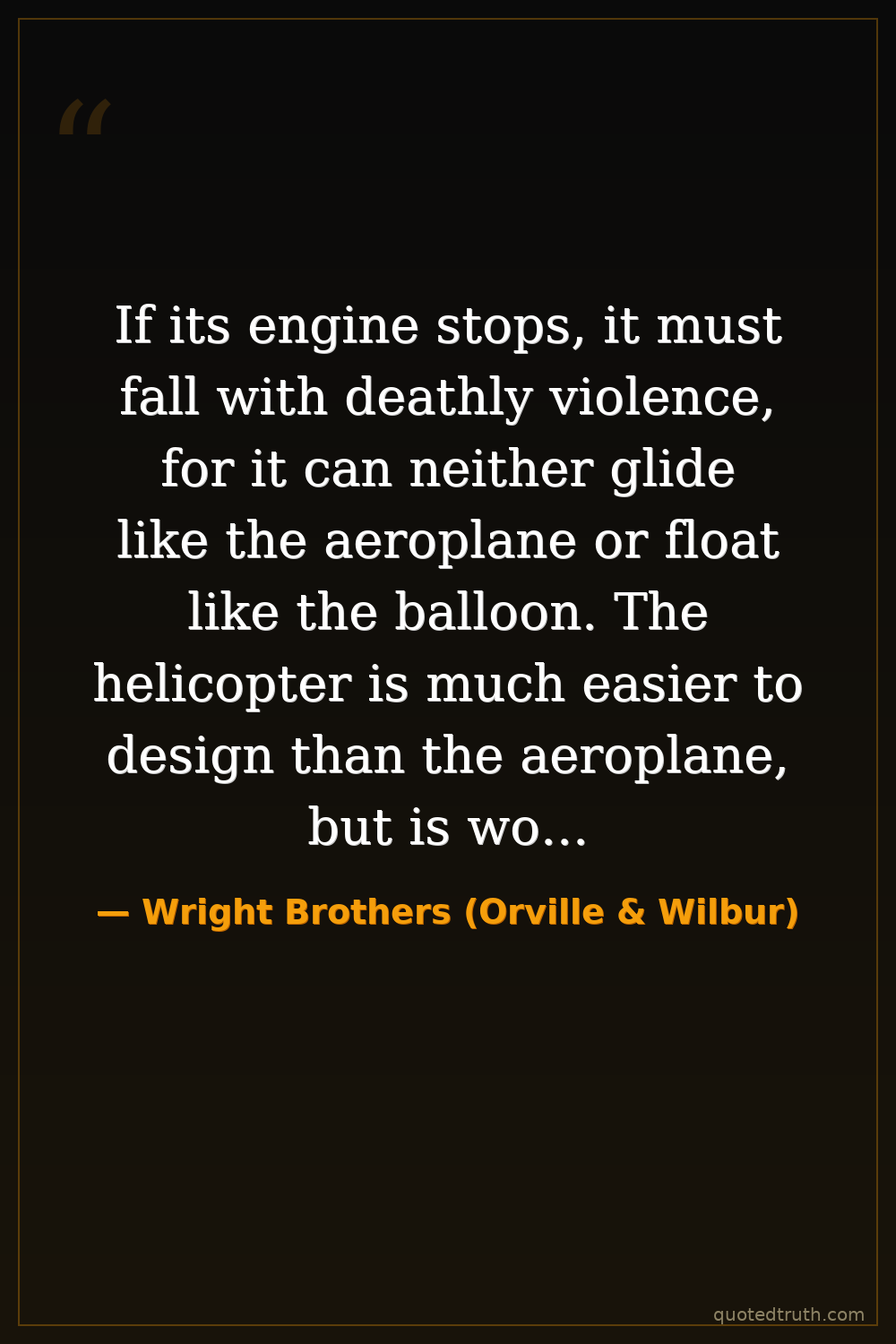
A flying machine that relies entirely on its engine for lift is fatally dangerous, because losing power gives it no way to survive the fall. Unlike an airplane, which can glide down on its wings, or a balloon, which stays aloft on buoyancy, a helicopter drops straight from the sky when the motor quits. So while building one is mechanically simpler, the result is useless because no pilot could trust it.
Relevance to Wright Brothers (Orville & Wilbur)
The Wrights obsessed over control and safe descent, not just getting off the ground. Their 1900–1902 gliders at Kitty Hawk taught them that wings plus steering mattered more than raw power, which is why the 1903 Flyer succeeded where rivals crashed. Bicycle mechanics by trade, they judged machines by whether a rider survived failure. This dismissal of helicopters reflects their engineering creed: a flying craft worth building must remain controllable when the engine dies.
The era
In the early 1900s, dozens of inventors were racing to conquer the sky, and vertical-lift machines fascinated the public since Leonardo's sketches. Steam and early gasoline engines were heavy, unreliable, and prone to sudden failure, making engine-dependent lift a death sentence. Balloons had ruled the air for over a century, and gliding experiments by Lilienthal and Chanute shaped the field. The Wrights spoke as the world debated which path, fixed-wing or rotor, would actually carry humans safely aloft.
AI-generated insights based on extensive research and information for context. Factual errors? Email [email protected].