Antoine Lavoisier — "The future of chemistry depends on the precision of its instruments and the accu…"
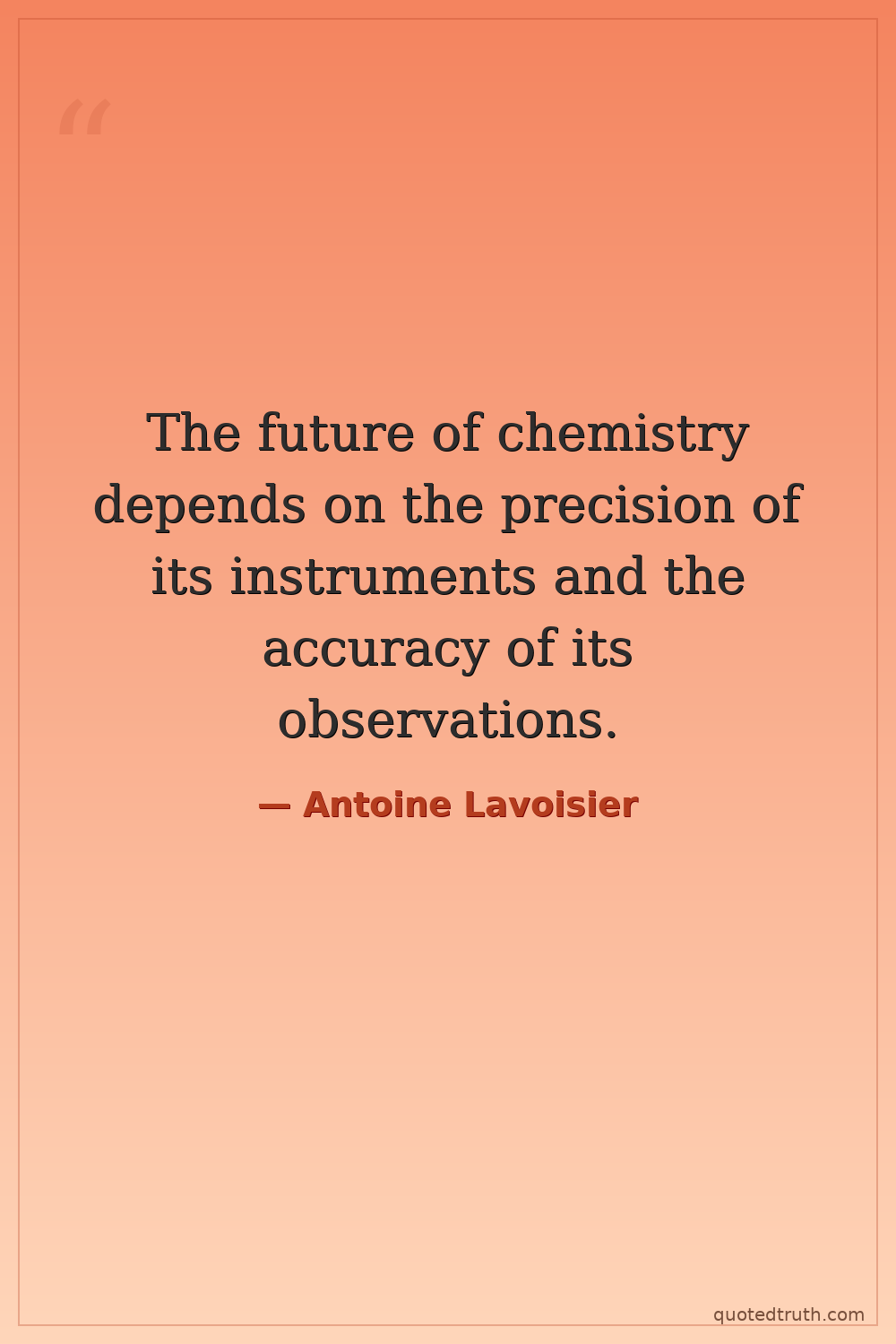
The future of chemistry depends on the precision of its instruments and the accuracy of its observations.
The future of chemistry depends on the precision of its instruments and the accuracy of its observations.
Click any product to generate a realistic preview. Up to 3 at a time.
* Initial load can take up to 90 seconds — revising the preview in another color is nearly instant.
"The chemist, like the artist, must have a vivid imagination, but it must be controlled by reason."
"As ideas are preserved and communicated by means of words, it necessarily follows that we cannot improve the language of any science, without at the same time improving the science itself; neither can…"
"The true philosopher is he who knows how to doubt."
"The most important thing for a man of science is to have a clear head and a good heart."
"I have always sought to unite theory with practice."
Found in 1 providers: grok
1 source checked
Chemistry advances only when its measurements are exact and its observations are rigorous. Without precise tools and careful recording of experimental results, conclusions rest on shaky ground. Clever theories mean nothing if the underlying data is sloppy. Progress requires discipline: measure carefully, record honestly, and let the numbers speak. Scientific knowledge is only as trustworthy as the instruments and methods used to gather it.
Lavoisier revolutionized chemistry by insisting on quantitative methods over qualitative guesswork. Using precision balances, he demonstrated the law of conservation of mass — proving matter is neither created nor destroyed in reactions. He dismantled phlogiston theory not through argument but through meticulous weight measurements. His systematic approach to combustion and respiration transformed chemistry from a speculative craft into a rigorous science grounded in numerical data and reproducible experiment.
Lavoisier worked during the Enlightenment, when reason and empirical method were displacing centuries of alchemical tradition. Chemistry in the 1770s–1780s still struggled for legitimacy — phlogiston theory dominated and qualitative description ruled. Instrument makers across Europe were refining balances, thermometers, and barometers. The French Academy of Sciences championed systematic inquiry. His insistence on measurement struck at the heart of this transformation, helping establish chemistry's identity as a precise, quantitative discipline.
AI-generated insights based on extensive research and information for context. Factual errors? Email [email protected].
Your cart is empty