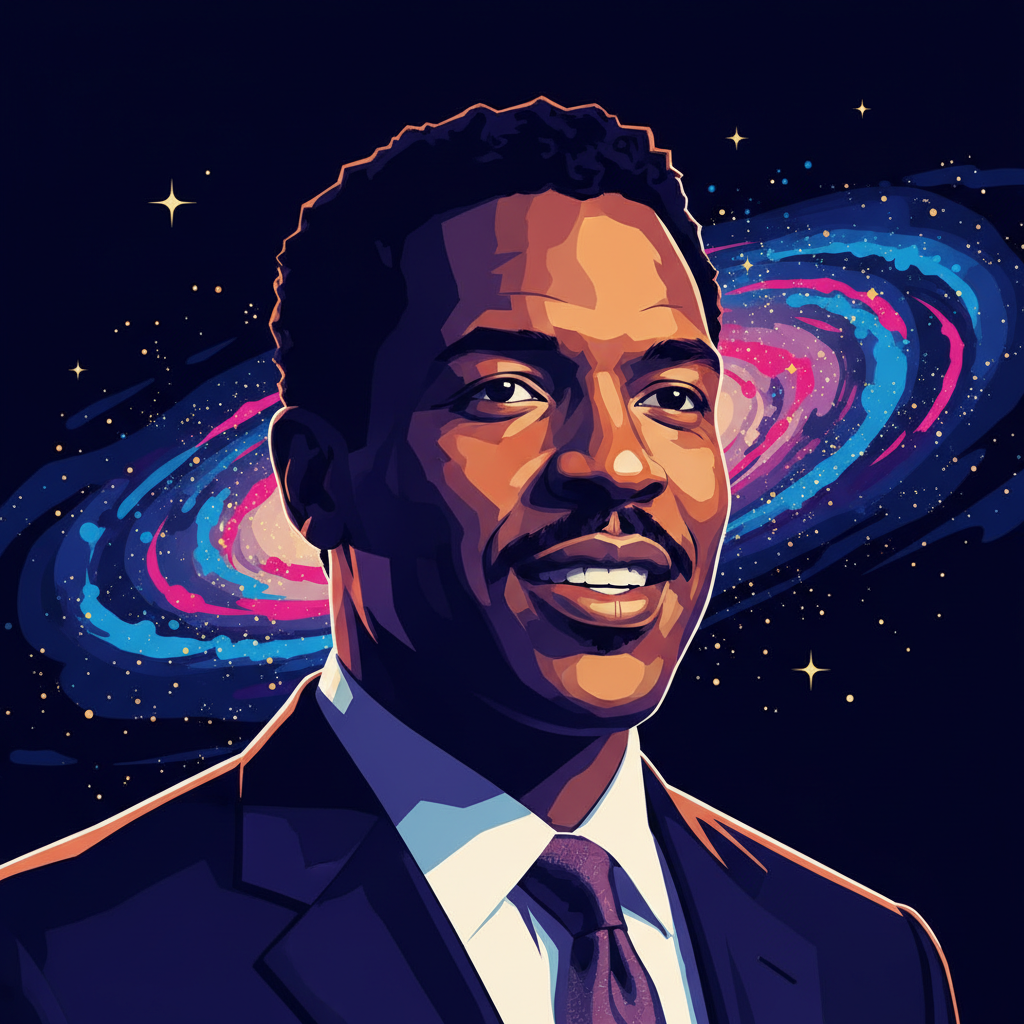
Neil deGrasse Tyson — "The greatest discoveries are not made in the laboratory, but in the mind."
The greatest discoveries are not made in the laboratory, but in the mind.
The greatest discoveries are not made in the laboratory, but in the mind.
Click any product to generate a realistic preview. Up to 3 at a time.
* Initial load can take up to 90 seconds — revising the preview in another color is nearly instant.
"I'm not a guru. I'm just a guy who loves the universe."
"The universe is a magnificent place, and it's all ours to discover."
"I would say, if you're not failing, you're not trying hard enough."
"Intelligent design, as I understand it, means that you have an intelligent designer somewhere. And the problem with that is, if you’re going to invoke an intelligent designer, you have to ask, 'Who de…"
"My life goal is to be a source of wonder and curiosity for others. If I can achieve that, I've done my job."
American astrophysicist, Hayden Planetarium director, and Cosmos: A Spacetime Odyssey host who carries the Carl Sagan public-science mantle. Closely associated with Bill Nye (fellow science communicator) and Brian Greene (theoretical physicist and string-theory popularizer). For an intellectual contrast, see Ken Ham, founder of Answers in Genesis and the Creation Museum — Ham's career has been organized around defending biblical 6-day creationism — exactly the science-education position Tyson's mainstream-science communication is structured to refute.
Found in 1 providers: grok
1 source checked
The most profound scientific breakthroughs begin not in equipment or experiments, but in a human mind willing to imagine what doesn't yet exist. Before any measurement happens, someone must conceive the right question. Theoretical leaps — Einstein imagining riding a light beam, Hawking picturing black hole radiation — preceded physical confirmation by years or decades. Experiments verify ideas; minds invent them first.
Tyson built his career as much on igniting curiosity as on research. As director of the Hayden Planetarium and host of Cosmos: A Spacetime Odyssey, he consistently championed imagination as science's true engine. His prolific writing and lecturing aim to expand how people think about the universe — reflecting his belief that a well-aimed human mind is a more powerful instrument than any telescope.
Tyson emerged as a prominent public voice during an era of massive investment in scientific hardware — the Large Hadron Collider, James Webb Space Telescope, and AI-driven research tools. Yet this same period saw surging anti-intellectualism, climate denial, and shrinking science education budgets. His insistence that conceptual thinking drives the greatest discoveries challenges the assumption that bigger machines alone produce deeper understanding of the universe.
AI-generated insights based on extensive research and information for context. Factual errors? Email [email protected].
Your cart is empty