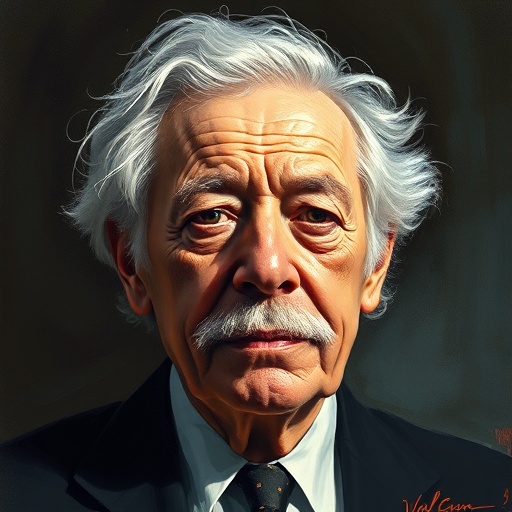
Linus Pauling — "The greatest discoveries of science have always been made by those who were not …"
The greatest discoveries of science have always been made by those who were not afraid to challenge the existing paradigms.
The greatest discoveries of science have always been made by those who were not afraid to challenge the existing paradigms.
Click any product to generate a realistic preview. Up to 3 at a time.
* Initial load can take up to 90 seconds — revising the preview in another color is nearly instant.
"I had something of a shock when I went to Europe in 1926 and discovered that there were a good number of people around that I thought to be smarter than me."
"I have always been a curious individual, and I believe that curiosity is the engine of progress."
"The human body can make a number of substances, but it cannot make vitamin C."
"The only thing that stands between a man and what he wants from life is often merely the will to try it and the faith to believe that it is possible."
"I had begun to think about the theory of the chemical bond very seriously in 1926, '27, after quantum mechanics was discovered and then in 1928 I published a paper, a preliminary paper, and said that …"
Found in 1 providers: grok
1 source checked
Scientific breakthroughs rarely come from confirming what's already accepted — they come from those courageous enough to challenge it. Paradigms, the shared frameworks defining what counts as valid science, can harden into unchallengeable dogma. Genuine discovery demands intellectual bravery: the willingness to declare the prevailing model incomplete or wrong and build something better, even when institutions, peers, and tradition all push back.
Pauling embodied this throughout his life. He applied quantum mechanics to chemistry when it was nearly unheard of, revolutionizing how scientists understood chemical bonds and earning the 1954 Nobel Prize in Chemistry. He then challenged Cold War nuclear policy, winning the 1962 Nobel Peace Prize after years of government surveillance and passport revocation. Even his controversial high-dose vitamin C advocacy demonstrated his lifelong refusal to accept any consensus unchallenged.
Pauling's career spanned the quantum revolution of the 1920s through Cold War rigidity. Mid-20th-century science was increasingly government-funded and institutionalized, pressuring conformity. McCarthyism punished academics who challenged political orthodoxy — Pauling had his passport revoked for anti-nuclear activism. Yet physics had just overturned centuries of Newtonian assumptions, making this tension between explosive theoretical paradigm-breaking and enforced ideological conformism the defining intellectual drama of his era.
AI-generated insights based on extensive research and information for context. Factual errors? Email [email protected].
Your cart is empty