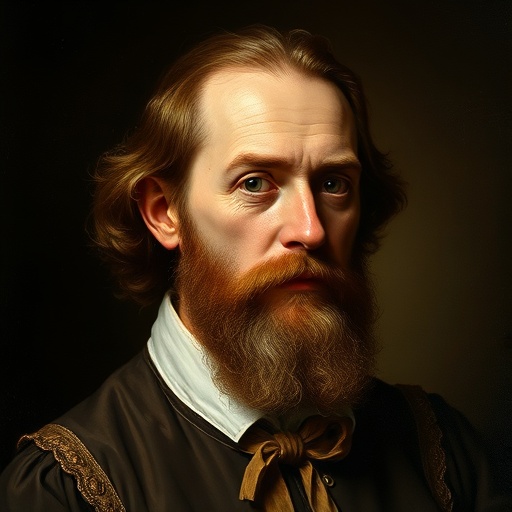
William Harvey — "The greatest discovery is to find the truth."
The greatest discovery is to find the truth.
The greatest discovery is to find the truth.
Click any product to generate a realistic preview. Up to 3 at a time.
* Initial load can take up to 90 seconds — revising the preview in another color is nearly instant.
"It seems to me that the motion of the blood is like that of water in a mill-stream."
"It is not by words, but by facts and arguments, that we must seek for truth."
"The blood carries nourishment to all parts of the body."
"It is a thing alike wonderful and incredible, to observe how the blood, from the very beginning of its motion, is distributed from the heart through the whole body, and then returns to the heart again…"
"The greatest pleasure is to discover something new."
English physician whose On the Motion of the Heart and Blood in Animals (1628) demonstrated blood circulation, overturning 1,400 years of Galenic medicine. Closely associated with Francis Bacon (his contemporary in the new English empiricism). For an intellectual contrast, see Galenic medicine, the 2nd-century Greek medical tradition (humors, blood-as-consumed-fuel) — Harvey calculated that the heart pumps more blood per hour than the body could possibly produce as fuel — a single quantitative observation that demolished the entire Galenic-Aristotelian medical worldview. The cleanest example in medical history of arithmetic disproving 14 centuries of authority.
A statement on the ultimate goal and reward of scientific endeavor.
Date: Uncertain (attributed)
EducationalFound in 1 providers: gemini
1 source checked
Truth is the ultimate goal of inquiry — not fame, wealth, or convenience, but the accurate understanding of how things actually work. This calls for rigorous observation over inherited assumptions, demanding that a person follow evidence wherever it leads, even when conclusions contradict authority or tradition. Real discovery means uncovering what is genuinely real, not confirming what we already believe.
Harvey spent decades dissecting animals and observing living hearts to prove blood circulates continuously — overturning Galen's 1,400-year-old theory. He risked his medical reputation and royal patronage to publish De Motu Cordis in 1628. His career embodied truth-seeking under pressure: systematic experiment over ancient doctrine, measurement over inherited belief.
The early modern period saw fierce tension between Scholastic authority — Aristotle, Galen, Church doctrine — and emerging empirical science. Harvey worked alongside Galileo's generation, when observation-based knowledge was revolutionary and dangerous. The Scientific Revolution was dismantling centuries of received wisdom, making truth-finding through direct investigation both culturally radical and professionally risky.
AI-generated insights based on extensive research and information for context. Factual errors? Email [email protected].
Your cart is empty