Charles Darwin — "The greatest discovery of all time is that a person can change his future by mer…"
The greatest discovery of all time is that a person can change his future by merely changing his attitude.
The greatest discovery of all time is that a person can change his future by merely changing his attitude.
Click any product to generate a realistic preview. Up to 3 at a time.
* Initial load can take up to 90 seconds — revising the preview in another color is nearly instant.
"I am almost convinced that species are not (it is like confessing a murder) immutable."
"I am not apt to follow blindly the lead of other men."
"I have always maintained that, in this country, a man can do whatever he likes, provided he is a gentleman."
"I am almost convinced (quite contrary to opinion I started with) that species are not (it is like confessing a murder) immutable."
"I could show fight on natural selection having done and doing more for the progress of civilization than you seem inclined to admit."
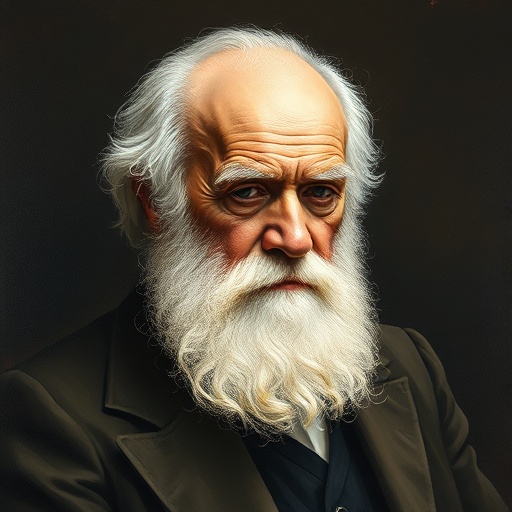
British naturalist whose On the Origin of Species (1859) established evolution by natural selection — the unifying theory of modern biology. Closely associated with Thomas Henry Huxley (his 'bulldog' public defender) and Alfred Russel Wallace (independent co-discoverer of natural selection). For an intellectual contrast, see William Paley, Anglican theologian and Natural Theology author (1743-1805) — Origin of Species is structurally a 400-page reply to Paley — Darwin admired Paley's watchmaker-argument as an undergraduate at Cambridge and then spent 20 years building the empirical machinery to displace him. The cleanest 'design argument vs natural selection' founding rebuttal in science.
The standard scholarly entry points to Charles Darwin's work: Janet Browne (Harvard, history of science) — Charles Darwin: Voyaging (1995) and The Power of Place (2002); Adrian Desmond (UCL, biographer) — Darwin: The Life of a Tormented Evolutionist (1991, with James Moore). These are the works graduate seminars cite when teaching Charles Darwin.
Often attributed to Darwin, but no evidence he ever said or wrote this. It sounds more like modern self-help. Likely a misattribution.
Date: Uncertain
EducationalFound in 1 providers: grok
1 source checked
Destiny is not a fixed track. This quote argues that the single most powerful force shaping a person's future is not talent, luck, or circumstance—it is attitude. Shift how you think and you redirect where your life goes. The discovery celebrated here is that transformation begins internally, making every person the chief architect of their own outcomes regardless of where they started.
Darwin embodied lifelong intellectual adaptation. He spent over twenty years refining his theory before publishing, driven by relentless curiosity rather than fear of controversy. His own life demonstrated that changing one's assumptions—about species, about creation, about nature itself—was the engine of progress. His evolutionary framework showed that organisms that adapt survive; applied to humans, mental flexibility and a willingness to revise one's outlook become the keys to thriving.
Darwin's era was defined by rigid Victorian determinism—class, birth, and religious doctrine were believed to fix one's fate. His 1859 publication of On the Origin of Species shattered static thinking by proving change is nature's fundamental law. This made the idea that humans could consciously reshape their futures through inner mindset revolutionary, resonating with the broader Romantic and transcendentalist movements then championing individual agency over inherited circumstance.
AI-generated insights based on extensive research and information for context. Factual errors? Email [email protected].
Your cart is empty