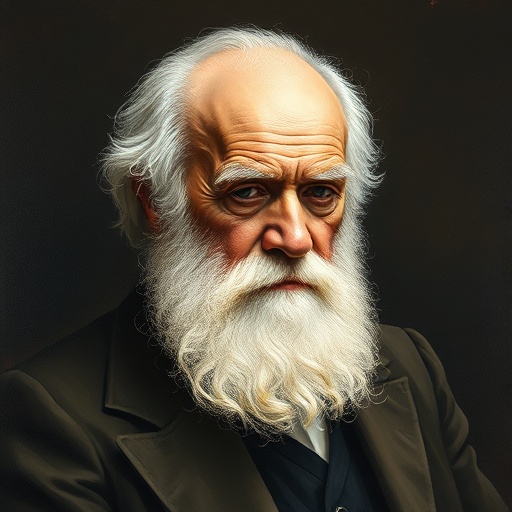
Charles Darwin — "I am not apt to follow blindly the lead of other men."
I am not apt to follow blindly the lead of other men.
I am not apt to follow blindly the lead of other men.
Click any product to generate a realistic preview. Up to 3 at a time.
* Initial load can take up to 90 seconds — revising the preview in another color is nearly instant.
"The more civilized so-called Caucasian races have beaten the Turkish hollow in the struggle for existence."
"I hate a Barnacle as no man ever did before, not even a Sailor in a slow-sailing ship."
"If the misery of the poor be caused not by the laws of nature, but by our institutions, great is our sin."
"I confess I am not much interested in the future, for I am too much occupied with the present."
"Man is descended from a hairy, tailed quadruped, probably arboreal in its habits, and an inhabitant of the Old World."
British naturalist whose On the Origin of Species (1859) established evolution by natural selection — the unifying theory of modern biology. Closely associated with Thomas Henry Huxley (his 'bulldog' public defender) and Alfred Russel Wallace (independent co-discoverer of natural selection). For an intellectual contrast, see William Paley, Anglican theologian and Natural Theology author (1743-1805) — Origin of Species is structurally a 400-page reply to Paley — Darwin admired Paley's watchmaker-argument as an undergraduate at Cambridge and then spent 20 years building the empirical machinery to displace him. The cleanest 'design argument vs natural selection' founding rebuttal in science.
The standard scholarly entry points to Charles Darwin's work: Janet Browne (Harvard, history of science) — Charles Darwin: Voyaging (1995) and The Power of Place (2002); Adrian Desmond (UCL, biographer) — Darwin: The Life of a Tormented Evolutionist (1991, with James Moore). These are the works graduate seminars cite when teaching Charles Darwin.
Found in 1 providers: grok
1 source checked
The speaker asserts intellectual independence — a refusal to accept ideas simply because authority figures or respected peers endorse them. It means forming judgments through personal investigation and reason rather than deference or social pressure. True understanding requires questioning received wisdom, not passively inheriting it. This is a declaration of epistemic autonomy: I think for myself, weigh evidence myself, and reach my own conclusions regardless of who disagrees.
Darwin spent decades quietly amassing evidence before publishing On the Origin of Species in 1859, knowing it would overturn centuries of religious and scientific orthodoxy. He resisted pressure from contemporaries like Louis Agassiz who rejected evolution. His meticulous self-directed research on barnacles, pigeons, and coral reefs reflected a deeply personal methodology — observation first, authority never. This independence defined how he worked and how he changed biology forever.
Victorian Britain operated on powerful hierarchies of intellectual authority — the Church of England, Royal Society luminaries, and university establishments set the boundaries of acceptable thought. Challenging established natural theology, which held that species were divinely fixed, required extraordinary independence of mind. Darwin's era rewarded conformity and punished heresy; his willingness to follow evidence over consensus, at personal and professional cost, made his revolutionary contribution possible.
AI-generated insights based on extensive research and information for context. Factual errors? Email [email protected].
Your cart is empty