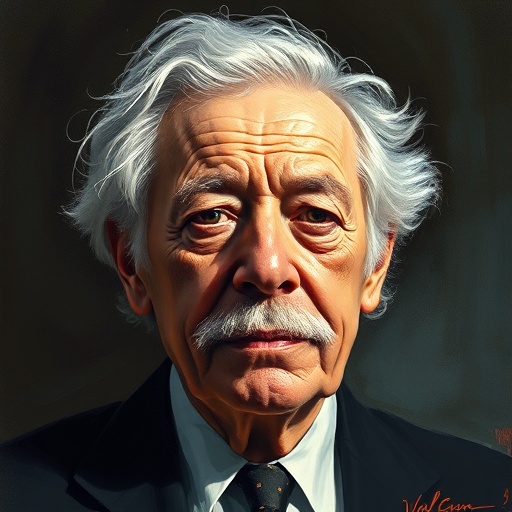
Linus Pauling — "Life... is a relationship between molecules."
Life... is a relationship between molecules.
Life... is a relationship between molecules.
Click any product to generate a realistic preview. Up to 3 at a time.
* Initial load can take up to 90 seconds — revising the preview in another color is nearly instant.
"I had begun to think about the theory of the chemical bond very seriously in 1926, '27, after quantum mechanics was discovered and then in 1928 I published a paper, a preliminary paper, and said that …"
"The most important thing is to never stop questioning."
"I have never been afraid to be wrong."
"I might well have become egotistical as a result [of the Langmuir Prize].... But... I think that I just said I shouldn't let this go to my head. I shouldn't think I'm really better than other people e…"
"The greatest adventure is to live your dreams."
Definition of life from a chemical perspective
Date: 1997 (Force of Nature by T. Hager)
GeneralFound in 1 providers: gemini
1 source checked
At its core, life is chemistry — biological existence emerges from the interactions, bonds, and reactions between molecules. Love, thought, disease, and growth are all molecular relationships playing out at the cellular level. Life isn't mystical or separate from matter; it's what happens when the right molecules interact in the right ways. To understand living things, study how molecules relate to one another.
Pauling won the 1954 Nobel Prize in Chemistry for his groundbreaking work on the chemical bond — literally the forces governing how molecules relate. He pioneered applying chemistry to biology, identifying sickle-cell anemia's molecular basis in 1949. His conviction that molecular structure determines biological function drove both his greatest discoveries and his later controversial megadose vitamin C advocacy. This quote is the philosophical distillation of his entire career.
Pauling worked during molecular biology's founding era. In 1953, Watson and Crick published DNA's double helix — a discovery Pauling narrowly missed. Science was dismantling vitalism, the long-held belief that life required a non-material force beyond chemistry. This revolution was also politically charged: Cold War nuclear testing meant man-made molecules were threatening life itself, driving Pauling's peace activism and earning him the 1962 Nobel Peace Prize.
AI-generated insights based on extensive research and information for context. Factual errors? Email [email protected].
Your cart is empty