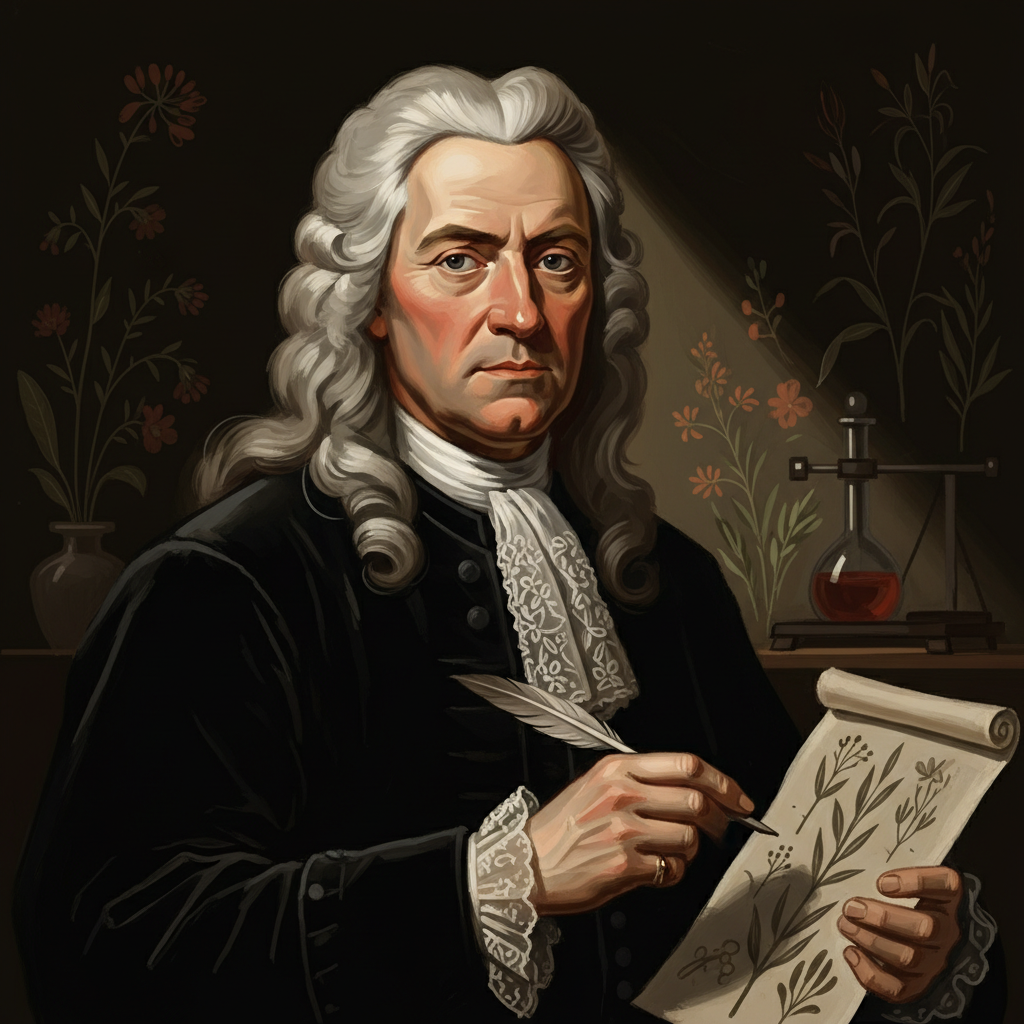
Carl Linnaeus — "The greatest joy is to be useful to one's fellow men."
The greatest joy is to be useful to one's fellow men.
The greatest joy is to be useful to one's fellow men.
Click any product to generate a realistic preview. Up to 3 at a time.
* Initial load can take up to 90 seconds — revising the preview in another color is nearly instant.
"Nature has been kind to me, and I have repaid her by being her faithful interpreter."
"The greatest pleasure of a gardener is to survey his work, and to admire the result of his own industry."
"All species of the same genus form a natural group, and all genera of the same order form a natural group."
"If a tree were to be a god, it would be a god of solitude."
"The greatest pleasure is to be found in the smallest things."
Swedish botanist and the father of modern taxonomy whose Systema Naturae (1735) introduced binomial nomenclature for naming all species. Closely associated with Joseph Banks (British naturalist who carried Linnaean classification on Cook's voyages). For an intellectual contrast, see Comte de Buffon, French naturalist and Histoire Naturelle author (1749-1788) — Buffon explicitly attacked Linnaean fixed-categories taxonomy as artificial and rejected the binomial system; his gradualist, environment-shaped natural history was the explicit alternative. Anticipates the fixed-species-vs-evolution debate Darwin would later resolve.
A statement reflecting his humanitarian values and belief in the practical application of science.
Date: Uncertain (attributed)
WisdomFound in 1 providers: gemini
1 source checked
Real happiness comes from being genuinely helpful to others — not from wealth, fame, or comfort. This quote frames usefulness as the highest purpose a person can achieve. In modern terms: find your joy in contribution, not consumption. Life gains its deepest meaning not through what you accumulate but through what you give — your skills, knowledge, and effort placed in service of other people.
Linnaeus's entire career was an act of service to collective human knowledge. His binomial naming system, still universal today, was designed so any scientist anywhere could communicate precisely about organisms. He trained eighteen "apostles" — students sent worldwide to collect specimens. He saw taxonomy not as personal achievement but as infrastructure for human progress, reflecting a man who believed his work had value only insofar as others could actually use it.
Linnaeus lived at the height of the Enlightenment (1707–1778), when European thinkers believed reason and systematic knowledge could liberate humanity. Natural philosophers saw themselves as public servants — discoveries should improve medicine, agriculture, and trade, not merely satisfy curiosity. Exploration was accelerating, new species flooded into Europe, and classifying them was urgent practical work. Being "useful" carried genuine moral weight: it meant contributing to civilization's rational advance rather than pursuing idle scholarship.
AI-generated insights based on extensive research and information for context. Factual errors? Email [email protected].
Your cart is empty