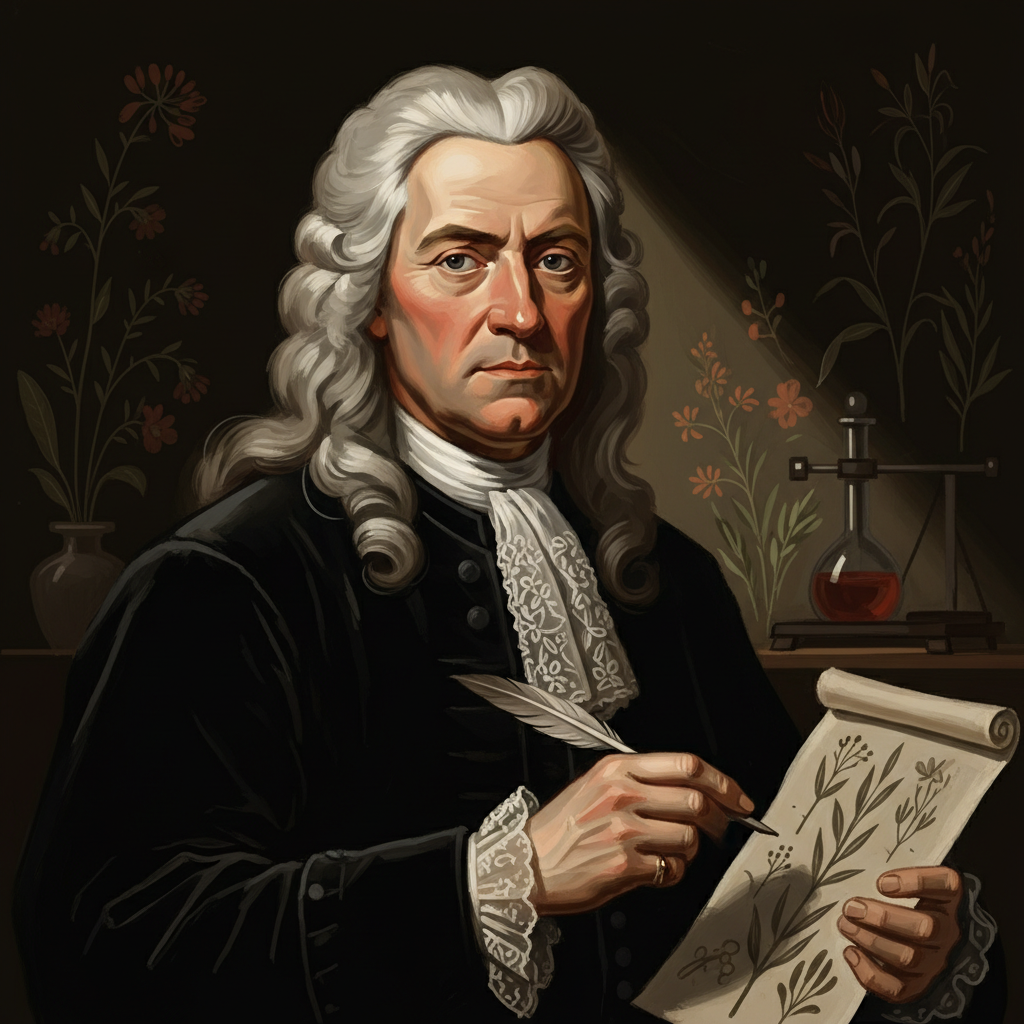
Carl Linnaeus — "Nature has been kind to me, and I have repaid her by being her faithful interpre…"
Nature has been kind to me, and I have repaid her by being her faithful interpreter.
Nature has been kind to me, and I have repaid her by being her faithful interpreter.
Click any product to generate a realistic preview. Up to 3 at a time.
* Initial load can take up to 90 seconds — revising the preview in another color is nearly instant.
"The flower's leaves...serve as bridal beds which the Creator has so gloriously prepared, adorned with such noble bed curtains, and perfumed with so many sweet scents to induce the young bridegroom to …"
"The number of species is fixed and unchanging."
"The earth is the Lord's, and the fullness thereof; the world, and they that dwell therein."
"The European is inventive, governed by laws, and wears tight clothing."
"Human beings, having, above all creatures, received the power of reason... need to be aware where nature is unaware. Nature reaches its culmination in humans, but human consciousness has not its essen…"
Swedish botanist and the father of modern taxonomy whose Systema Naturae (1735) introduced binomial nomenclature for naming all species. Closely associated with Joseph Banks (British naturalist who carried Linnaean classification on Cook's voyages). For an intellectual contrast, see Comte de Buffon, French naturalist and Histoire Naturelle author (1749-1788) — Buffon explicitly attacked Linnaean fixed-categories taxonomy as artificial and rejected the binomial system; his gradualist, environment-shaped natural history was the explicit alternative. Anticipates the fixed-species-vs-evolution debate Darwin would later resolve.
A personal reflection on his life's work and his role as a scientist.
Date: c. 1770s
Nature & WorldFound in 1 providers: gemini
1 source checked
The quote expresses mutual gratitude between a person and the natural world. Nature provided opportunity, beauty, and endless fascination; in return, he committed his life to accurately describing and classifying her systems. Calling himself a 'faithful interpreter' signals humility — he saw his role as translating nature's existing order into human language, not inventing it. Dedication and reverence, not conquest, define his relationship with the living world.
Linnaeus spent his career cataloguing and naming thousands of plants and animals, producing Systema Naturae and establishing binomial nomenclature — the two-word naming system still used globally. He led expeditions through Lapland seeking new species and trained disciples sent worldwide. A devout man, he believed he was revealing God's order in nature. The phrase 'faithful interpreter' captures his self-image precisely: his taxonomy was translation, not invention.
Linnaeus worked during the Enlightenment, when European thinkers were systematizing every field of knowledge. Global exploration was flooding Europe with thousands of unknown species, but no standard naming system existed — the same plant could carry a dozen different names across countries. Natural history was considered both a scientific and religious calling; classifying creation meant honoring God. Linnaeus's taxonomic project met a genuine crisis of intellectual order at exactly the right historical moment.
AI-generated insights based on extensive research and information for context. Factual errors? Email [email protected].
Your cart is empty