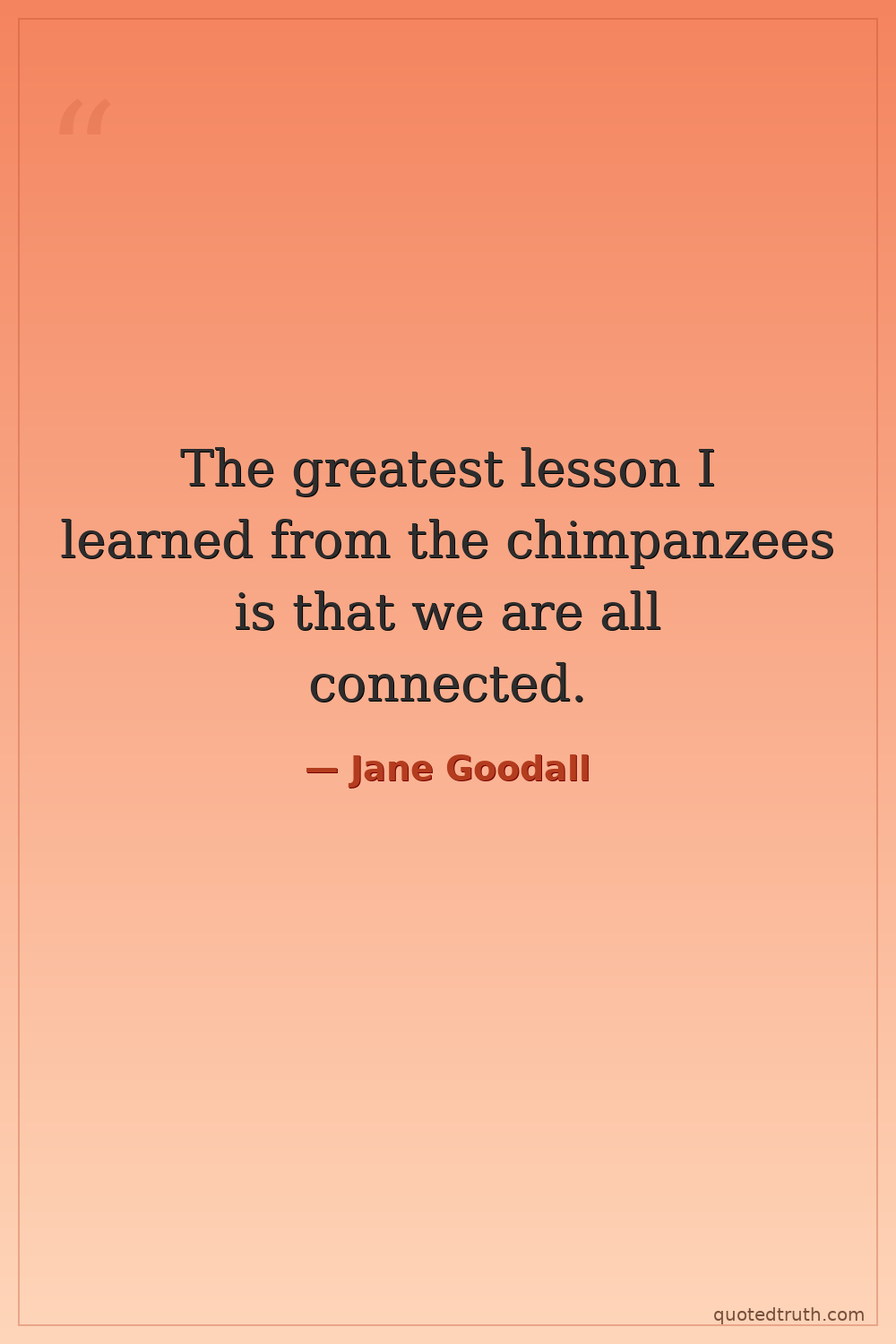
Jane Goodall — "The greatest lesson I learned from the chimpanzees is that we are all connected."
The greatest lesson I learned from the chimpanzees is that we are all connected.
The greatest lesson I learned from the chimpanzees is that we are all connected.
Click any product to generate a realistic preview. Up to 3 at a time.
* Initial load can take up to 90 seconds — revising the preview in another color is nearly instant.
"The future of the planet depends on us, and we need to take that responsibility seriously."
"I believe that the human heart, when it is truly open, is capable of great compassion."
"I believe that love is the most powerful force in the universe."
"We need to foster a sense of empathy and compassion in our children, and teach them to care about others."
"My greatest hope is that we can learn to live in peace with all creatures."
British primatologist who in 1960 began the longest-running wild primate study at Gombe Stream, transforming our understanding of chimpanzees. Closely associated with Dian Fossey (mountain-gorilla researcher) and Birutė Galdikas (orangutan researcher; together with Goodall and Fossey one of Louis Leakey's 'Trimates'). For an intellectual contrast, see Walter Palmer, American dentist who killed Cecil the Lion in Zimbabwe in 2015 — Palmer represents the trophy-hunting tradition Goodall's life's work has been organized against — the colonial-era hunter-naturalist worldview that treated primates and big game as specimens or trophies, which Goodall's Roots & Shoots and Jane Goodall Institute exist specifically to displace.
Found in 1 providers: grok
1 source checked
We are all connected means that humans and other life forms share deep biological, behavioral, and emotional bonds—not just genetic ancestry. Life on Earth operates as an interconnected web: what harms one species ripples through others. The quote rejects the idea that humans stand apart from nature, asserting instead that understanding animals like chimpanzees illuminates our own identity, responsibilities, and place within the broader community of life.
Goodall spent over 60 years observing chimpanzees at Gombe Stream, Tanzania, beginning in 1960. She documented tool use, complex social hierarchies, and emotional bonds in chimps—discoveries that forced science to reconsider what separates humans from other animals. That proximity convinced her of our shared nature. She became a leading conservation advocate, founding the Jane Goodall Institute and Roots and Shoots, driven by the belief that human fate is inseparable from nature's.
Goodall began her Gombe research in 1960, during a pivotal era for environmentalism. Rachel Carson's Silent Spring exposed ecological damage from pesticides, sparking a global conservation movement. The 1970s brought landmark legislation including the Endangered Species Act. Habitat destruction and biodiversity loss were accelerating worldwide. Scientists were developing systems ecology showing how species interdependence sustains ecosystems, making Goodall's message of connection both scientifically resonant and politically urgent.
AI-generated insights based on extensive research and information for context. Factual errors? Email [email protected].
Your cart is empty