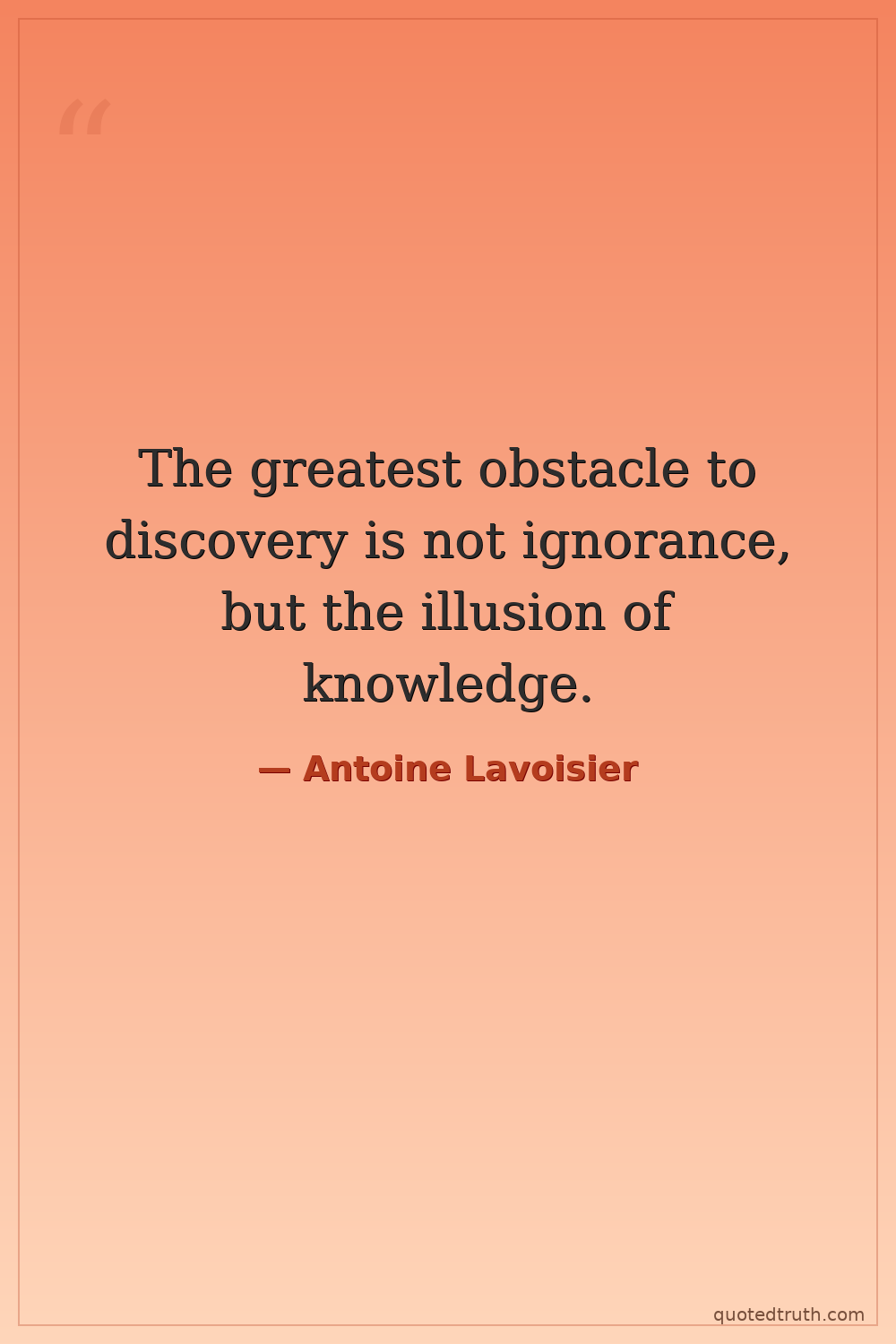
Antoine Lavoisier — "The greatest obstacle to discovery is not ignorance, but the illusion of knowled…"
The greatest obstacle to discovery is not ignorance, but the illusion of knowledge.
The greatest obstacle to discovery is not ignorance, but the illusion of knowledge.
Click any product to generate a realistic preview. Up to 3 at a time.
* Initial load can take up to 90 seconds — revising the preview in another color is nearly instant.
"Nothing is created, either in the operations of art, or in those of nature; and it may be considered as a general principle that in every operation there exists an equal quantity of matter before and …"
"It is not by chance that I have succeeded, but by hard work and perseverance."
"It is almost possible to predict one or two days in advance, within a rather broad range of probability, what the weather is going to be; it is even thought that it will not be impossible to publish d…"
"I have always found that the more I learned, the more I realized how much I did not know."
"I have no other ambition than to serve humanity."
Found in 1 providers: grok
1 source checked
Thinking you already know something is more dangerous to discovery than knowing nothing at all. Ignorance at least leaves room for curiosity — you recognize the gap and go looking. But false certainty closes inquiry before it starts. The real barrier to breakthroughs isn't a blank mind; it's a mind filled with wrong answers that feel like right ones, blocking the questions that would expose them.
Lavoisier spent his career dismantling phlogiston theory — the era's entrenched 'knowledge' that a mysterious fire-substance escaped during combustion. Scientists were certain phlogiston existed; it was fiction. Through precise quantitative experiments, Lavoisier proved combustion involved oxygen, overthrowing a confident, systematic error held by Europe's finest minds. His entire legacy rests on recognizing that false certainty is far harder to dislodge than simple ignorance, because it masquerades as established truth.
Lavoisier worked at the Enlightenment's peak, when Europe's intellectuals were replacing received scholastic wisdom with reason and experiment — yet science itself harbored deep false certainties like phlogiston, caloric fluid, and miasma theory. Powerful institutions defended entrenched ideas fiercely. The French Academy of Sciences championed rigor, but wrong frameworks had prestige behind them. The Revolution that executed Lavoisier in 1794 also demonstrated how catastrophically dangerous it becomes when ideology is mistaken for knowledge.
AI-generated insights based on extensive research and information for context. Factual errors? Email [email protected].
Your cart is empty