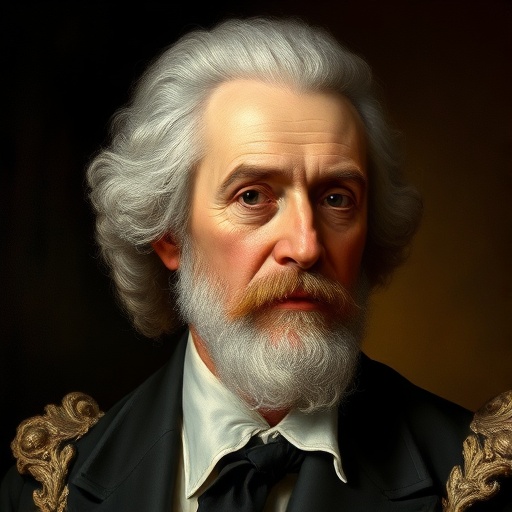
Antoine Lavoisier — "I have always regarded the study of nature as the most noble and elevated of pur…"
I have always regarded the study of nature as the most noble and elevated of pursuits.
I have always regarded the study of nature as the most noble and elevated of pursuits.
Click any product to generate a realistic preview. Up to 3 at a time.
* Initial load can take up to 90 seconds — revising the preview in another color is nearly instant.
"It took them only an instant to cut off that head, but France may not produce another like it in a century."
"Nothing is lost, nothing is created, everything is transformed."
"The desire to do good is the most powerful motive of all."
"The value of a discovery consists not in its novelty, but in its truth."
"Nothing is created, either in the operations of art, or in those of nature; and it may be considered as a general principle that in every operation there exists an equal quantity of matter before and …"
Found in 1 providers: grok
1 source checked
Studying the natural world is the highest pursuit available to the human mind—more valuable than wealth, power, or status. It positions scientific curiosity and careful observation as inherently noble: nature rewards those who look closely at it with truth. This reflects a conviction that understanding how the world actually works is the most meaningful thing a person can dedicate their life to.
Lavoisier lived this conviction fully: a wealthy tax collector by profession, he voluntarily redirected his fortune and time into experimental chemistry, identifying oxygen's role in combustion and respiration and disproving the phlogiston theory. His meticulous, quantitative methods transformed chemistry from speculation into rigorous science. He built one of Europe's finest private laboratories purely to pursue nature's laws—demonstrating that 'study' meant disciplined measurement and systematic proof.
The 18th-century Enlightenment placed reason and empirical inquiry at civilization's center, actively challenging Church authority and Aristotelian dogma that had governed knowledge for centuries. Natural philosophy was rapidly becoming experimental science. Newton had already transformed physics, and Lavoisier's generation believed chemistry deserved the same rigor. His era genuinely held that systematic knowledge of nature could liberate humanity from superstition, making reverence for its study both personal conviction and cultural declaration.
AI-generated insights based on extensive research and information for context. Factual errors? Email [email protected].
Your cart is empty