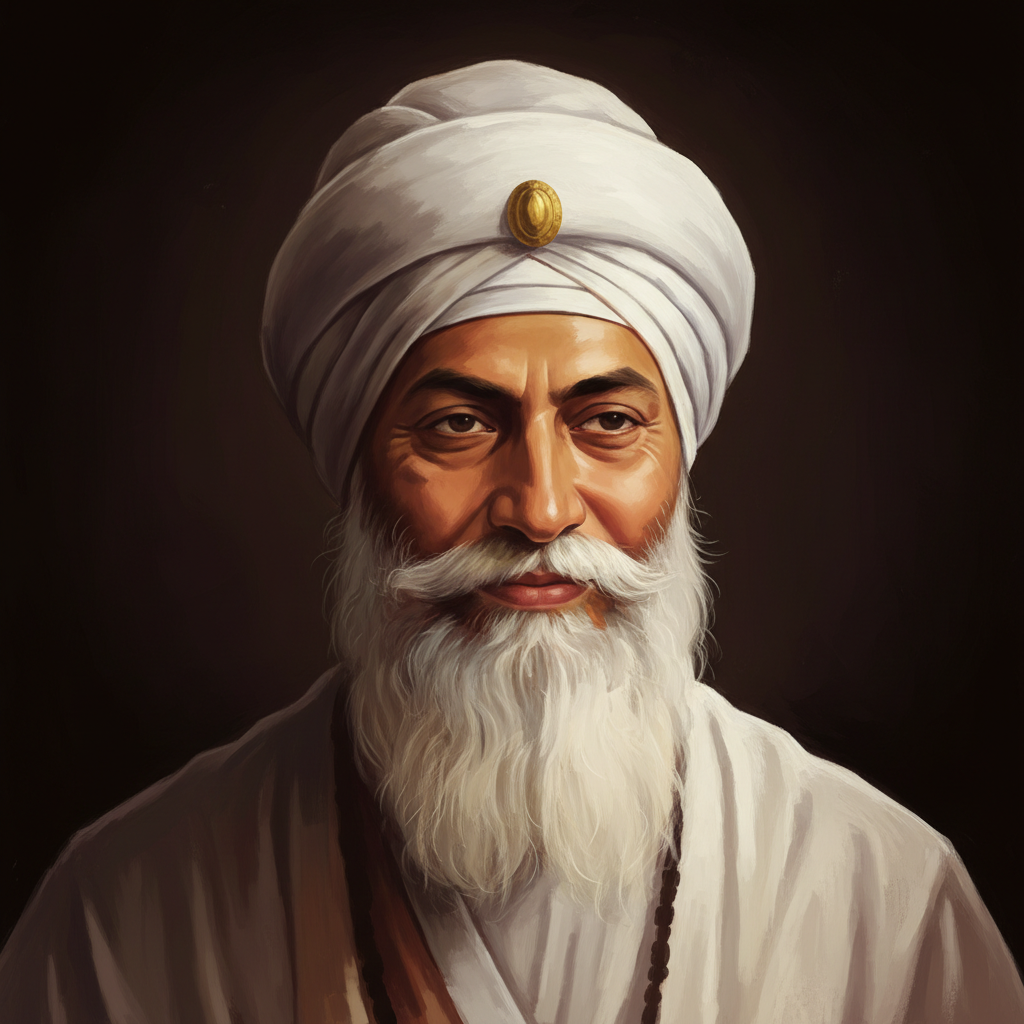
Guru Nanak — "The greatest treasure is the Name of God."
The greatest treasure is the Name of God.
The greatest treasure is the Name of God.
Click any product to generate a realistic preview. Up to 3 at a time.
* Initial load can take up to 90 seconds — revising the preview in another color is nearly instant.
"The world is a fleeting show, a temporary abode."
"The sun and moon, O Lord, are Thy lamps; the firmament Thy salver; the orbs of the stars the pearls encased in it."
"Before becoming a Muslim, a Hindu, a Christian, a Jew, let us become a Human."
"There is but One God. His Name is Truth. He is the Creator. He fears none. He is without enmity. He is timeless, unborn, self-existent. By the Guru's Grace, He is met."
"The nights are wasted sleeping, and the days are wasted eating; the human spends his life in vain."
Founder of Sikhism and the first of the Ten Sikh Gurus, whose teachings of one universal God and rejection of caste shaped Punjab. Closely associated with Kabir (mystical poet whose verses appear in the Sikh Guru Granth Sahib). For an intellectual contrast, see Brahmanical orthodoxy, the Hindu caste-and-ritual establishment of his era — Sikhism was founded as a deliberate alternative to both Hindu ritual hierarchy and Islamic exclusivism — Nanak's universalism was a structural rejection of caste and priestly mediation.
Found in 1 providers: gemini
1 source checked
The most valuable thing a person can possess isn't wealth, land, or status—it's a conscious, living connection to the divine. Repeating and meditating on God's Name (Naam) transforms the inner self, cutting through ego and attachment. External riches decay; this internal treasure compounds, bringing peace, purpose, and liberation that no material fortune can provide.
Guru Nanak spent his life rejecting inherited privilege—he walked away from a comfortable government post to wander thousands of miles preaching equality and devotion. He composed hymns centered on Naam Simran, the meditative remembrance of God, founding Sikhism on this practice. His own spiritual awakening came through direct divine experience, not ritual or scripture accumulation, making this declaration personally autobiographical.
Fifteenth-century Punjab sat at the crossroads of Mughal expansion and Hindu caste orthodoxy, where religious identity meant temple fees, priestly gatekeeping, and sectarian violence. Wealth determined access to both God and justice. Nanak's declaration that the Name—available to any person regardless of caste, gender, or coin—was the supreme treasure was a radical democratization of spirituality in a deeply stratified, transactional religious landscape.
AI-generated insights based on extensive research and information for context. Factual errors? Email [email protected].
Your cart is empty