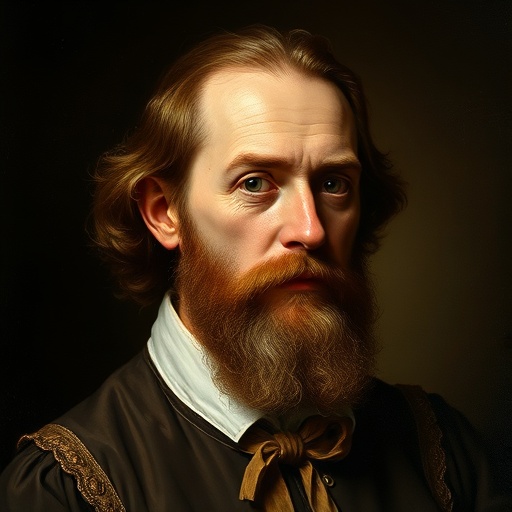
William Harvey — "The heart, like a pump, perpetually propels the blood."
The heart, like a pump, perpetually propels the blood.
The heart, like a pump, perpetually propels the blood.
Click any product to generate a realistic preview. Up to 3 at a time.
* Initial load can take up to 90 seconds — revising the preview in another color is nearly instant.
"The true physician is one who loves humanity."
"The greatest pleasure is to be found in the service of humanity."
"There is no perfect knowledge which can be entitled ours, that is innate; none but what has been obtained from experience, or derived in some way from our senses."
"The heart by its pulsific action moves, perfects, and cherishes the blood, and preserves it from corruption and coagulation."
"The vital spirit is not a separate entity, but intimately connected with the blood."
English physician whose On the Motion of the Heart and Blood in Animals (1628) demonstrated blood circulation, overturning 1,400 years of Galenic medicine. Closely associated with Francis Bacon (his contemporary in the new English empiricism). For an intellectual contrast, see Galenic medicine, the 2nd-century Greek medical tradition (humors, blood-as-consumed-fuel) — Harvey calculated that the heart pumps more blood per hour than the body could possibly produce as fuel — a single quantitative observation that demolished the entire Galenic-Aristotelian medical worldview. The cleanest example in medical history of arithmetic disproving 14 centuries of authority.
De Motu Cordis, Chapter 1 (Paraphrased for clarity, but the mechanical analogy is central)
Date: 1628
Life & DeathFound in 1 providers: grok
1 source checked
The heart functions as a mechanical pump, continuously moving blood through the body in a constant, rhythmic cycle. It never stops pushing blood forward — this is an ongoing, automatic process, not a sporadic or one-time event. The comparison to a pump strips away mysticism and frames the heart as a functional, understandable machine operating by physical principles anyone can observe and measure.
Harvey spent decades dissecting animals and humans to prove blood circulates rather than being consumed. His 1628 masterwork De Motu Cordis demolished Galenic theory by demonstrating the heart's mechanical, pumping action. This mechanical framing was Harvey's personal intellectual signature — he approached the body as an engineer would a device, making him the father of modern physiology.
In the early 1600s, Galenic medicine still taught that the liver produced blood which organs then consumed. Harvey's mechanical pump metaphor was radical — it meant the body operated like clockwork, not through mystical humors. This aligned with the broader Scientific Revolution, where Galileo, Descartes, and Kepler were similarly reducing natural phenomena to mechanical, measurable principles.
AI-generated insights based on extensive research and information for context. Factual errors? Email [email protected].
Your cart is empty