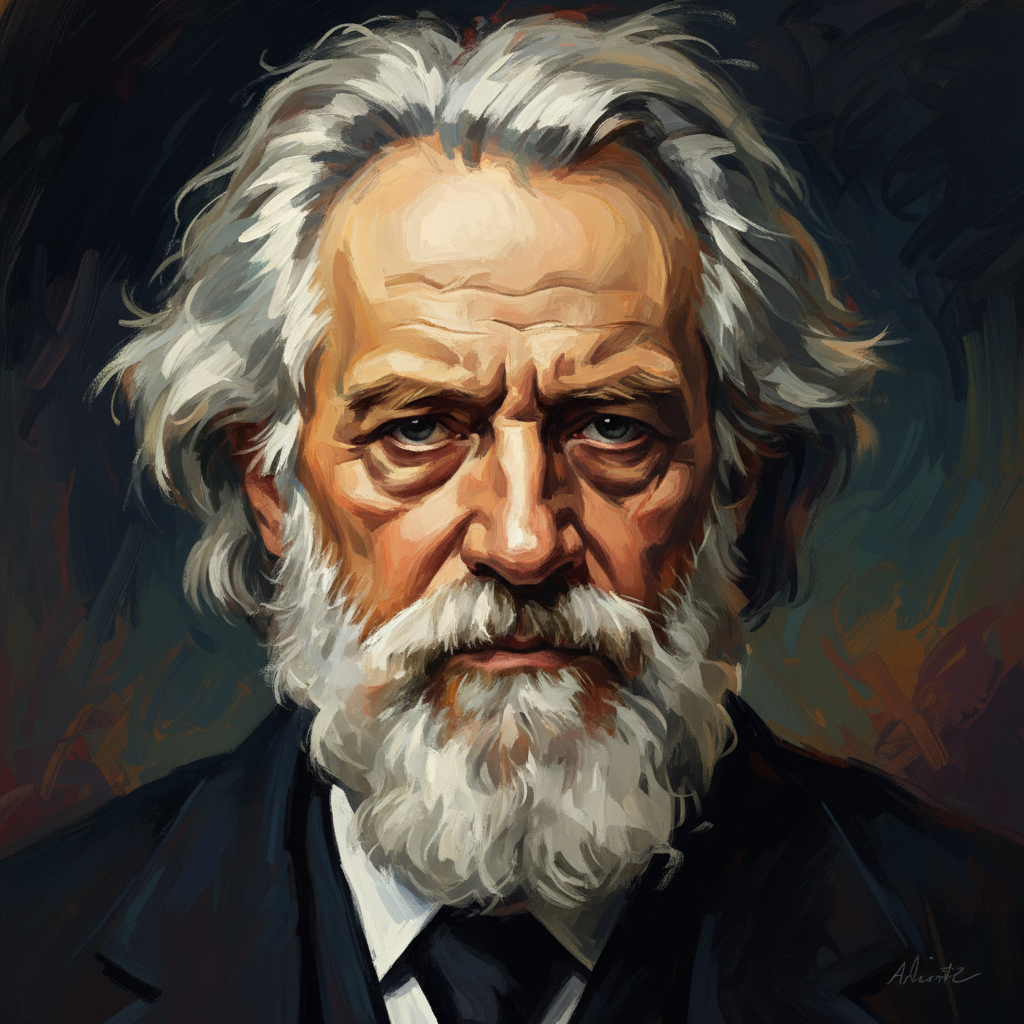
Arthur Schopenhauer — "The highest degree of world-weariness is when one has no longer any wish for any…"
The highest degree of world-weariness is when one has no longer any wish for anything.
The highest degree of world-weariness is when one has no longer any wish for anything.
Click any product to generate a realistic preview. Up to 3 at a time.
* Initial load can take up to 90 seconds — revising the preview in another color is nearly instant.
"The world is hell, and men are on the one hand the tormented souls and on the other the devils in it."
"The brain is a parasite of the organism."
"The only thing that makes life bearable is art."
"That woman is by nature intended to obey is shown by the fact that every woman who is placed in the unnatural position of absolute independence at once attaches herself to some kind of man, by whom sh…"
"The difficulty is to try and teach the multitude that something can be true and untrue at the same time."
German philosopher of pessimism whose The World as Will and Representation (1819) defined the suffering-and-renunciation tradition. Closely associated with Immanuel Kant (the system Schopenhauer built on and revised). For an intellectual contrast, see G.W.F. Hegel, German Idealist of the rational unfolding of Spirit — Schopenhauer scheduled his Berlin lectures opposite Hegel's and spent decades attacking Hegel's optimistic system as deliberately mystifying nonsense — the foundational rivalry of 19th-century German philosophy.
The standard scholarly entry points to Arthur Schopenhauer's work: Bryan Magee (Oxford, populariser-philosopher) — The Philosophy of Schopenhauer (1983); Christopher Janaway (Southampton, Schopenhauer specialist) — Self and World in Schopenhauer's Philosophy (1989); David E. Cartwright (Wisconsin–Whitewater) — Schopenhauer: A Biography (2010). These are the works graduate seminars cite when teaching Arthur Schopenhauer.
Your cart is empty