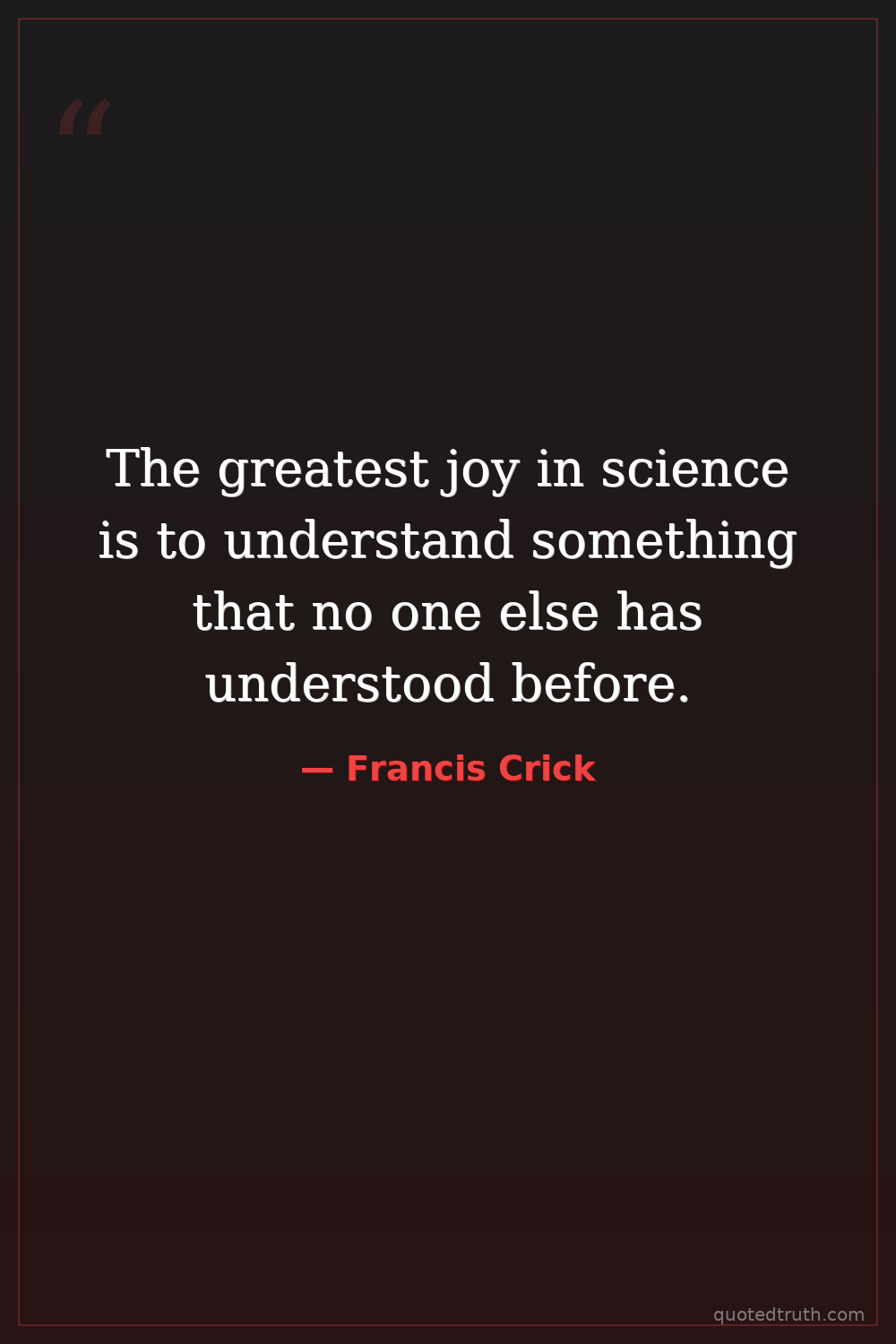
Francis Crick — "The greatest joy in science is to understand something that no one else has unde…"
The greatest joy in science is to understand something that no one else has understood before.
The greatest joy in science is to understand something that no one else has understood before.
Click any product to generate a realistic preview. Up to 3 at a time.
* Initial load can take up to 90 seconds — revising the preview in another color is nearly instant.
"I think it's important to be skeptical of everything."
"You, your joys and your sorrows, your memories and your ambitions, your sense of personal identity and free will, are in fact no more than the behavior of a vast assembly of nerve cells and their asso…"
"It is essential to be a bit arrogant to do good science."
"If you want to get ahead in science, you have to be prepared to be a bit of a bastard."
"The origin of life appears to be almost a miracle, so many are the conditions which would have had to be satisfied to get it going."
Found in 1 providers: grok
1 source checked
The greatest reward in science is not fame or funding—it's the private, electric moment when you grasp a truth about nature that no human being has ever grasped before. Confusion resolves into clarity, and you briefly hold knowledge the entire world has missed. That irreplaceable feeling of being first to understand drives scientists to endure years of tedious, uncertain work for a single transformative insight.
Crick lived this quote literally. In 1953, he and Watson deduced the double helix structure of DNA, grasping the molecular basis of heredity before anyone on Earth. Crick later described that morning as the greatest of his life. Driven by the same hunger, he pivoted entirely to neuroscience, spending his final decades chasing the neural correlates of consciousness—another mystery where being first to understand was the entire point.
The mid-20th century was science's most electrifying era—atomic physics, antibiotics, computing, and molecular biology all exploding simultaneously. The Cold War poured unprecedented funding into research, creating fierce international competition. The race to crack DNA's structure involved rival labs across three countries. Crick's era proved that individual insight, not massive machinery, could still unlock nature's deepest secrets, making the lone breakthrough moment both culturally celebrated and genuinely achievable.
AI-generated insights based on extensive research and information for context. Factual errors? Email [email protected].
Your cart is empty