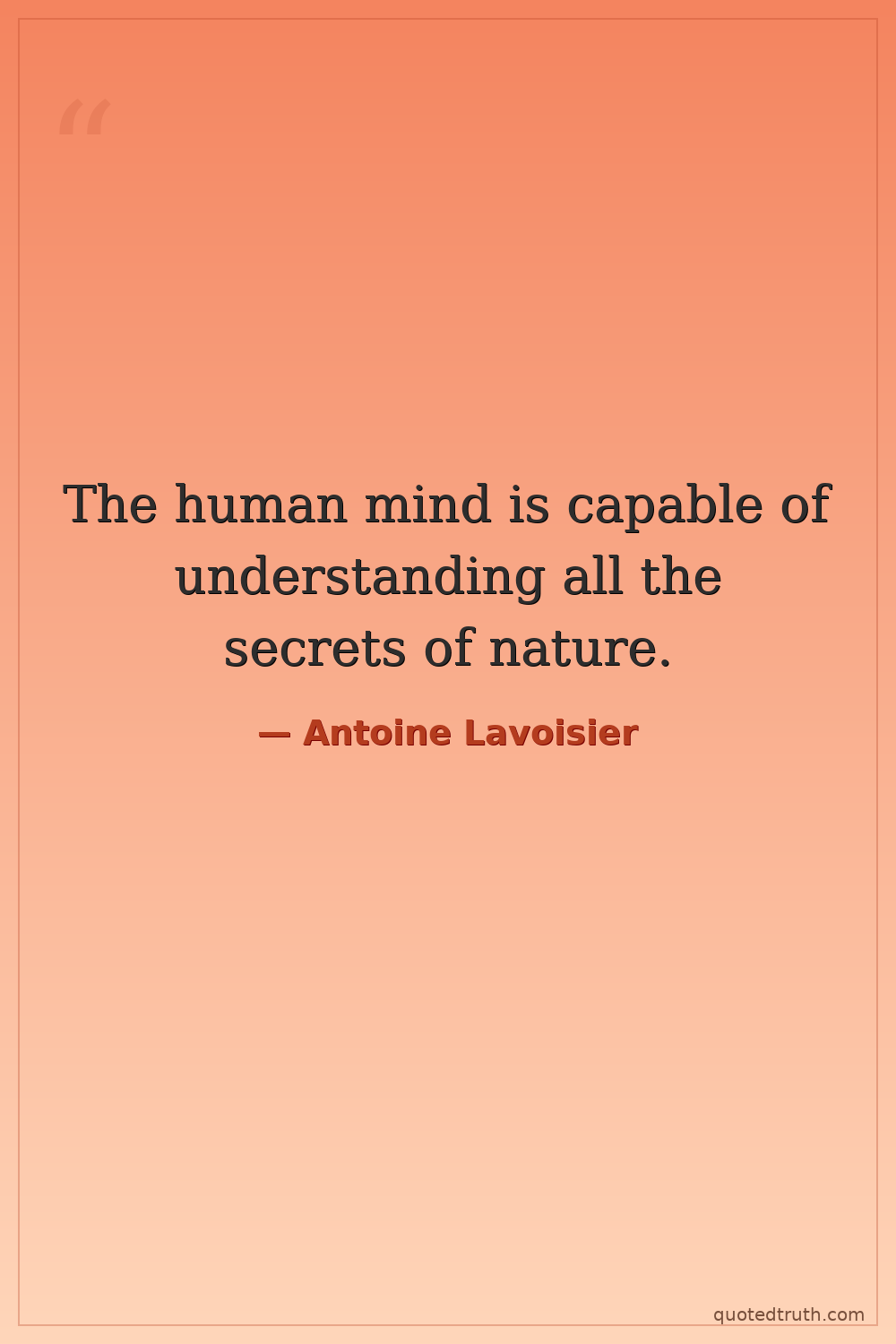
Antoine Lavoisier — "The human mind is capable of understanding all the secrets of nature."
The human mind is capable of understanding all the secrets of nature.
The human mind is capable of understanding all the secrets of nature.
Click any product to generate a realistic preview. Up to 3 at a time.
* Initial load can take up to 90 seconds — revising the preview in another color is nearly instant.
"The art of concluding from experience and observation consists in evaluating probabilities."
"It is not sufficient to know, one must apply."
"I die as I have lived, a servant of science and a victim of the French Revolution."
"The desire to do good is the most powerful motive of all."
"I consider nature a vast chemical laboratory, in which all sorts of combinations and decompositions are continually taking place."
Found in 1 providers: grok
1 source checked
Human intellect, when rigorously applied through observation and reason, can uncover every mechanism underlying the natural world. No phenomenon is inherently beyond comprehension — nature operates by discoverable laws, not arbitrary mystery. This is a confidence claim: given the right methods, patience, and tools, people can decode chemistry, physics, biology, and beyond. It rejects the idea that nature holds secrets permanently sealed off from rational investigation.
Lavoisier lived this conviction. He overturned phlogiston theory through precise measurement, identified oxygen and hydrogen, established the law of conservation of mass, and co-authored a systematic chemical nomenclature that replaced alchemical guesswork with rigorous language. His laboratory at the Arsenal in Paris was a temple to quantitative method. Every experiment he ran was a bet that nature's rules were findable — and he kept winning that bet.
The late 18th-century Enlightenment made this sentiment both radical and galvanizing. Diderot's Encyclopédie was cataloguing all human knowledge; Newton had already proven nature obeyed mathematical laws. Yet alchemy, vitalism, and religious explanations of natural phenomena still dominated popular understanding. Lavoisier's era believed reason could liberate humanity from superstition — a conviction so politically charged it intertwined with Revolutionary ideals, making scientific confidence inseparable from philosophical and social transformation.
AI-generated insights based on extensive research and information for context. Factual errors? Email [email protected].
Your cart is empty