What it means
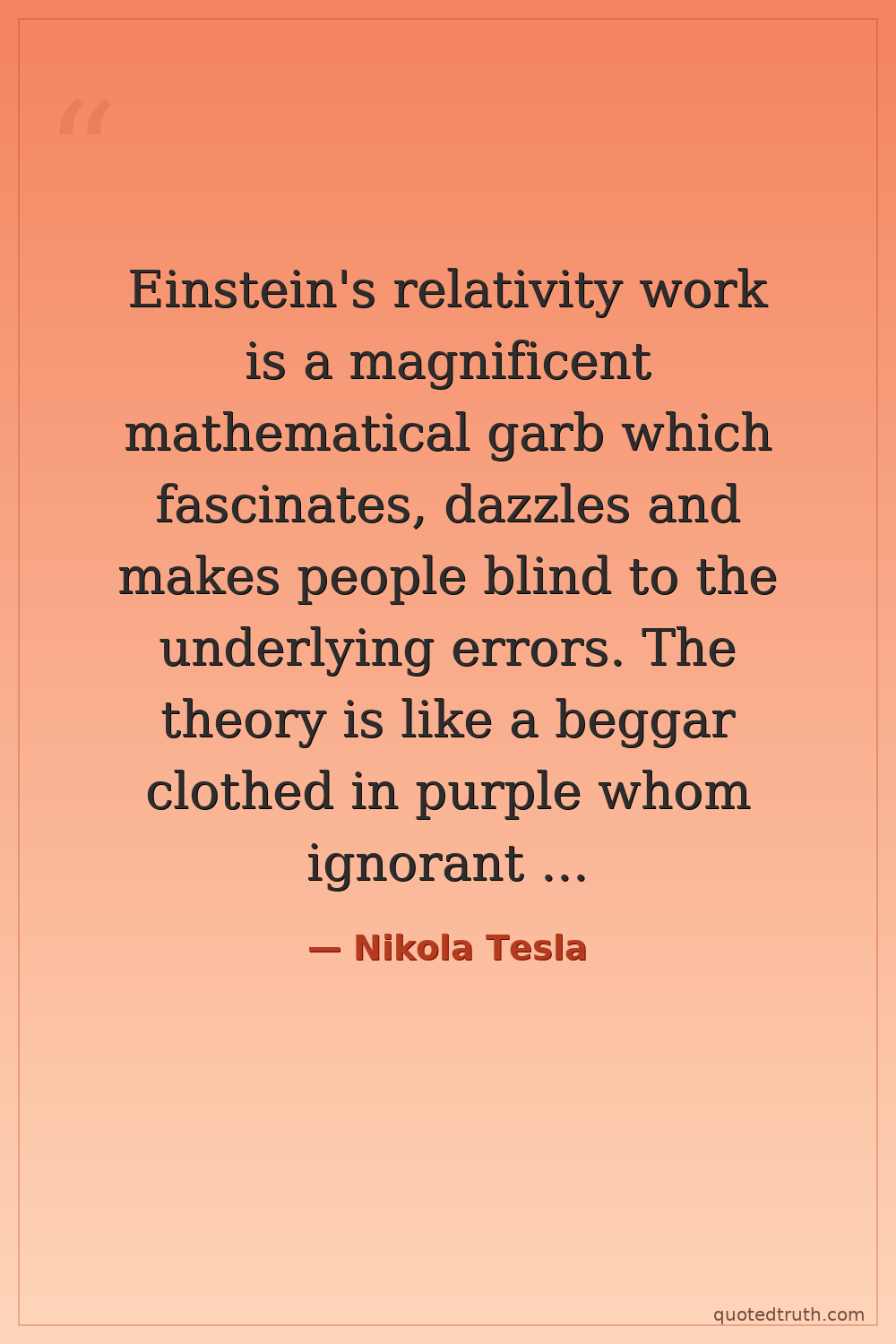
Tesla argues Einstein's relativity theory dazzles with its mathematical sophistication while hiding fundamental errors beneath the surface. He uses the image of a beggar mistaken for royalty — the theory's impressive appearance fools uncritical observers. Tesla insists the physicists championing it are doing metaphysics, building elegant abstract systems rather than true empirical science rooted in verifiable, physical observations of how the world actually works.
Relevance to Nikola Tesla
Tesla was a hands-on inventor who built tangible systems — AC power grids, motors, radio. He distrusted purely abstract theory his entire life, clinging to classical ether physics and rejecting relativity publicly. This quote reflects his deep empiricist identity: real science meant building things that worked. His rivalry with Einstein was partly generational — Tesla belonged to the era of Edison-style experimentation, not thought experiments and mathematical abstraction.
The era
Einstein published special relativity in 1905 and general relativity in 1915, triggering a revolution that displaced classical Newtonian mechanics. By the 1920s and 30s, quantum mechanics further abstracted physics into pure mathematics. Many engineers and classical physicists felt the field was abandoning physical intuition for incomprehensible formalism. Tesla, deeply tied to 19th-century electromagnetic theory and the luminiferous ether concept, saw this shift as science abandoning its grounding in observable reality.
AI-generated insights based on extensive research and information for context. Factual errors? Email [email protected].