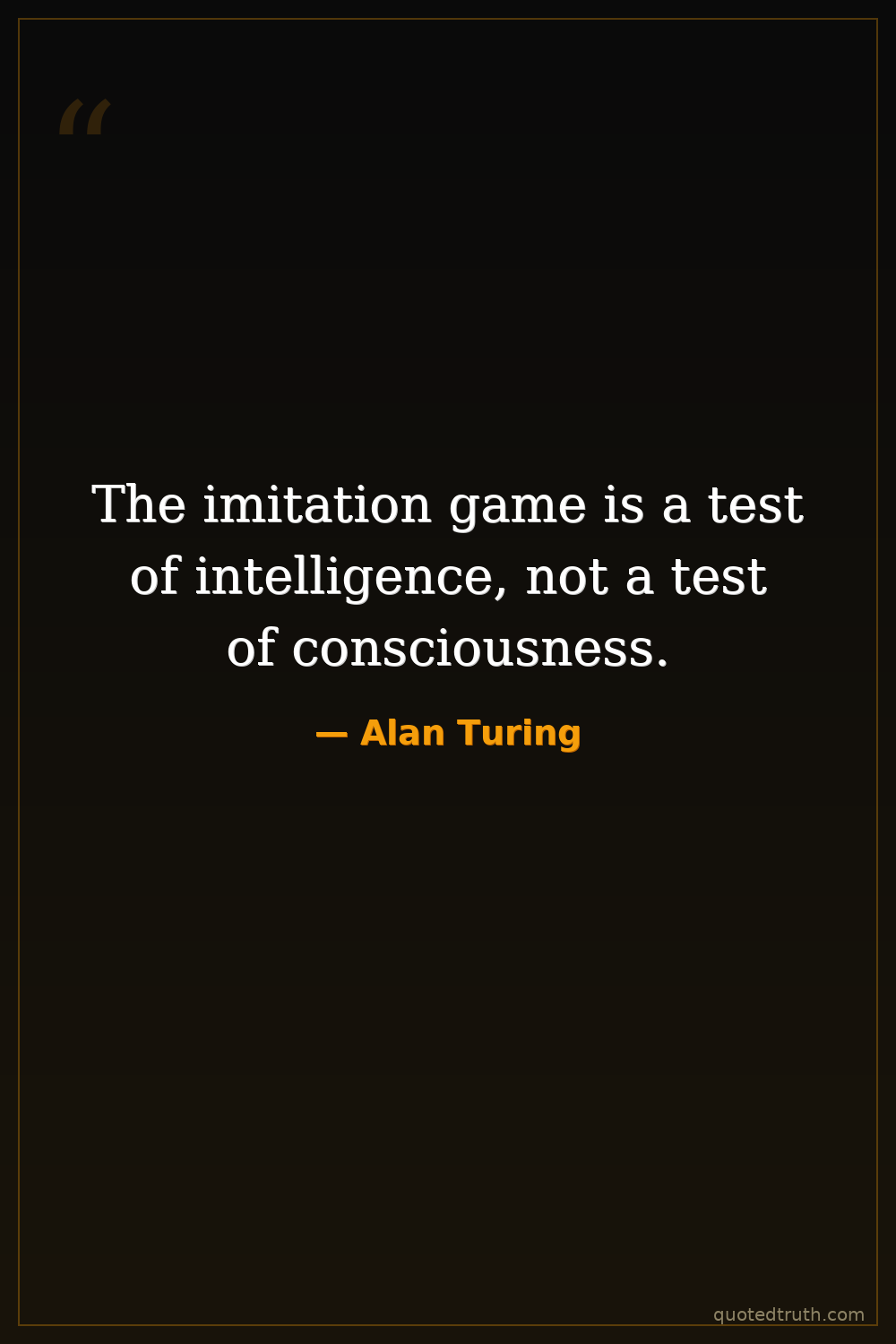
Alan Turing — "The imitation game is a test of intelligence, not a test of consciousness."
The imitation game is a test of intelligence, not a test of consciousness.
The imitation game is a test of intelligence, not a test of consciousness.
Click any product to generate a realistic preview. Up to 3 at a time.
* Initial load can take up to 90 seconds — revising the preview in another color is nearly instant.
"The human mind is capable of doing many things that a machine cannot, but a machine can do many things that a human cannot."
"I believe that in about fifty years' time it will be possible to programme computers, with a storage capacity of about 10^9, to make them play the imitation game so well that an average interrogator w…"
"Up to a point, it is better to just let the snags [bugs] be there than to spend such time in design that there are none."
"I expect to lie in the sun, talk French and modern Greek, and make love, though the sex and nationality... has yet to be decided: in fact it is quite possible that this item will be altogether omitted…"
"We are trying to create a machine that can solve problems."
Attributed, clarification of the Turing Test, but precise quote is elusive.
Date: Approx. 1950
ShockingFound in 1 providers: grok
1 source checked
Intelligence and consciousness are not the same thing. If a machine responds to questions indistinguishably from a human, that behavioral performance is sufficient to call it intelligent—we don't need to know whether it has inner experience. The test measures functional output, not metaphysical status. Stop asking unanswerable questions about feelings; ask whether the system produces intelligent results.
Turing's 1950 paper 'Computing Machinery and Intelligence' proposed the Imitation Game precisely to sidestep philosophy's deadlocks. His Bletchley Park codebreaking showed machines performing reasoning humans couldn't match at scale. Prosecuted by Britain for homosexuality—judged by what he was, not what he contributed—Turing understood viscerally how inner reality and external categorization can be brutally disconnected.
In 1950, computers were classified wartime machinery just entering public awareness. No philosophical tradition existed for artificial cognition. The Cold War made automation urgent and ideologically charged. As machines grew capable, consciousness became the last conceptual firewall separating humans from tools—Turing deliberately punctured that comfort by insisting behavioral evidence, not metaphysical essence, should define intelligence.
AI-generated insights based on extensive research and information for context. Factual errors? Email [email protected].
Your cart is empty