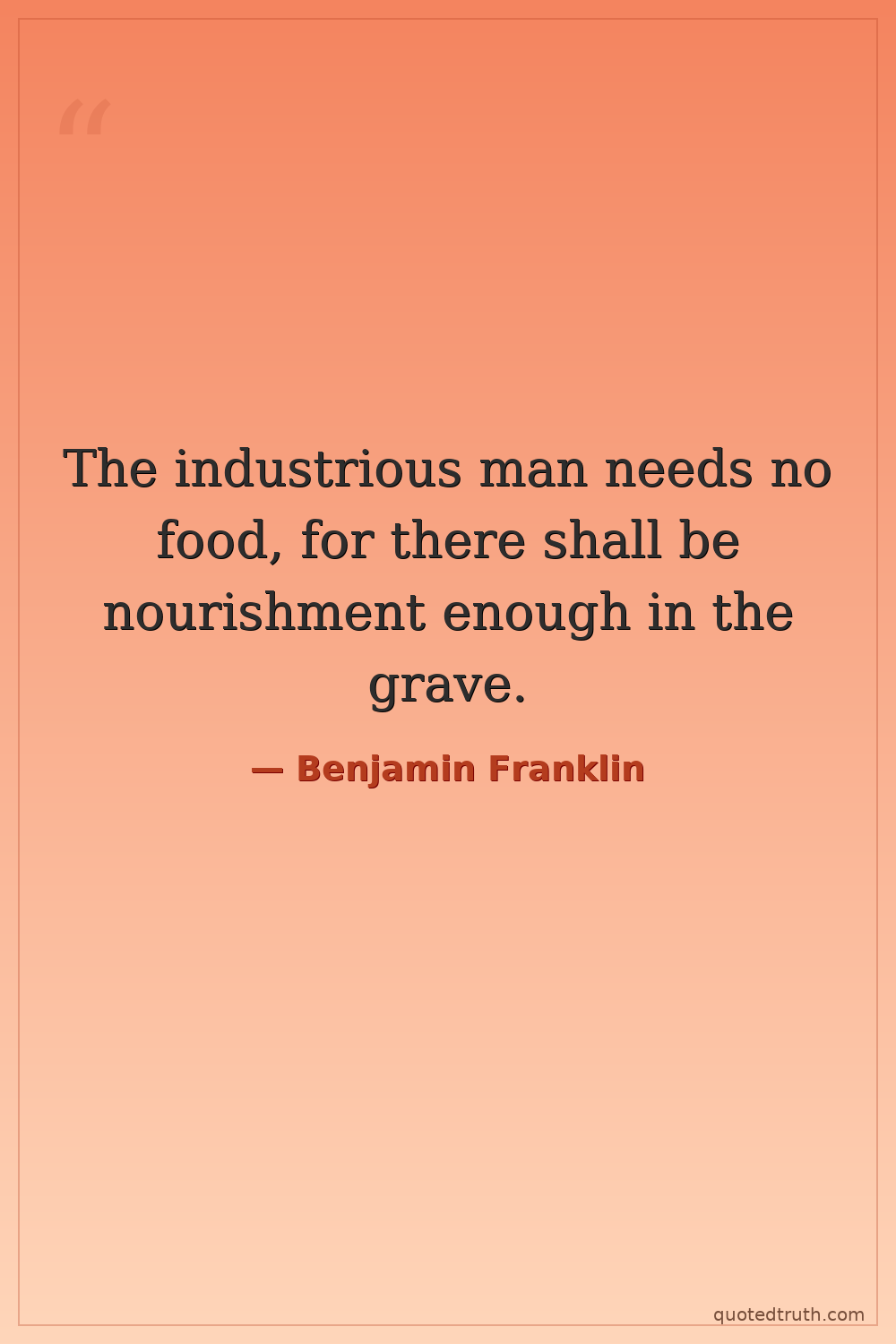
Benjamin Franklin — "The industrious man needs no food, for there shall be nourishment enough in the …"
The industrious man needs no food, for there shall be nourishment enough in the grave.
The industrious man needs no food, for there shall be nourishment enough in the grave.
Click any product to generate a realistic preview. Up to 3 at a time.
* Initial load can take up to 90 seconds — revising the preview in another color is nearly instant.
"A man who lives on hope dies farting."
"He that by the Plough would thrive, Himself must either hold or drive."
"It is a grand mistake to think of being great without ever being good."
"Anger is never without a Reason, but seldom with a good One."
"Keep your eyes wide open before marriage, half shut afterwards."
Polymath Founding Father, diplomat, and Poor Richard's Almanack author who helped draft the Declaration of Independence and the Constitution. Closely associated with John Adams (fellow Founder, Massachusetts statesman) and Thomas Jefferson (fellow Declaration drafter). For an intellectual contrast, see Thomas Hutchinson, last royal governor of colonial Massachusetts — Franklin leaked Hutchinson's loyalist correspondence to Boston in 1772 to inflame revolutionary sentiment — Hutchinson represented the colonial-aristocrat crown-loyalty that Franklin's revolution was organized to dismantle.
From 'Poor Richard's Almanack' (lesser-known wisdom)
Date: Unknown, likely 18th century
Food & DrinkFound in 1 providers: gemini
1 source checked
The quote darkly jokes that an extremely hardworking person toils so relentlessly they require no sustenance—because death will provide the ultimate, eternal rest. It is sardonic: the 'nourishment' in the grave is the final rest earned by overwork. Rather than celebrating industry, it reads as a grim warning about workaholism taken to its logical extreme, using black humor to challenge the notion that endless labor is inherently virtuous.
Franklin built his identity on industriousness—rising from a printer's apprentice to America's most celebrated polymath through relentless effort. His Poor Richard's Almanack dispensed dozens of proverbs urging hard work and frugality. Yet Franklin also believed in balance, enjoying Paris salons and intellectual society. This sardonic quip mirrors his signature wit: using dark irony to signal that even his beloved industriousness has limits, and that the human body will eventually demand what it is owed.
Colonial and early modern America was shaped by the Protestant work ethic—idleness was moral failure and labor was godly duty. Scarce resources, frequent crop failures, and frontier hardship meant productivity literally determined survival. Yet this period also saw early Enlightenment skepticism questioning religious extremism. Franklin's era glorified tireless work so relentlessly that a sardonic pushback against that cultural norm was both daring and entirely characteristic of his Enlightenment-era rationalist wit.
AI-generated insights based on extensive research and information for context. Factual errors? Email [email protected].
Your cart is empty