What it means
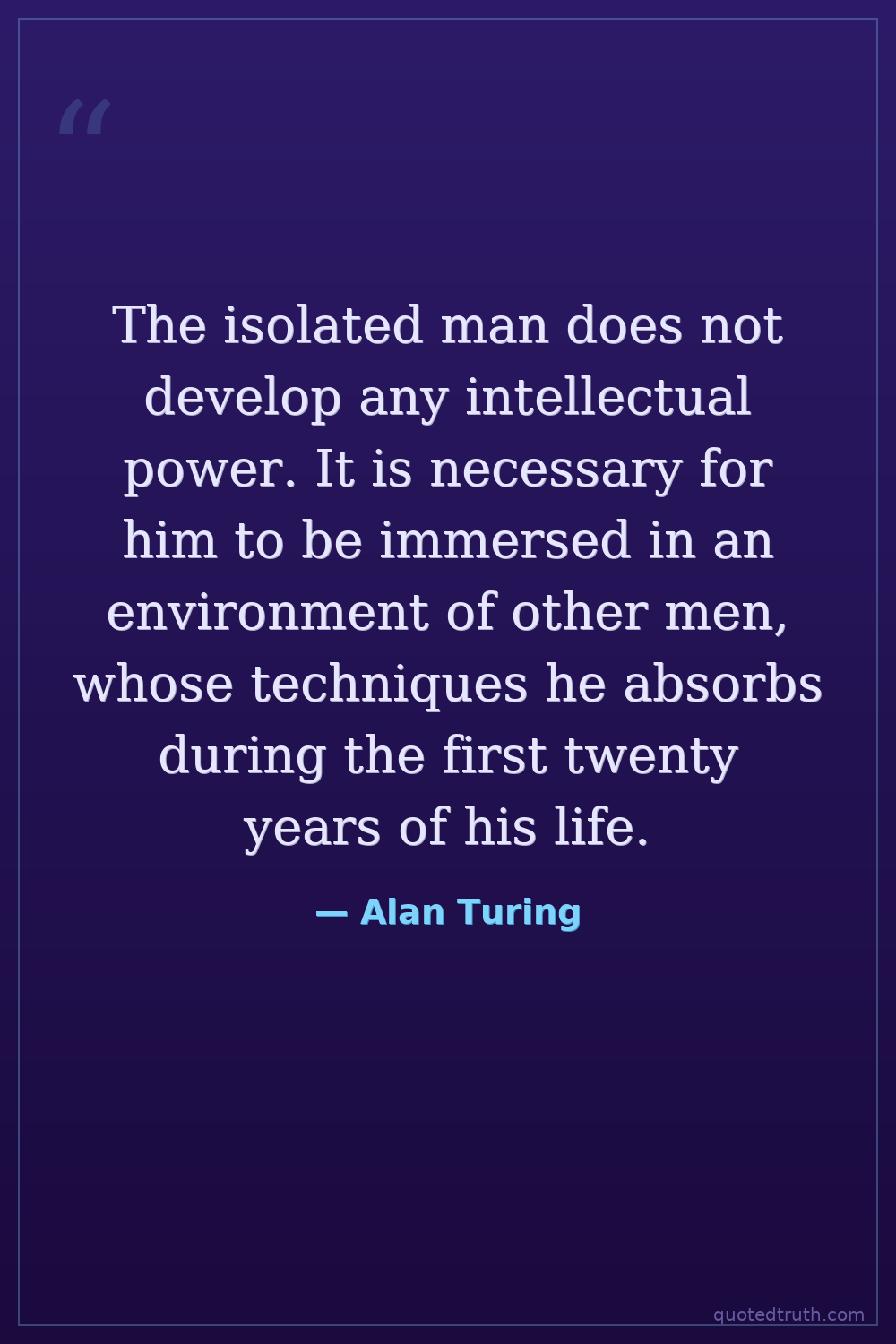
Human intelligence isn't innate — it's built through immersion in society. A person cut off from other humans won't develop real intellectual capacity because learning happens by absorbing the accumulated techniques, habits of mind, and knowledge of those around you. The first two decades of life are critical: that's when a person soaks up the cultural and cognitive toolkit that makes sophisticated thinking possible. Intelligence is fundamentally social.
Relevance to Alan Turing
Turing wrote this in his landmark 1950 paper "Computing Machinery and Intelligence," where he probed whether machines could think. If human intelligence depends on social absorption over decades, replicating it mechanically is extraordinarily hard. Turing thrived in collaborative environments — Bletchley Park's codebreaking teams, Cambridge's mathematical culture — yet lived in profound social isolation due to his criminalized homosexuality, giving this observation an unmistakably painful personal dimension.
The era
In 1950, computing was newborn — Turing's Manchester Mark 1 was among the world's first stored-program computers. Machine intelligence was suddenly urgent and controversial. Simultaneously, developmental psychology was advancing: how children learn and what makes humans cognitively unique were live debates. Post-WWII Britain emphasized rebuilding institutions and education. Turing's framing of intelligence as socially transmitted challenged both the romantic myth of the lone genius and naive optimism about thinking machines.
AI-generated insights based on extensive research and information for context. Factual errors? Email [email protected].