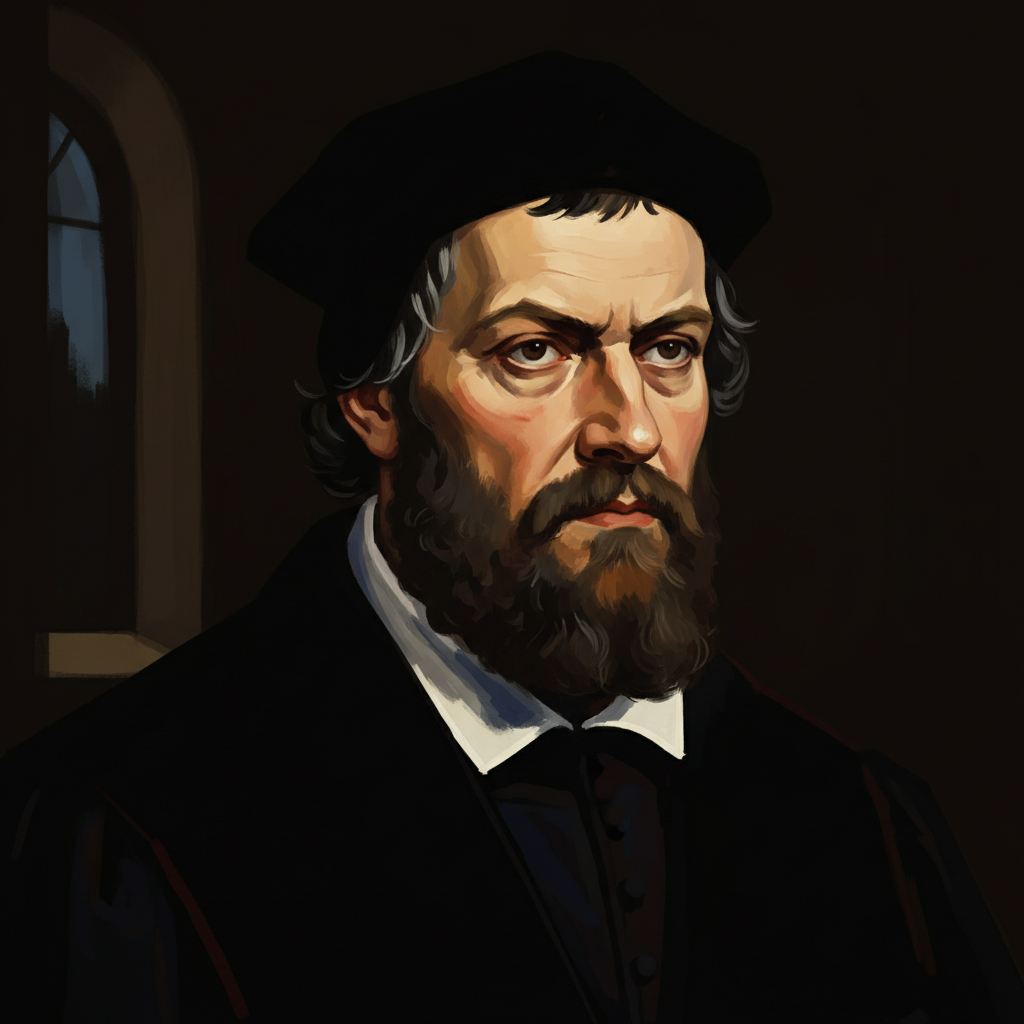
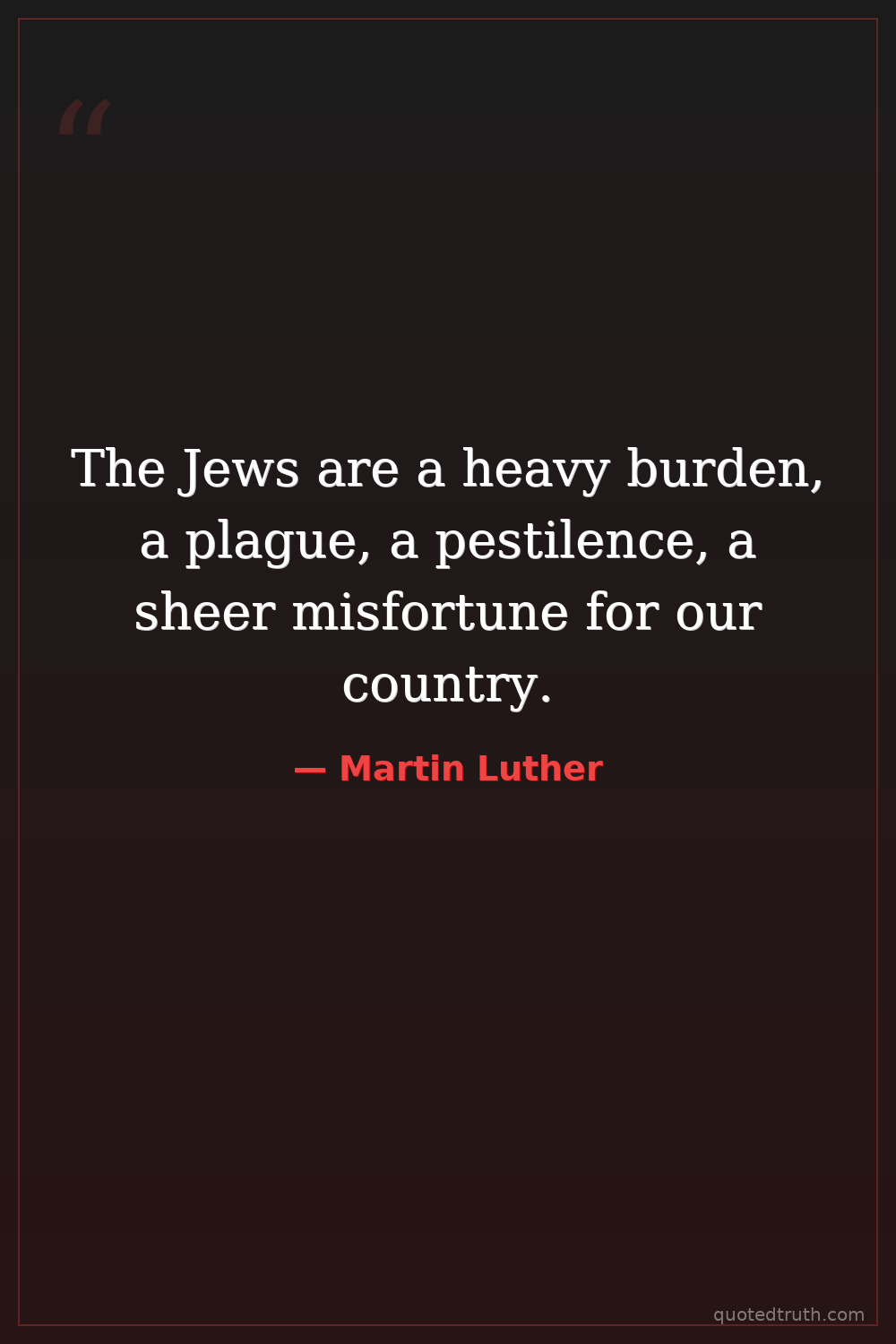
Martin Luther — "The Jews are a heavy burden, a plague, a pestilence, a sheer misfortune for our …"
The Jews are a heavy burden, a plague, a pestilence, a sheer misfortune for our country.
The Jews are a heavy burden, a plague, a pestilence, a sheer misfortune for our country.
Click any product to generate a realistic preview. Up to 3 at a time.
* Initial load can take up to 90 seconds — revising the preview in another color is nearly instant.
"I frankly confess that even if it were possible I should not wish to have free choice given to me, or to have anything left in my own hands by which I might strive for salvation."
"We are not yet what we shall be, but we are growing toward it, the process is not yet finished, but it is going on, this is not the end, but it is the road."
"If I am not allowed to laugh in heaven, I don't want to go there."
"The more you read the Bible, the more you will love it; the more you love it, the more you will read it."
"And so, dear Christian, beware of the Jews . . . you can see how God's wrath has consigned them to the Devil, who has robbed them not only of a proper understanding of the Scriptures, but also of comm…"
German theologian whose 95 Theses (1517) launched the Protestant Reformation and broke the Catholic Church's monopoly on Western Christianity. Closely associated with Philipp Melanchthon (Lutheran systematizer) and John Calvin (later Reformer who built on Luther's break). For an intellectual contrast, see Pope Leo X, Renaissance pope (1513-1521) — Leo X's indulgence sales triggered Luther's break and Leo excommunicated him in 1521 — Luther's entire Reformation is structured as a direct answer to the indulgence-funded Vatican Leo represented.
Found in 1 providers: deepseek
1 source checked
This statement brands an entire people as a destructive disease afflicting the nation. It frames Jewish presence not as a religious or civic difference but as a catastrophic national crisis, stripping individuals of humanity by reducing them to a collective threat. The speaker calls for urgent alarm, implying the surrounding society is a victim suffering under this group's existence and must respond to the supposed affliction.
This reflects the darkest turn in Luther's career. After initially hoping Jews would convert to his reformed Christianity, he grew bitter when they did not, and in 1543 published On the Jews and Their Lies, urging burning synagogues, seizing prayer books, and expelling Jewish communities. The quote comes from that treatise. A brilliant theologian and translator who reshaped Western Christianity, Luther also bequeathed a virulent antisemitic legacy later exploited by the Nazis.
Early modern Europe in the 1540s was convulsed by the Protestant Reformation Luther ignited in 1517. Jews faced centuries of expulsions from England, France, and Spain, forced conversions, ghettoization, and blood-libel accusations. Religious identity defined political belonging, and minority communities were scapegoated during plagues, economic stress, and confessional warfare. Princes used religious polemic to justify expulsions, and Luther's pamphlet provided theological ammunition that several German territories promptly cited when restricting or banishing Jewish residents.
AI-generated insights based on extensive research and information for context. Factual errors? Email [email protected].
Your cart is empty