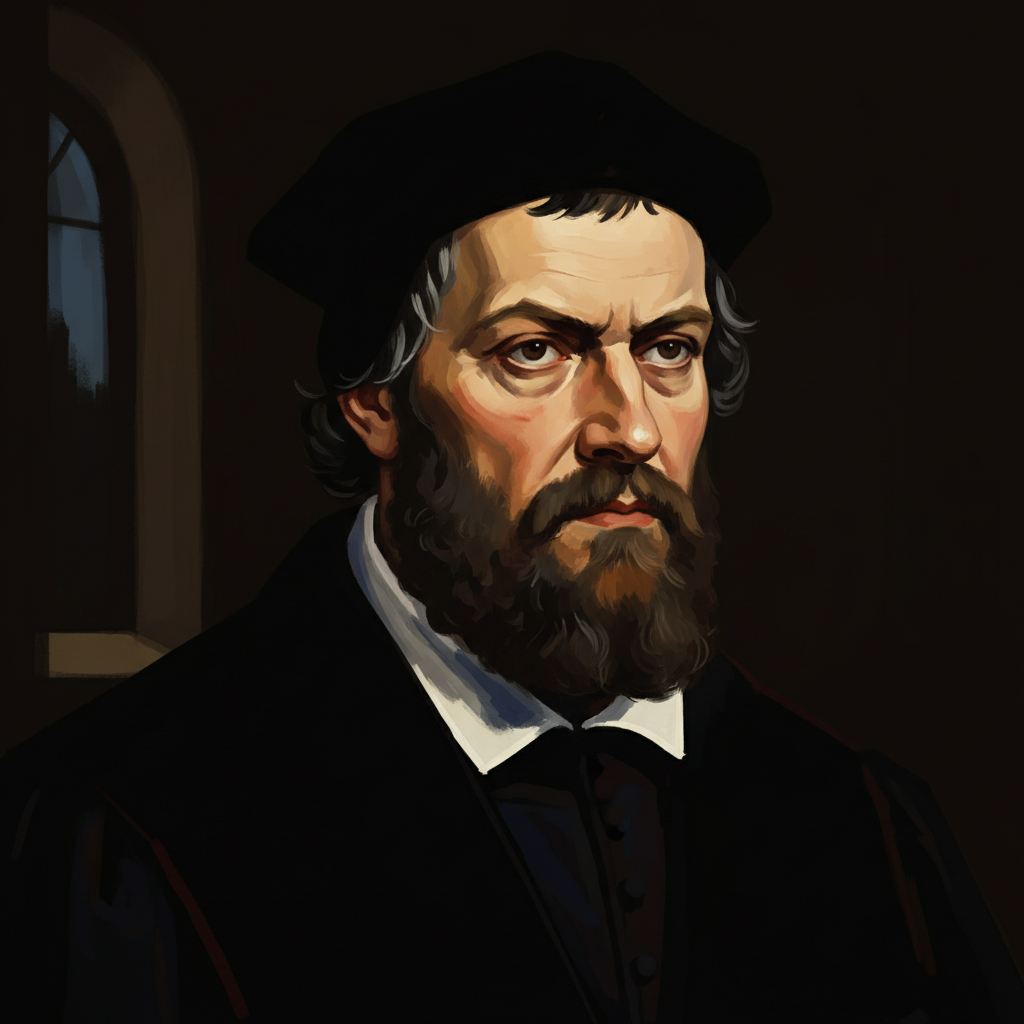
Martin Luther — "If I am not allowed to laugh in heaven, I don't want to go there."
If I am not allowed to laugh in heaven, I don't want to go there.
If I am not allowed to laugh in heaven, I don't want to go there.
Click any product to generate a realistic preview. Up to 3 at a time.
* Initial load can take up to 90 seconds — revising the preview in another color is nearly instant.
"It is a sin to be sad."
"Their houses also should be razed and destroyed. For they pursue in them the same aims as in their synagogues. Instead they might be lodged under a roof or in a barn, like the Gypsies."
"Mankind has a free will; but it is free to milk cows and to build houses, nothing more."
"If I profess with the loudest voice and clearest exposition every portion of the truth of God except precisely that little point which the world and the devil are at that moment attacking, I am not co…"
"I have no pleasure in any man who despises music. It is no invention of ours: it is the gift of God."
German theologian whose 95 Theses (1517) launched the Protestant Reformation and broke the Catholic Church's monopoly on Western Christianity. Closely associated with Philipp Melanchthon (Lutheran systematizer) and John Calvin (later Reformer who built on Luther's break). For an intellectual contrast, see Pope Leo X, Renaissance pope (1513-1521) — Leo X's indulgence sales triggered Luther's break and Leo excommunicated him in 1521 — Luther's entire Reformation is structured as a direct answer to the indulgence-funded Vatican Leo represented.
Found in 1 providers: gemini
1 source checked
Luther is saying that joy and laughter are essential to a life worth living, even an eternal one. If paradise requires suppressing humor and happiness, then it isn't truly paradise at all. He values genuine human emotion over a sterile, humorless perfection, suggesting that authentic spirituality includes warmth, wit, and the ability to enjoy existence rather than demanding solemn piety as the price of salvation.
Luther was famously earthy, humorous, and unafraid to mock religious pretension, often cracking jokes and drinking beer with students during his 'Table Talk' evenings. He rejected the grim monastic asceticism of his former Augustinian life, embracing marriage to Katharina von Bora and family joy. His theology of grace freed believers from performing sanctity, making room for laughter as compatible with faith rather than sinful frivolity.
In early-modern Europe, the medieval Catholic Church emphasized somber penance, fasting, and fear of purgatory, treating levity as spiritually dangerous. Monastic culture prized silence and gravity. Luther's 1517 Ninety-Five Theses shattered this atmosphere, and the Reformation redefined piety around faith and conscience rather than ritual severity. His earthy humor scandalized opponents but resonated with ordinary Germans exhausted by clerical gloom, indulgence-selling, and the performative holiness of the late medieval church.
AI-generated insights based on extensive research and information for context. Factual errors? Email [email protected].
Your cart is empty