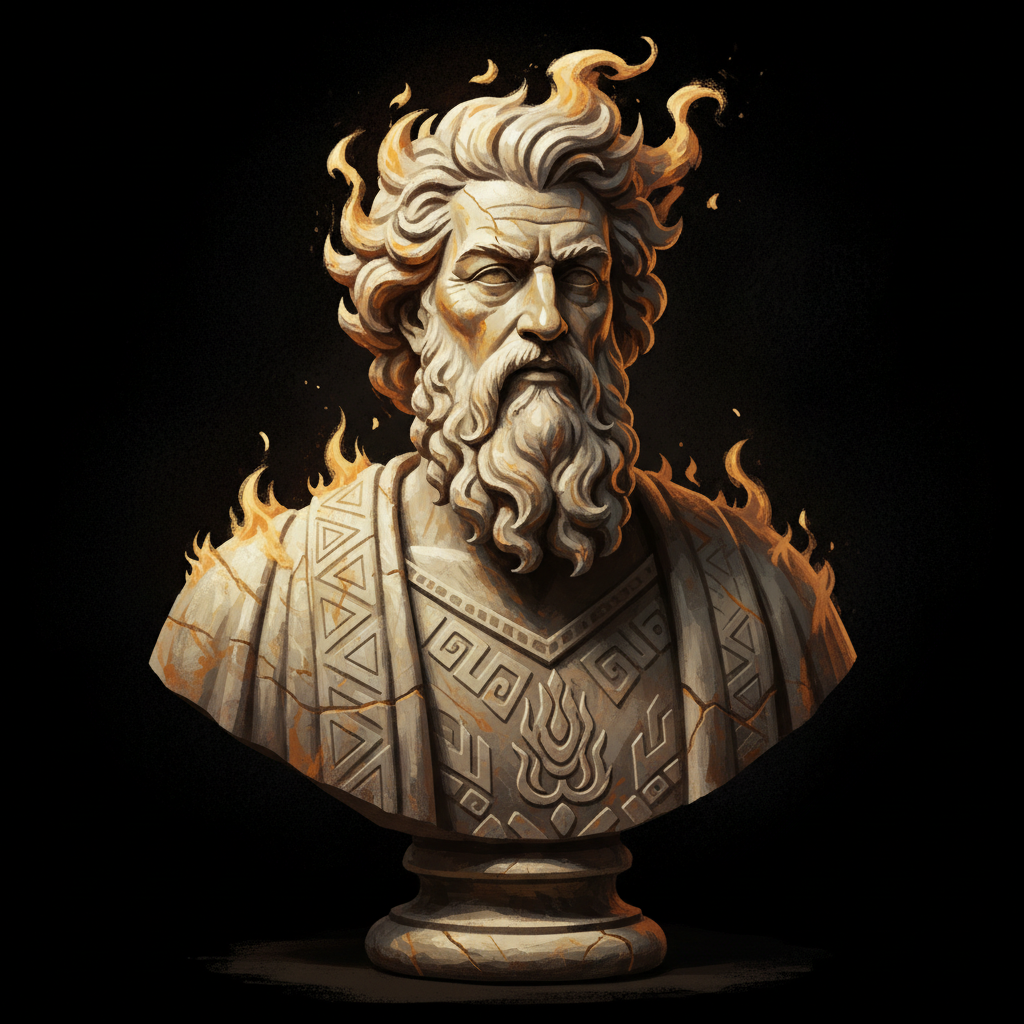
Zoroaster — "The Lie is the source of all evil, the Truth is the source of all good."
The Lie is the source of all evil, the Truth is the source of all good.
The Lie is the source of all evil, the Truth is the source of all good.
Click any product to generate a realistic preview. Up to 3 at a time.
* Initial load can take up to 90 seconds — revising the preview in another color is nearly instant.
"Taking the first footstep with a good thought, the second with a good word, and the third with a good deed. I entered paradise."
"One need not scale the heights of the heavens, nor travel along the highways of the world to find Ahura Mazda. With purity of mind and holiness of heart one can find Him in one's own heart."
"In the radiance of righteousness, we shall learn self-knowledge and righteous thinking."
"The greatest wisdom is to know oneself. The second greatest is to know where you put your keys."
"Therefore, you who are living, make known these doctrines to those who are striving for the Lie, so that they may not bring about a second destruction for themselves."
Iranian prophet who founded Zoroastrianism, the first major religion of cosmic dualism between good (Ahura Mazda) and evil (Angra Mainyu). Closely associated with The Buddha (near-contemporary Eastern moral-cosmological revolutionary). For an intellectual contrast, see Friedrich Nietzsche, German philosopher of 'beyond good and evil' — Nietzsche appropriated Zarathustra's name for Thus Spoke Zarathustra (1883) precisely to invert the original's moral cosmology — the historical Zoroaster founded the good-versus-evil framework Nietzsche's character announces the end of.
Found in 1 providers: grok
1 source checked
Deception and falsehood are the root from which every harmful action grows, while honesty and truthfulness are the foundation of every beneficial one. The saying frames morality as a binary choice between two cosmic forces: choosing to lie corrupts the world and oneself, while choosing truth aligns a person with what is genuinely good. Ethics, in this view, reduces to one simple test—am I being truthful or deceitful?
Zoroaster built his entire religion around the cosmic struggle between Asha (truth, order) and Druj (the lie, chaos). As a priest-prophet who reformed older Iranian polytheism, he taught that humans must actively choose Asha through good thoughts, good words, and good deeds. This quote distills the dualistic ethics at the heart of his Gathas, where Ahura Mazda represents truth and the hostile spirit embodies the lie that pollutes creation.
Zoroaster lived in ancient Persia, likely between 1500 and 1000 BCE, among pastoral Iranian tribes practicing ritual sacrifice and worshipping many gods. Cattle raids, tribal violence, and corrupt priesthoods made oath-keeping and honesty existential concerns for settled herding communities. By elevating truth to a cosmic principle, Zoroaster gave a fractured society a unifying moral standard that later shaped Persian imperial ethics under Cyrus and influenced Judaism, Christianity, and Islam.
AI-generated insights based on extensive research and information for context. Factual errors? Email [email protected].
Your cart is empty