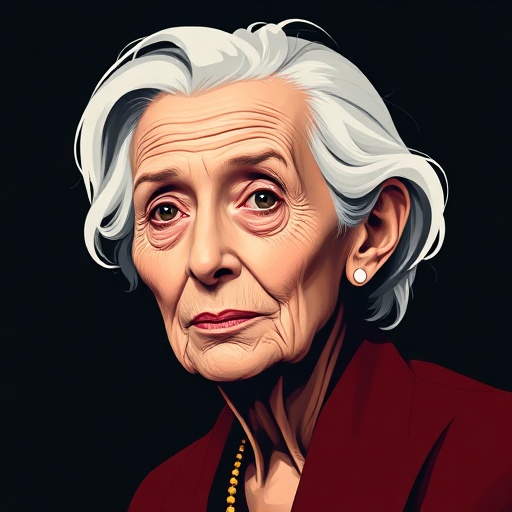
Jane Goodall — "The loss of biodiversity is a tragedy for all of us."
The loss of biodiversity is a tragedy for all of us.
The loss of biodiversity is a tragedy for all of us.
Click any product to generate a realistic preview. Up to 3 at a time.
* Initial load can take up to 90 seconds — revising the preview in another color is nearly instant.
"We must never give up hope."
"I'm not afraid of getting old. I'm afraid of not having enough time to do all the things I want to do."
"When I was a little girl, I used to pretend I was Tarzan. I would climb trees and talk to the animals."
"The root of our problems is that we have become disconnected from the natural world."
"Every single one of us can make a difference, and we should never forget that."
British primatologist who in 1960 began the longest-running wild primate study at Gombe Stream, transforming our understanding of chimpanzees. Closely associated with Dian Fossey (mountain-gorilla researcher) and Birutė Galdikas (orangutan researcher; together with Goodall and Fossey one of Louis Leakey's 'Trimates'). For an intellectual contrast, see Walter Palmer, American dentist who killed Cecil the Lion in Zimbabwe in 2015 — Palmer represents the trophy-hunting tradition Goodall's life's work has been organized against — the colonial-era hunter-naturalist worldview that treated primates and big game as specimens or trophies, which Goodall's Roots & Shoots and Jane Goodall Institute exist specifically to displace.
Found in 1 providers: grok
1 source checked
When a species disappears, an entire ecosystem loses a critical thread. This quote argues that biodiversity loss—the vanishing of plant, animal, and microbial species—harms everyone, not just wildlife. Diverse ecosystems purify water, stabilize climate, produce food, and yield medicines humans depend on. Extinction is not a distant ecological abstraction; it directly threatens human health, economies, and long-term survival. Every species lost diminishes the biological foundation all life shares.
Goodall began studying chimpanzees at Gombe, Tanzania in 1960, watching their forest habitat shrink from logging and agriculture. She witnessed chimp populations collapse from thousands to a few hundred. That firsthand devastation drove her to found the Jane Goodall Institute in 1977 and the Roots & Shoots youth program, pivoting from pure science to global advocacy. This quote reflects her lived conviction: biodiversity loss is not theory but a tragedy she observed across six decades of fieldwork.
Goodall's conservation voice rose during the 1980s–2000s, when scientists began documenting what they termed the sixth mass extinction. The 1992 Rio Earth Summit produced the Convention on Biological Diversity, marking global acknowledgment of species loss as a crisis. Tropical deforestation accelerated, coral reefs bleached, and amphibian populations crashed worldwide. As climate change compounded habitat destruction, her warning that biodiversity collapse threatens all humanity gained urgent traction in international environmental policy debates.
AI-generated insights based on extensive research and information for context. Factual errors? Email [email protected].
Your cart is empty