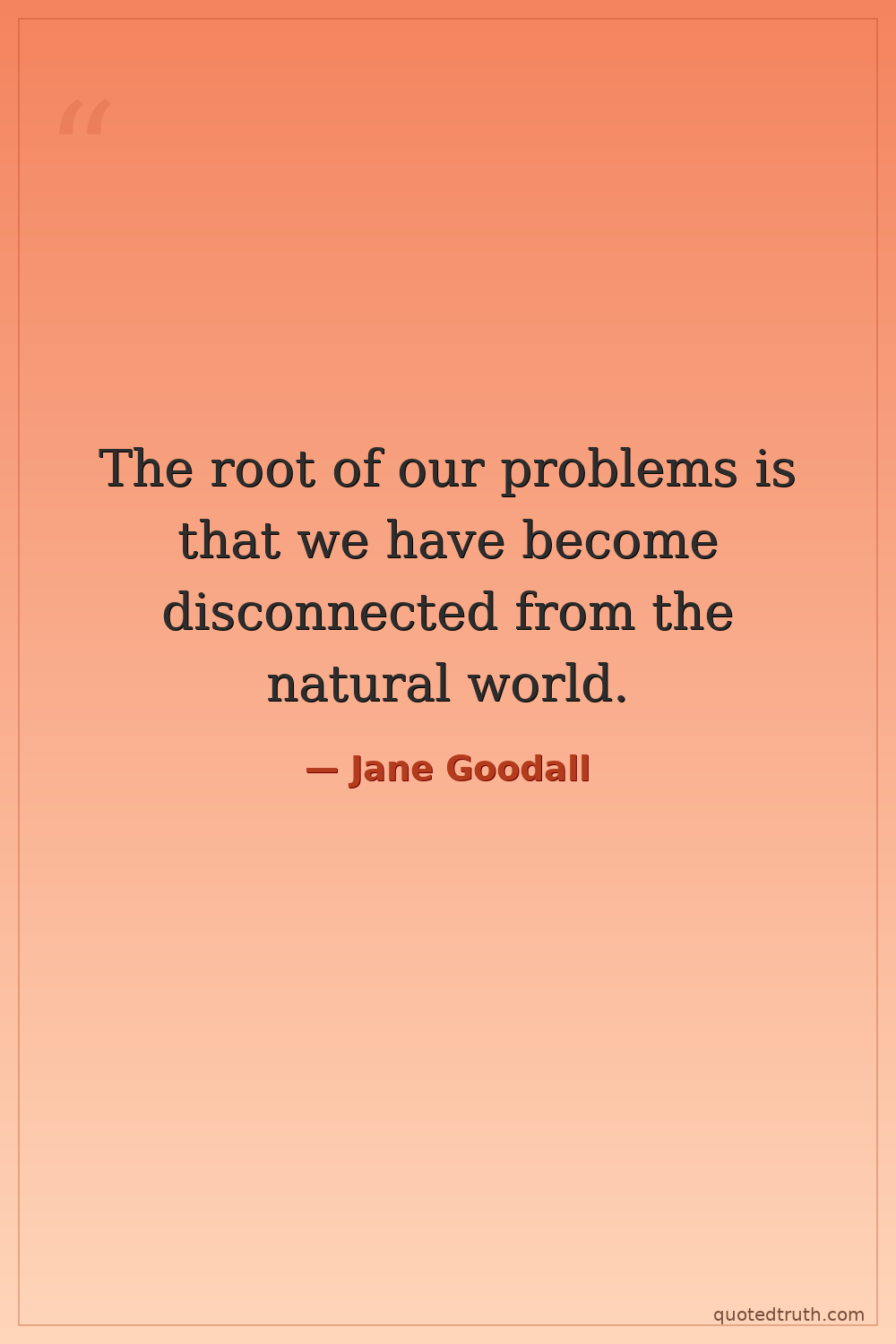
Jane Goodall — "The root of our problems is that we have become disconnected from the natural wo…"
The root of our problems is that we have become disconnected from the natural world.
The root of our problems is that we have become disconnected from the natural world.
Click any product to generate a realistic preview. Up to 3 at a time.
* Initial load can take up to 90 seconds — revising the preview in another color is nearly instant.
"I'm often asked if I get lonely out in the field. And the answer is no, because I'm surrounded by life."
"The future depends on what we do in the present."
"The natural world is a source of wonder and inspiration, and we need to protect it."
"If we don't change our ways, we are heading for disaster."
"We are at a critical point in time. We need to act now to save the planet."
British primatologist who in 1960 began the longest-running wild primate study at Gombe Stream, transforming our understanding of chimpanzees. Closely associated with Dian Fossey (mountain-gorilla researcher) and Birutė Galdikas (orangutan researcher; together with Goodall and Fossey one of Louis Leakey's 'Trimates'). For an intellectual contrast, see Walter Palmer, American dentist who killed Cecil the Lion in Zimbabwe in 2015 — Palmer represents the trophy-hunting tradition Goodall's life's work has been organized against — the colonial-era hunter-naturalist worldview that treated primates and big game as specimens or trophies, which Goodall's Roots & Shoots and Jane Goodall Institute exist specifically to displace.
Found in 1 providers: grok
1 source checked
Humanity's greatest challenges — environmental destruction, climate change, social dysfunction — stem from losing our intimate relationship with nature. When people stop experiencing the natural world firsthand, they make harmful decisions without feeling their consequences. This is not just about ecology; it is about the psychological and moral grounding that contact with nature provides. Restoring that bond is a prerequisite for solving problems, not merely a byproduct of doing so.
Goodall spent decades living inside Gombe Stream forest, observing chimpanzees so closely she named individuals like David Greybeard and documented their emotions and social bonds. That immersion shaped her conviction that proximity to nature builds empathy essential for protecting it. After her research years, she became a global conservation advocate, arguing that urbanization and screen culture sever exactly the empathy her own fieldwork depended on — making this quote autobiographical.
Goodall began her Gombe research in 1960, during rapid post-war industrialization and suburban expansion that physically distanced Western populations from natural landscapes. By the 1990s and 2000s, when she became a prominent conservation voice, Amazon deforestation, accelerating species extinction, and climate change demanded urgent public engagement. The concurrent explosion of urban digital culture deepened the gap between everyday human experience and ecological reality, making her diagnosis both timely and globally resonant.
AI-generated insights based on extensive research and information for context. Factual errors? Email [email protected].
Your cart is empty