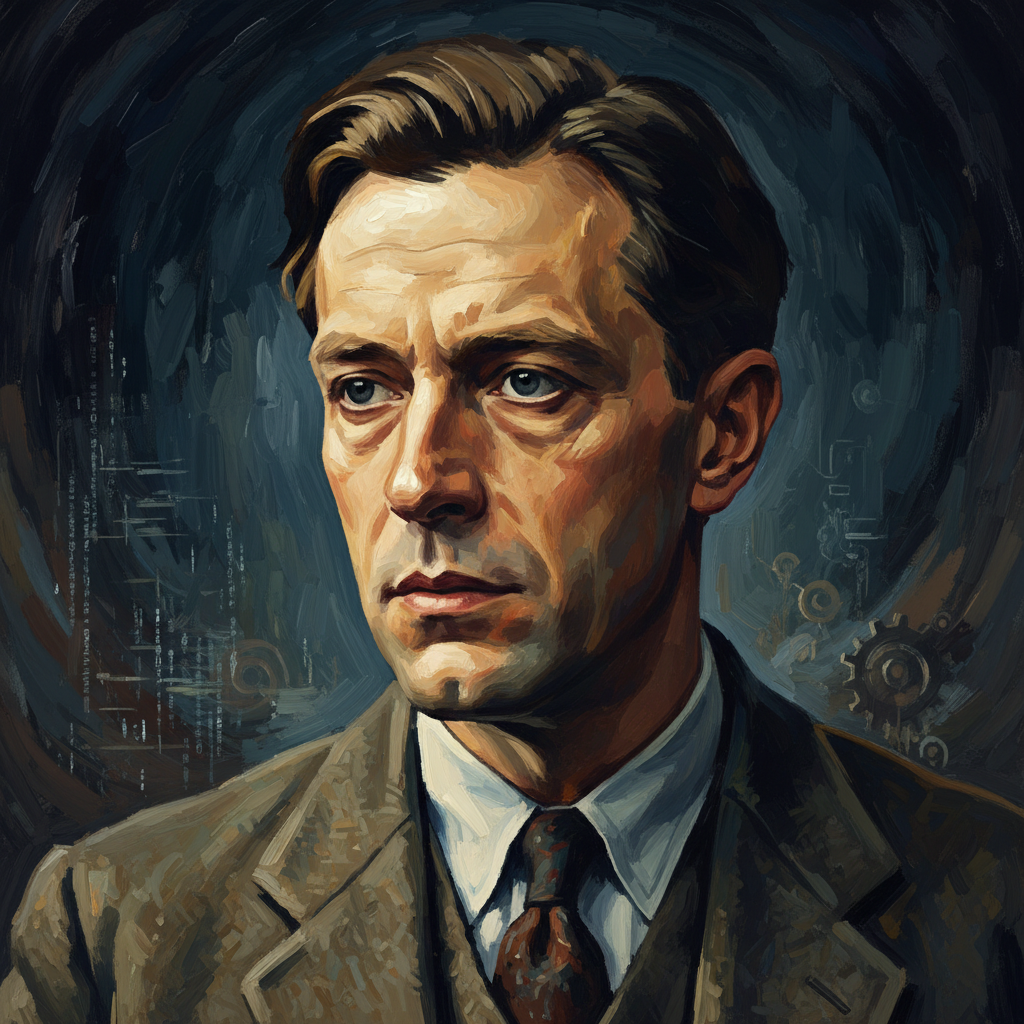
Alan Turing — "The machine has a definite state at any moment, which is determined by the instr…"
The machine has a definite state at any moment, which is determined by the instructions it has received and by the results of its previous operations.
The machine has a definite state at any moment, which is determined by the instructions it has received and by the results of its previous operations.
Click any product to generate a realistic preview. Up to 3 at a time.
* Initial load can take up to 90 seconds — revising the preview in another color is nearly instant.
"The activity of the intuition consists in making spontaneous judgements which are not the result of conscious trains of reasoning. These judgments are often but by no means invariably correct…"
"Possibly a machine might be made to enjoy this delicious dish, but any attempt to make one do so would be idiotic."
"No, I am not interested in developing a powerful brain. All I am interested in is a rather crude imitation of a child's brain."
"The view that machines cannot give rise to surprises is due, I believe, to a fallacy to which philosophers and mathematicians are particularly subject."
"The most important thing for a mathematician is intuition."
Found in 1 providers: grok
1 source checked
At any given moment, a machine's current condition is entirely the product of two things: the commands it was given and the outcomes of everything it has already done. There is no randomness, no hidden influence — its present state is fully traceable to its past inputs and operations. Behavior is deterministic, predictable, and explainable through logical cause and effect.
Turing formalized this principle in his 1936 paper introducing the Turing machine, the theoretical foundation of modern computing. His entire career — from cracking Enigma at Bletchley Park to designing the ACE computer — depended on this deterministic logic. He believed mind and machine could be understood through formal rules, which drove his later work on machine intelligence and the Turing Test.
Turing wrote during the 1930s–50s, when computing was purely theoretical and the first electronic computers were being built. World War II demonstrated that deterministic logical machines could break complex ciphers and alter history. The postwar era saw governments and scientists wrestling with what machines could and could not do — Turing's deterministic framework became the conceptual bedrock of the entire digital age.
AI-generated insights based on extensive research and information for context. Factual errors? Email [email protected].
Your cart is empty