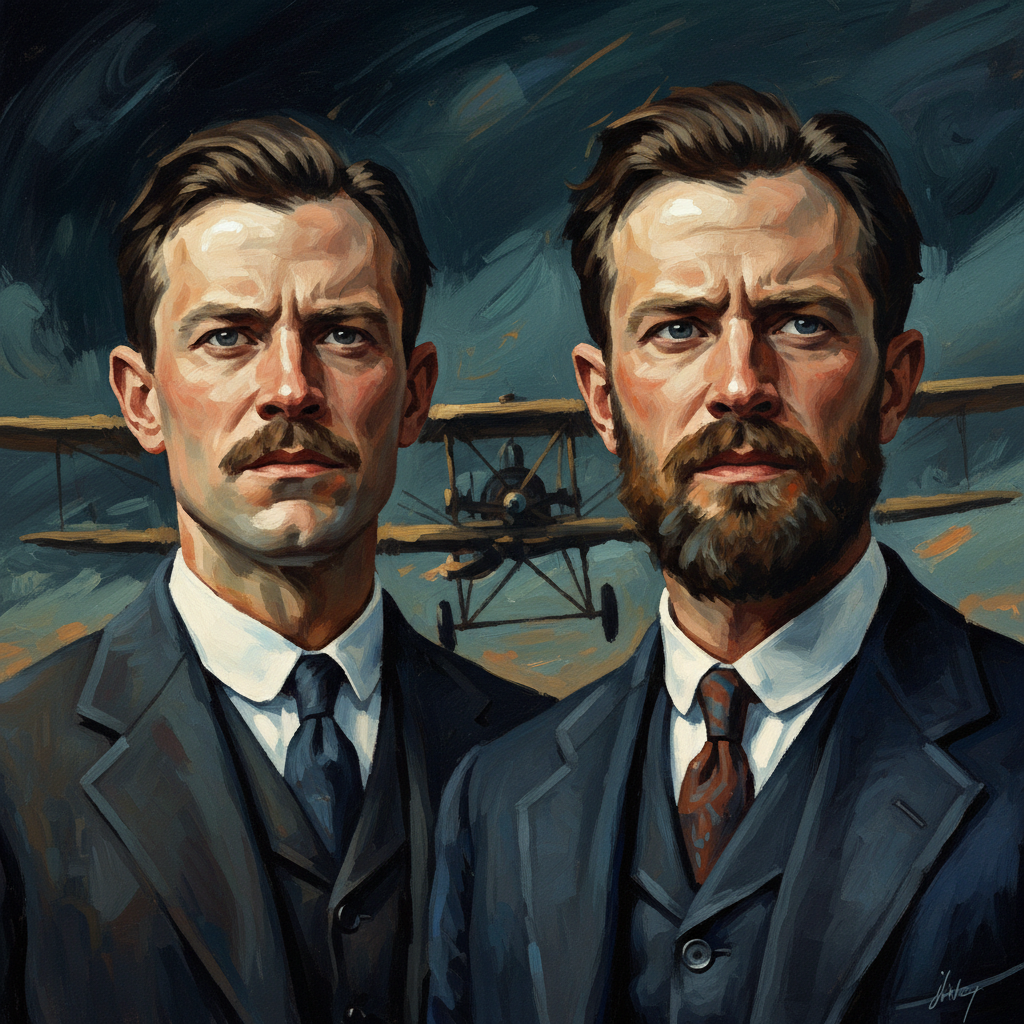
Wright Brothers (Orville & Wilbur) — "The machine itself is but a tool, the spirit that controls it is the thing."
The machine itself is but a tool, the spirit that controls it is the thing.
The machine itself is but a tool, the spirit that controls it is the thing.
Click any product to generate a realistic preview. Up to 3 at a time.
* Initial load can take up to 90 seconds — revising the preview in another color is nearly instant.
"The greatest value of our experiments has been their negative results."
"Learning the secret of flight from a bird was a good deal like learning the secret of magic from a magician—something the magician won't tell, and the bird can't tell."
"We could not but feel that the time was at hand for man to make a practical flight."
"The machine is under perfect control and can be turned in any direction at will."
"The only way to learn to fly is to fly."
American aviation pioneers who achieved the first sustained powered controlled airplane flight at Kitty Hawk, NC, on December 17, 1903. Closely associated with Octave Chanute (their gliding mentor and aeronautical correspondent). For an intellectual contrast, see Samuel Pierpont Langley, Smithsonian Institution Secretary and government-funded aviation researcher — Langley's Aerodrome crashed twice into the Potomac in October-December 1903 with $50,000 of War Department funding; the Wright Brothers' bicycle-shop empiricism beat Langley's institutional Big Science by 9 days. The most-cited example in engineering history of empirical-tinkerer beating institution-funded credentialism.
Found in 1 providers: grok
1 source checked
A machine or piece of technology is just an instrument, no more meaningful than a hammer sitting on a shelf. What gives it purpose, direction, and worth is the human operating it — their judgment, courage, intention, and skill. Without that guiding spirit, even the most advanced invention accomplishes nothing. The tool amplifies the person, but it is the person who decides what gets built, attempted, or achieved.
The Wrights spent years hand-building gliders and engines, yet always insisted their real breakthrough was learning to pilot — mastering three-axis control through their own bodies and nerve. While rivals like Langley poured money into bigger machines, Orville and Wilbur practiced on Kitty Hawk dunes until flying became instinctive. They saw themselves as aviators first, engineers second, believing the pilot's trained judgment, not horsepower, would conquer the air.
At the turn of the twentieth century, industrial America worshipped machinery — factories, locomotives, telegraphs — as if mechanical progress alone defined civilization. Inventors chased bigger engines and patents while newspapers mocked heavier-than-air flight as fantasy. The Wrights worked in this climate of machine-fetishism yet quietly rejected it, emphasizing pilot skill and empirical wind-tunnel testing over brute mechanical force, which was why their 1903 Flyer succeeded where well-funded government projects spectacularly crashed.
AI-generated insights based on extensive research and information for context. Factual errors? Email [email protected].
Your cart is empty