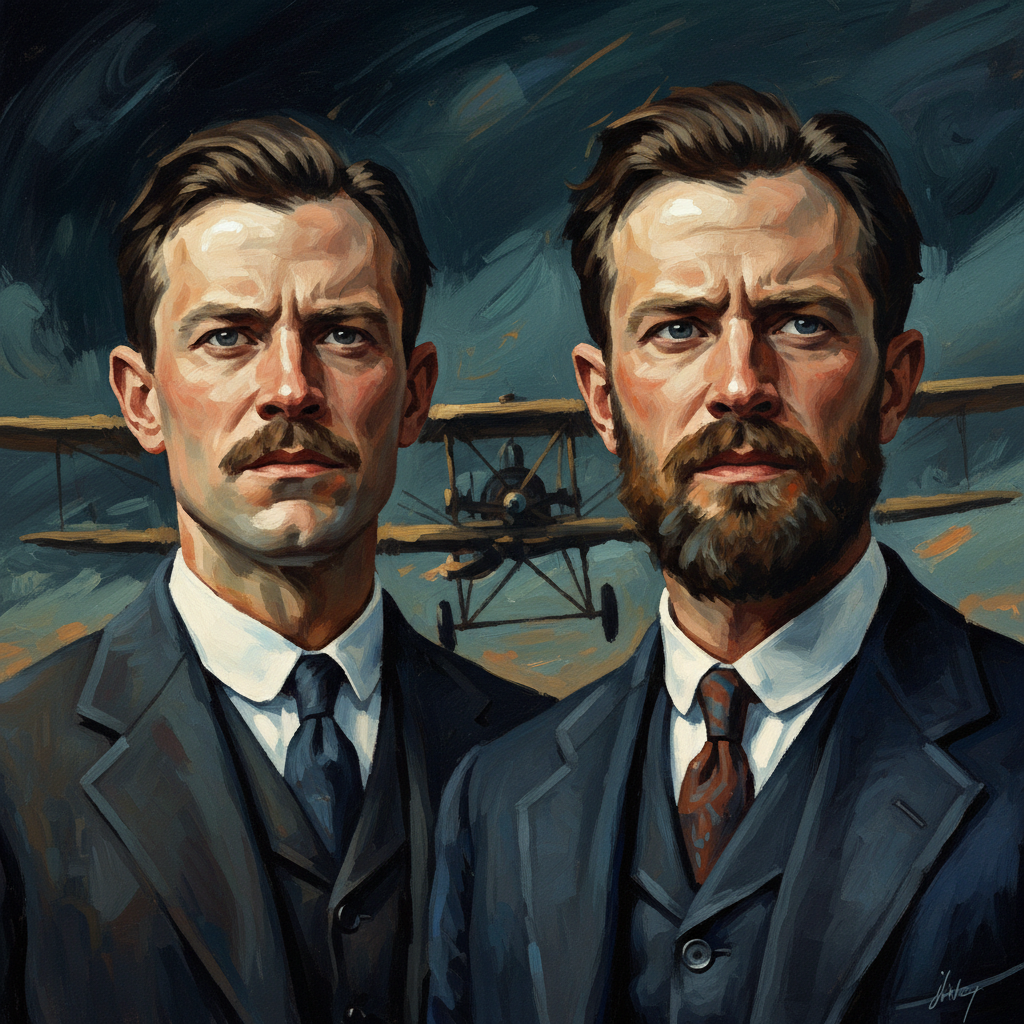
Wright Brothers (Orville & Wilbur) — "We could not but feel that the time was at hand for man to make a practical flig…"
We could not but feel that the time was at hand for man to make a practical flight.
We could not but feel that the time was at hand for man to make a practical flight.
Click any product to generate a realistic preview. Up to 3 at a time.
* Initial load can take up to 90 seconds — revising the preview in another color is nearly instant.
"We have hopes of making a flight of considerable length before long."
"The first great principle of success in flying is to learn to soar without power."
"We were not looking for fame, but we were looking for knowledge."
"The course of the experiment was not always smooth. The machine would start all right, but the propelling power was not sufficient to overcome the resistance of the air."
"The machine is now a commercial success."
American aviation pioneers who achieved the first sustained powered controlled airplane flight at Kitty Hawk, NC, on December 17, 1903. Closely associated with Octave Chanute (their gliding mentor and aeronautical correspondent). For an intellectual contrast, see Samuel Pierpont Langley, Smithsonian Institution Secretary and government-funded aviation researcher — Langley's Aerodrome crashed twice into the Potomac in October-December 1903 with $50,000 of War Department funding; the Wright Brothers' bicycle-shop empiricism beat Langley's institutional Big Science by 9 days. The most-cited example in engineering history of empirical-tinkerer beating institution-funded credentialism.
Found in 1 providers: grok
1 source checked
The Wright Brothers sensed that decades of theoretical study, gliding experiments, and engineering progress had finally converged to the point where sustained, controlled, powered human flight was no longer a distant dream but an achievable engineering challenge. They believed the moment had arrived to stop speculating and actually fly a heavier-than-air machine under its own power, with a pilot aboard, in genuine controlled flight.
Orville and Wilbur ran a Dayton bicycle shop while methodically tackling flight, building wind tunnels, testing over 200 wing shapes, and refining three-axis control. Unlike rivals chasing prizes, they treated aviation as a solvable engineering problem. By 1903, after years of glider trials at Kitty Hawk, they were confident their data, propeller designs, and lightweight engine made powered flight not just possible but imminent and practical.
At the turn of the 20th century, inventors worldwide raced toward powered flight. Otto Lilienthal had died gliding in 1896, Samuel Langley's government-funded Aerodrome failed publicly weeks before Kitty Hawk, and skeptics including the New York Times mocked the pursuit. Yet internal combustion engines, lightweight materials, and aerodynamic theory were maturing rapidly, making the Wrights' confidence that practical flight was finally within human reach both bold and accurate.
AI-generated insights based on extensive research and information for context. Factual errors? Email [email protected].
Your cart is empty