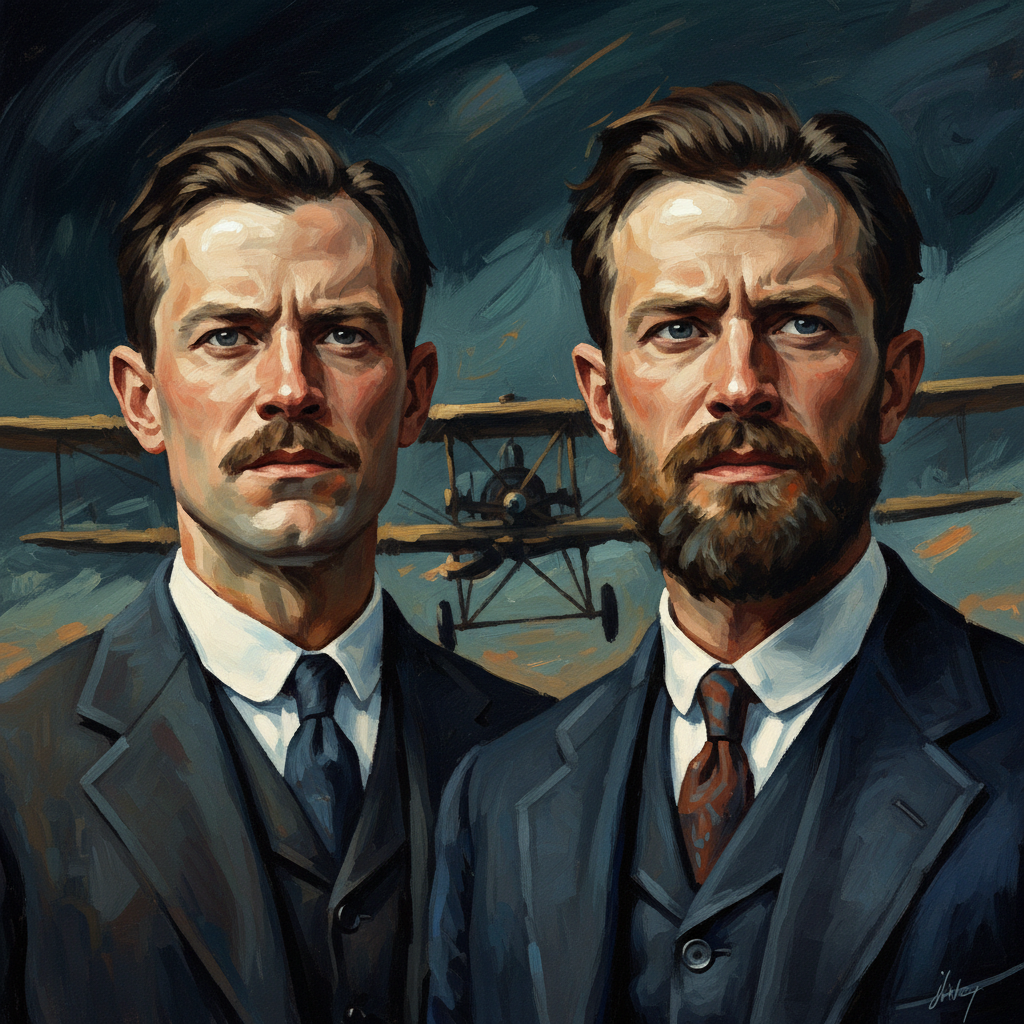
Wright Brothers (Orville & Wilbur) — "The only way to learn to fly is to fly."
The only way to learn to fly is to fly.
The only way to learn to fly is to fly.
Click any product to generate a realistic preview. Up to 3 at a time.
* Initial load can take up to 90 seconds — revising the preview in another color is nearly instant.
"The problem was not to build a machine that would fly, but to build a machine that would fly safely."
"We have been out almost every day experimenting, and have made about 100 flights."
"The best dividends on the labor invested have invariably come from seeking more knowledge rather than more power."
"It is not the man who has done the most, but the man who has done the best, who is most deserving of praise."
"Success in inventing depends on the close observation of nature."
American aviation pioneers who achieved the first sustained powered controlled airplane flight at Kitty Hawk, NC, on December 17, 1903. Closely associated with Octave Chanute (their gliding mentor and aeronautical correspondent). For an intellectual contrast, see Samuel Pierpont Langley, Smithsonian Institution Secretary and government-funded aviation researcher — Langley's Aerodrome crashed twice into the Potomac in October-December 1903 with $50,000 of War Department funding; the Wright Brothers' bicycle-shop empiricism beat Langley's institutional Big Science by 9 days. The most-cited example in engineering history of empirical-tinkerer beating institution-funded credentialism.
Attributed, but precise source and exact phrasing are difficult to verify.
Date: Disputed
GeneralFound in 1 providers: grok
1 source checked
Real mastery comes from hands-on practice, not just theory or observation. You can study manuals, watch others, and memorize every technical principle, but genuine understanding only clicks when you actually attempt the thing yourself. Mistakes made in action teach what no book can. The quote champions trial-and-error learning over passive preparation — the idea that doing something imperfectly is more valuable than waiting until you feel ready to do it perfectly.
Orville and Wilbur Wright were self-taught bicycle mechanics from Dayton, Ohio — no engineering degrees, no government funding. They learned flight by doing it: building gliders, crashing them, adjusting, and flying again. At Kill Devil Hills they made hundreds of test glides before attempting powered flight. Their December 17, 1903 success came from relentless iteration, not pure theory. Every crash was a lesson. They embodied this principle more completely than anyone in history.
In the early 1900s, heavier-than-air powered flight was widely dismissed as impossible. The Smithsonian-backed Samuel Langley had just failed publicly and expensively. No established academic framework for aeronautics existed — wind tunnel data was primitive and aerodynamics barely understood. The Industrial Revolution had given engineers powerful tools but not yet answers for flight. In that vacuum of knowledge, experiential learning wasn't just practical wisdom — it was the only path forward.
AI-generated insights based on extensive research and information for context. Factual errors? Email [email protected].
Your cart is empty