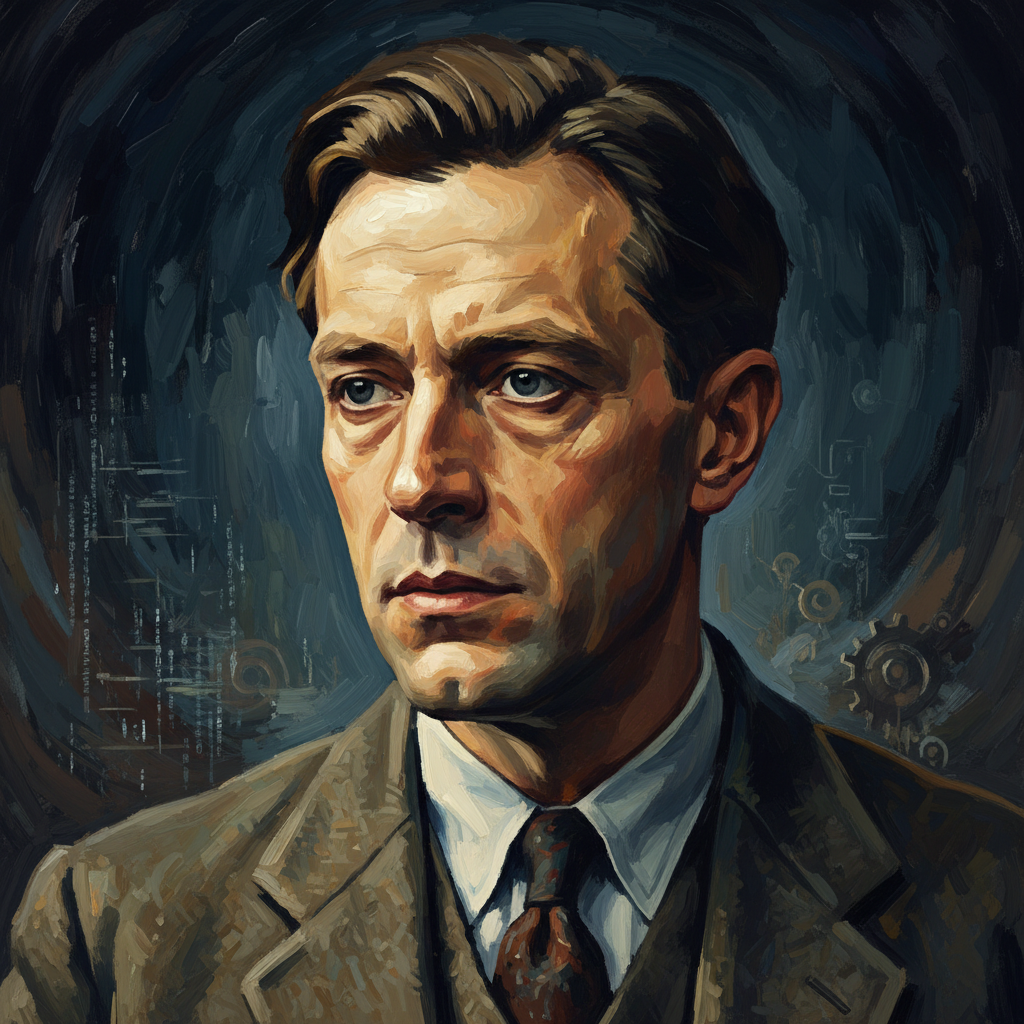
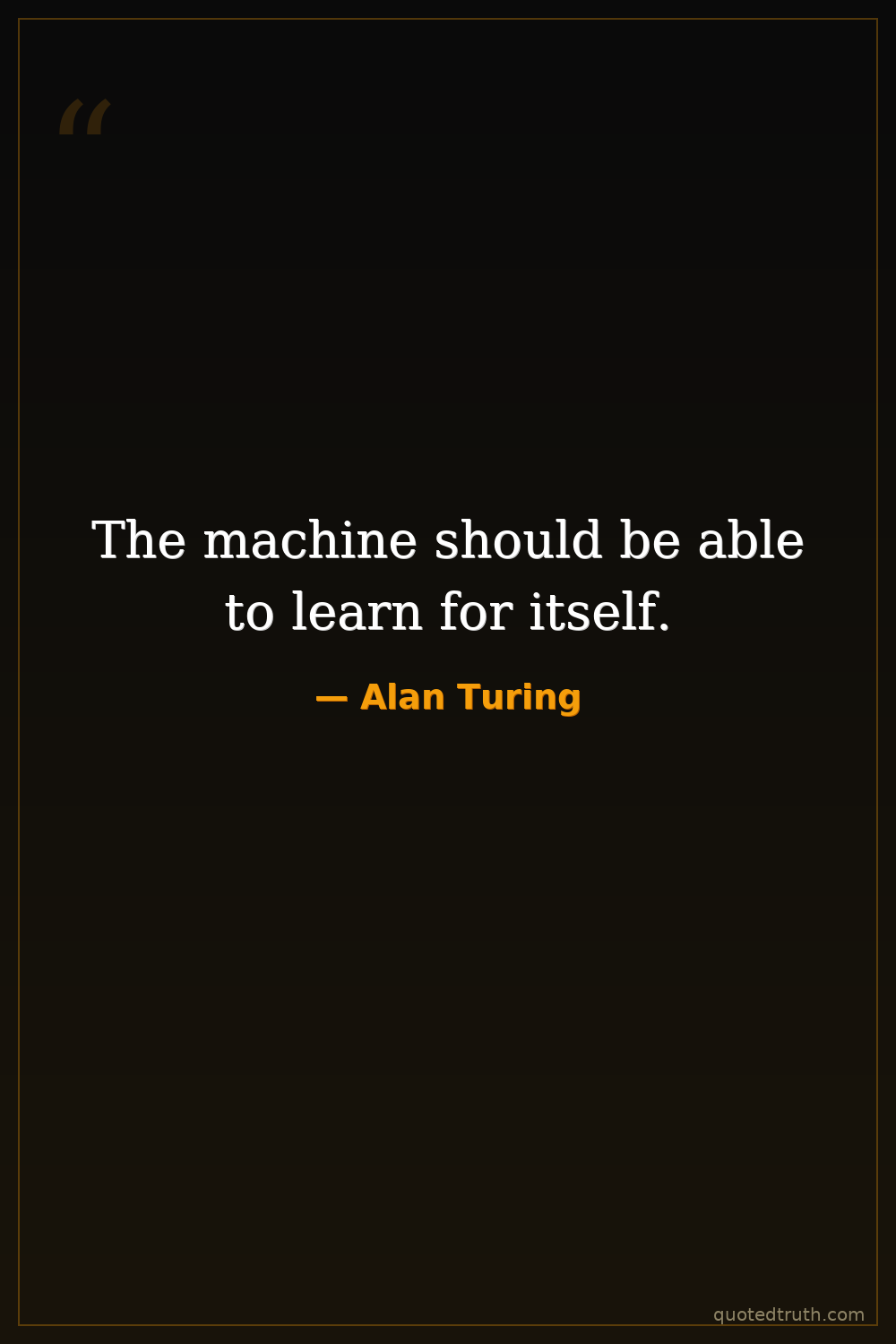
Alan Turing — "The machine should be able to learn for itself."
The machine should be able to learn for itself.
The machine should be able to learn for itself.
Click any product to generate a realistic preview. Up to 3 at a time.
* Initial load can take up to 90 seconds — revising the preview in another color is nearly instant.
"A computer is a universal machine. It can do anything that can be described as a computation."
"I am not afraid of computers. I am afraid of the people who program them."
"The machine cannot do anything new."
"Mathematical reasoning may be regarded rather schematically as the exercise of a combination of two facilities, which we may call intuition and ingenuity. The activity of the intuition consists in mak…"
"The problem of creating intelligent machines is one of the most challenging and exciting problems in all of science."
Attributed, general implication from his writings on machine learning, but exact quote is elusive.
Date: Approx. 1950
ShockingFound in 1 providers: grok
1 source checked
A machine should not need every answer pre-programmed — it should improve through exposure to data and experience, discovering patterns on its own. Intelligence, Turing argued, means adapting rather than executing fixed instructions. This is the core premise of modern machine learning: instead of writing explicit rules, you train a system on examples and let it build its own model of the world.
Turing proposed this in his 1950 paper 'Computing Machinery and Intelligence,' the same paper introducing the Turing Test. His wartime work at Bletchley Park — building the Bombe to break Enigma — showed him that adaptive systems outperformed rigid ones. He genuinely believed machines could achieve human-level thought, and self-learning was the necessary mechanism. This conviction defined his entire research vision and made him the philosophical father of AI.
In 1950, computers were enormous vacuum-tube machines executing only fixed programs — there was no AI field, no neural networks, no concept of training data. The world was entering the Cold War, and government interest in computation was driven by code-breaking and ballistics. Turing's suggestion that machines should learn challenged every assumption of the era, foreshadowing a revolution in computing that would not fully arrive for another thirty years.
AI-generated insights based on extensive research and information for context. Factual errors? Email [email protected].
Your cart is empty