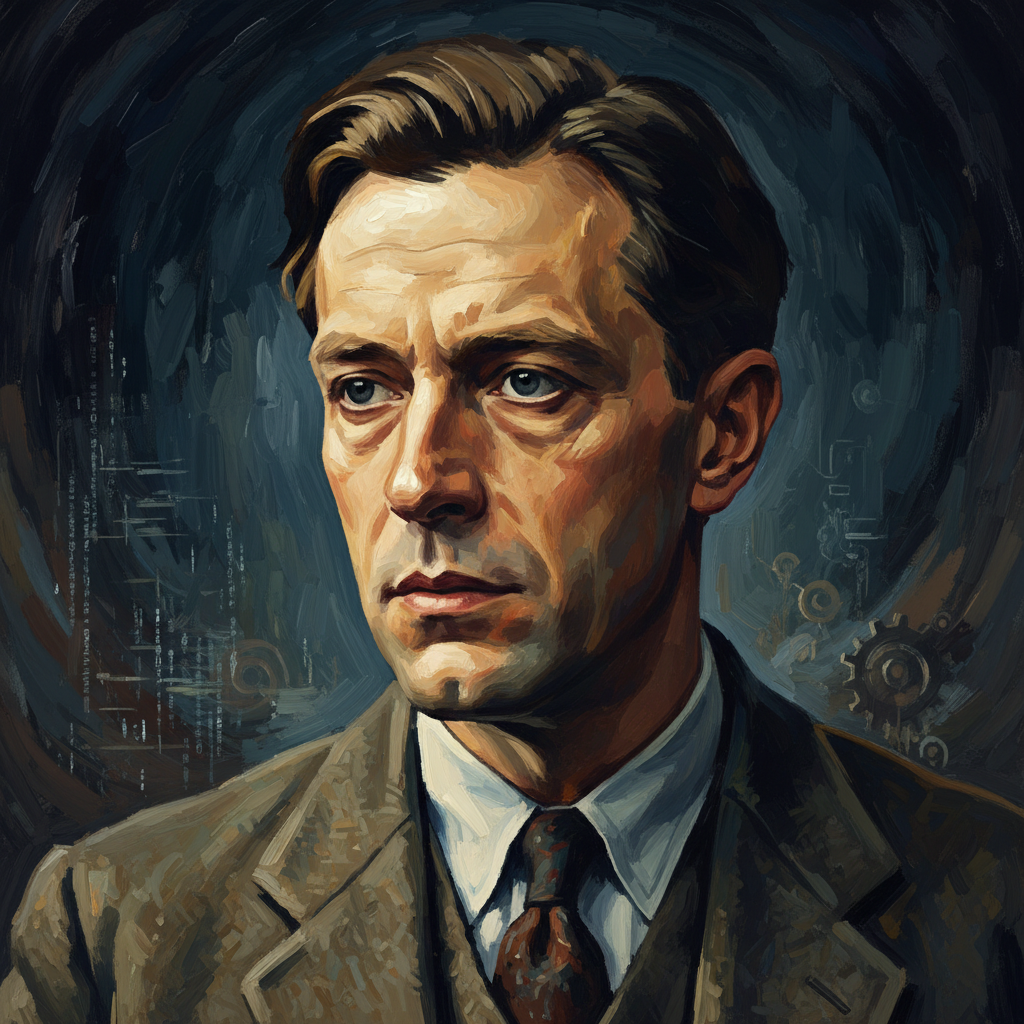
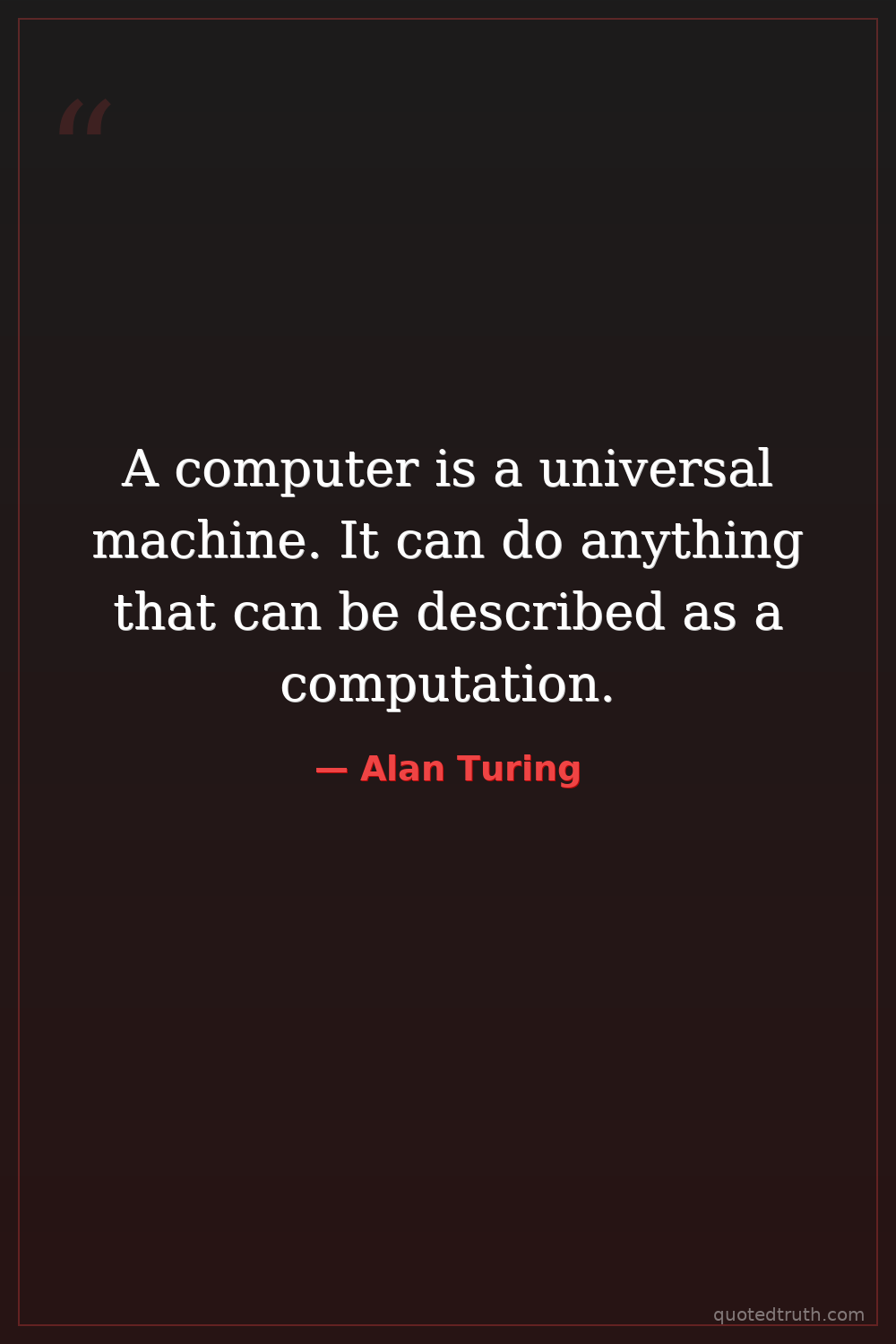
Alan Turing — "A computer is a universal machine. It can do anything that can be described as a…"
A computer is a universal machine. It can do anything that can be described as a computation.
A computer is a universal machine. It can do anything that can be described as a computation.
Click any product to generate a realistic preview. Up to 3 at a time.
* Initial load can take up to 90 seconds — revising the preview in another color is nearly instant.
"The activity of the intuition consists in making spontaneous judgements which are not the result of conscious trains of reasoning. These judgments are often but by no means invariably correct…"
"The question of whether machines can think is a philosophical one, not a scientific one."
"In the time of Galileo it was argued that the texts, 'And the sun stood still ... and hasted not to go down about a whole day' (Joshua x. 13) and 'He laid the foundations of the earth, that it should …"
"It seems probable that once the machine thinking method had started, it would not take long to outstrip our feeble powers and would take control."
"The possibility of a machine thinking is a disturbing thought for many people."
Found in 1 providers: grok
1 source checked
A computer isn't limited to one task — it's a general-purpose engine capable of executing any process that can be formally expressed as a sequence of steps. This principle underlies every modern device: the same hardware runs video games, processes medical scans, and writes documents, because computation itself is universal. If you can precisely describe what you want done, a computer can, in principle, do it.
Turing formalized this in 1936 with the Universal Turing Machine — a theoretical model proving one machine could simulate any other given sufficient memory and time. During World War II he applied it practically, designing the Bombe machines at Bletchley Park to break Nazi Enigma ciphers. His 1950 paper proposing the Turing Test pushed further: if computation is universal, could it simulate human thought itself?
In the 1930s–1950s, computers were enormous single-purpose machines: one calculated artillery tables, another tabulated census data. The notion that one architecture could replace all of them was radical. World War II accelerated the field — cracking Axis codes demanded programmable machines. Turing's theoretical framework arrived just as physical hardware became feasible, giving engineers a mathematical blueprint for the universal, programmable computers that defined the entire digital age.
AI-generated insights based on extensive research and information for context. Factual errors? Email [email protected].
Your cart is empty