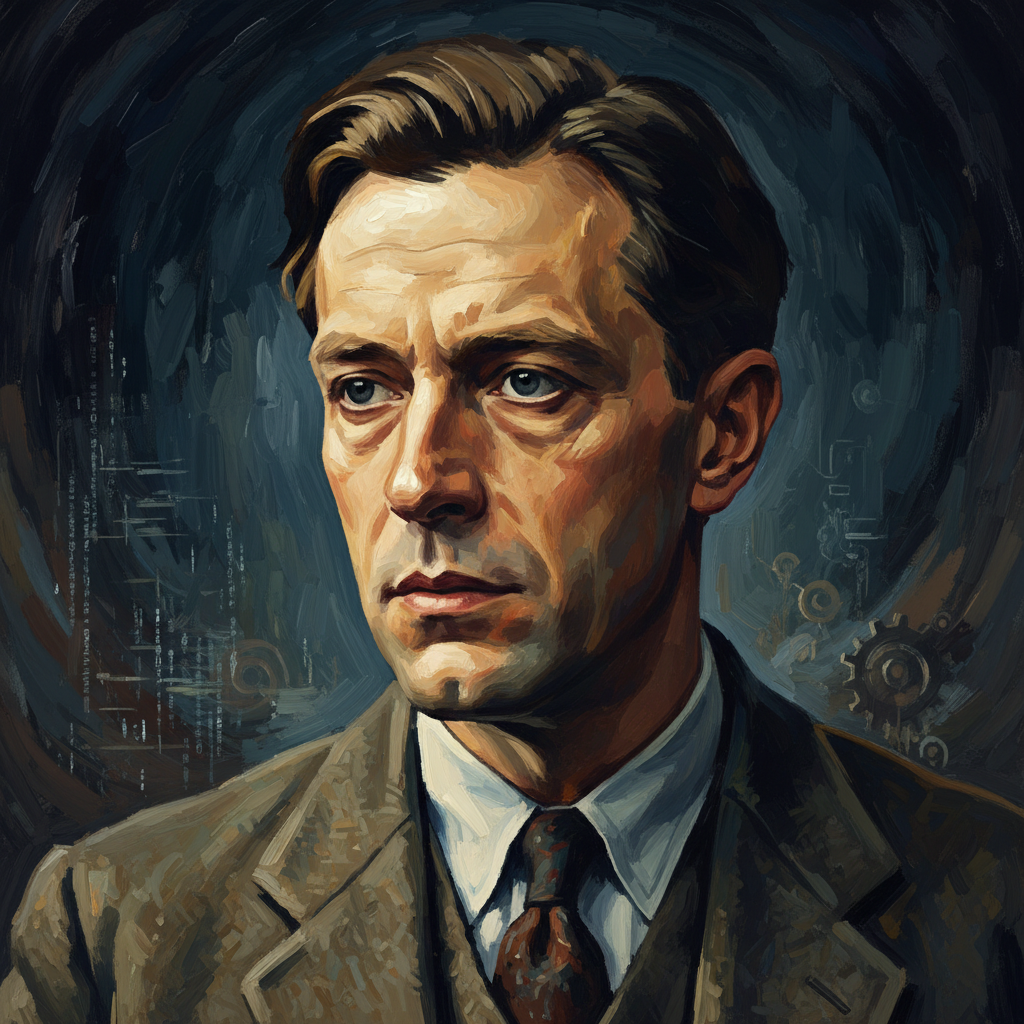
Alan Turing — "The machine will eventually be able to do anything that a human can do."
The machine will eventually be able to do anything that a human can do.
The machine will eventually be able to do anything that a human can do.
Click any product to generate a realistic preview. Up to 3 at a time.
* Initial load can take up to 90 seconds — revising the preview in another color is nearly instant.
"I am not interested in whether a machine can think, but in whether it can make me think."
"I've now got myself into the kind of trouble that I have always considered to be quite a possibility for me, though I have usually rated it at about 10:1 against."
"The future of computing lies in the development of intelligent machines."
"The machine should be able to learn for itself."
"Logic will get you from A to B. Imagination will take you everywhere."
Attributed, general implication from his writings, but exact quote is elusive.
Date: Approx. 1950s
ShockingFound in 1 providers: grok
1 source checked
Machines will eventually replicate every cognitive capability humans possess — not just computation, but reasoning, creativity, language, and judgment. Intelligence is not uniquely biological; it is a process that can be mechanized. Given sufficient development, artificial systems will match human mental performance across all domains. This is a bold rejection of the idea that human thought is fundamentally special or unreproducible by non-organic systems.
Turing spent his career building the theoretical and practical foundations for this claim. His 1936 Turing machine formalized computation itself. His 1950 paper 'Computing Machinery and Intelligence' proposed the Turing Test — a direct operationalization of this belief. He worked on early stored-program computers at Manchester University. His entire intellectual project assumed intelligence was substrate-independent: a formal process, not a mystical human property.
In the late 1940s and early 1950s, the first electronic computers were just emerging — ENIAC, the Manchester Mark 1, the Cambridge EDSAC. Most scientists, philosophers, and the public viewed human thought as categorically beyond mechanical replication, often for religious or philosophical reasons. Norbert Wiener's cybernetics and Shannon's information theory were opening new frameworks, but claiming machines would fully equal humans was genuinely radical and widely dismissed.
AI-generated insights based on extensive research and information for context. Factual errors? Email [email protected].
Your cart is empty