Confucius — "The Master said, 'He who acts with a constant view to his own advantage will be …"
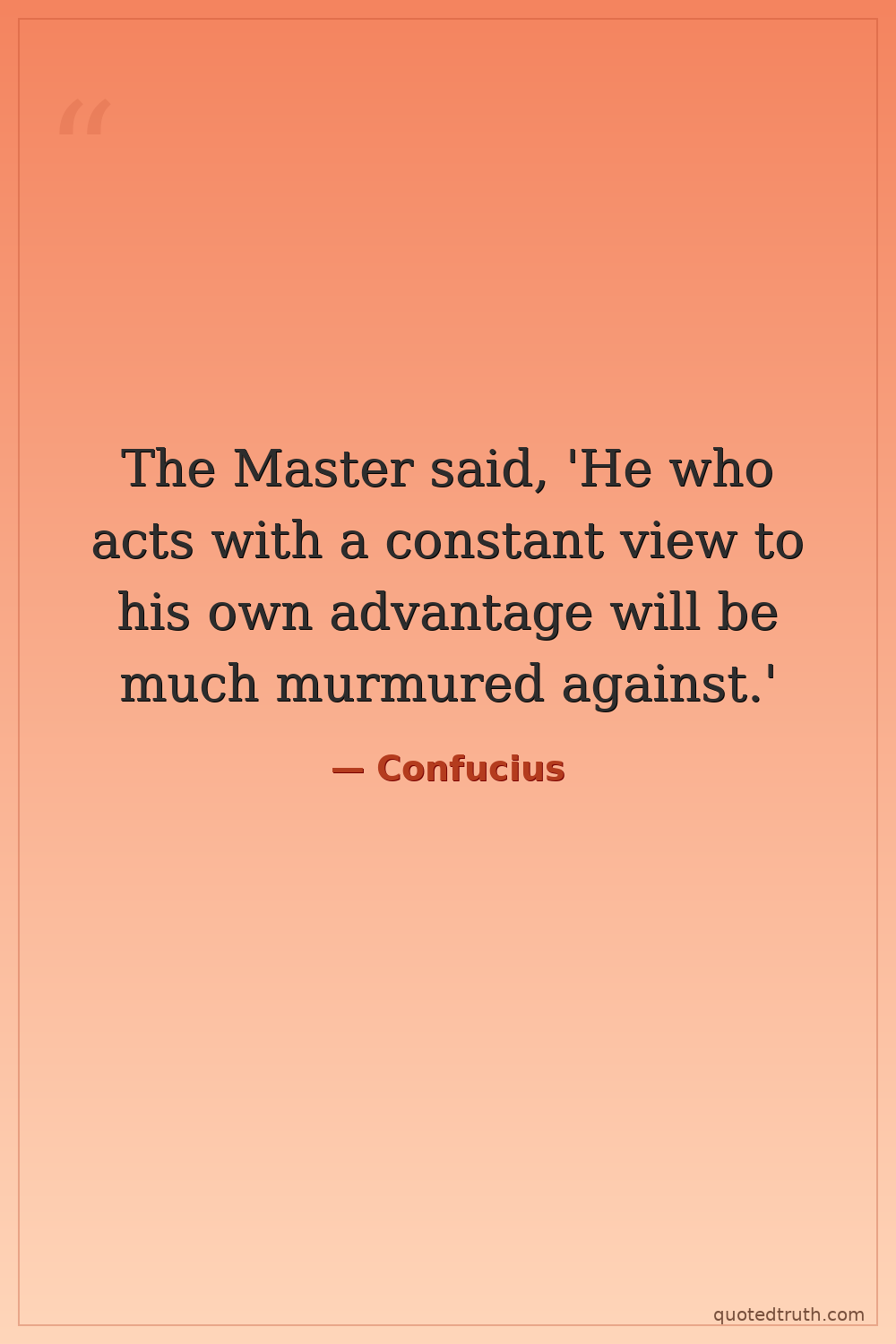
The Master said, 'He who acts with a constant view to his own advantage will be much murmured against.'
The Master said, 'He who acts with a constant view to his own advantage will be much murmured against.'
Click any product to generate a realistic preview. Up to 3 at a time.
* Initial load can take up to 90 seconds — revising the preview in another color is nearly instant.
"It is not possible for one to be a gentleman and yet not be benevolent."
"When you see a good person, think of becoming like her/him. When you see someone not so good, reflect on your own weak points."
"The superior man has a proper pride, but is not proud."
"A man without constancy cannot be a diviner or a physician."
"What the gentleman wants is in himself, what the small man wants is in others."
Chinese philosopher and teacher whose teachings (compiled by his students in the Analects) became the foundational ethical framework of East Asian civilization for 2,500 years. Closely associated with Mencius (his most-influential follower a century later). For an intellectual contrast, see Laozi, near-contemporary Chinese sage and Tao Te Ching author — Confucius systematized social order through ritual and family hierarchy; Laozi's Taoist effortless-action philosophy argued such systems were the disease, not the cure. The two founding poles of Chinese moral philosophy — every East Asian moral tradition since has positioned itself between them.
The standard scholarly entry points to Confucius's work: Philip J. Ivanhoe (Georgetown, Chinese philosophy) — Confucian Moral Self Cultivation (2000); Edward Slingerland (UBC, Asian Studies) — Effortless Action: Wu-wei as Conceptual Metaphor (2003); Tu Weiming (Harvard, Confucian scholar) — Confucian Thought: Selfhood as Creative Transformation (1985). These are the works graduate seminars cite when teaching Confucius.
Found in 1 providers: grok
1 source checked
Someone who always makes decisions based purely on personal gain will attract widespread resentment and complaints from others. When you consistently put your own interests first, people notice, feel used, and begin to criticize you behind your back. Self-serving behavior damages your reputation and social standing, even if it brings short-term rewards. Other people's goodwill matters, and chasing advantage at every turn steadily burns through it.
Confucius spent his life teaching that moral character (ren) and righteousness (yi) should guide action rather than profit (li). He traveled between warring states seeking rulers who would govern ethically rather than opportunistically, and was often rejected for refusing expedient advice. As a teacher who accepted students regardless of wealth, he modeled service over self-interest, and his emphasis on the junzi (exemplary person) directly contrasts with the self-seeking figure this saying warns against.
Confucius lived during the late Spring and Autumn period (551-479 BCE), when the Zhou dynasty's authority had collapsed and rival states competed ruthlessly for power. Officials switched loyalties for personal gain, rulers assassinated rivals, and ministers enriched themselves while peasants suffered. Against this backdrop of naked opportunism, Confucius's warning carried real weight: he was rebuilding a moral vocabulary for public life, insisting that social harmony required leaders and citizens who placed duty and virtue above private profit.
AI-generated insights based on extensive research and information for context. Factual errors? Email [email protected].
Your cart is empty