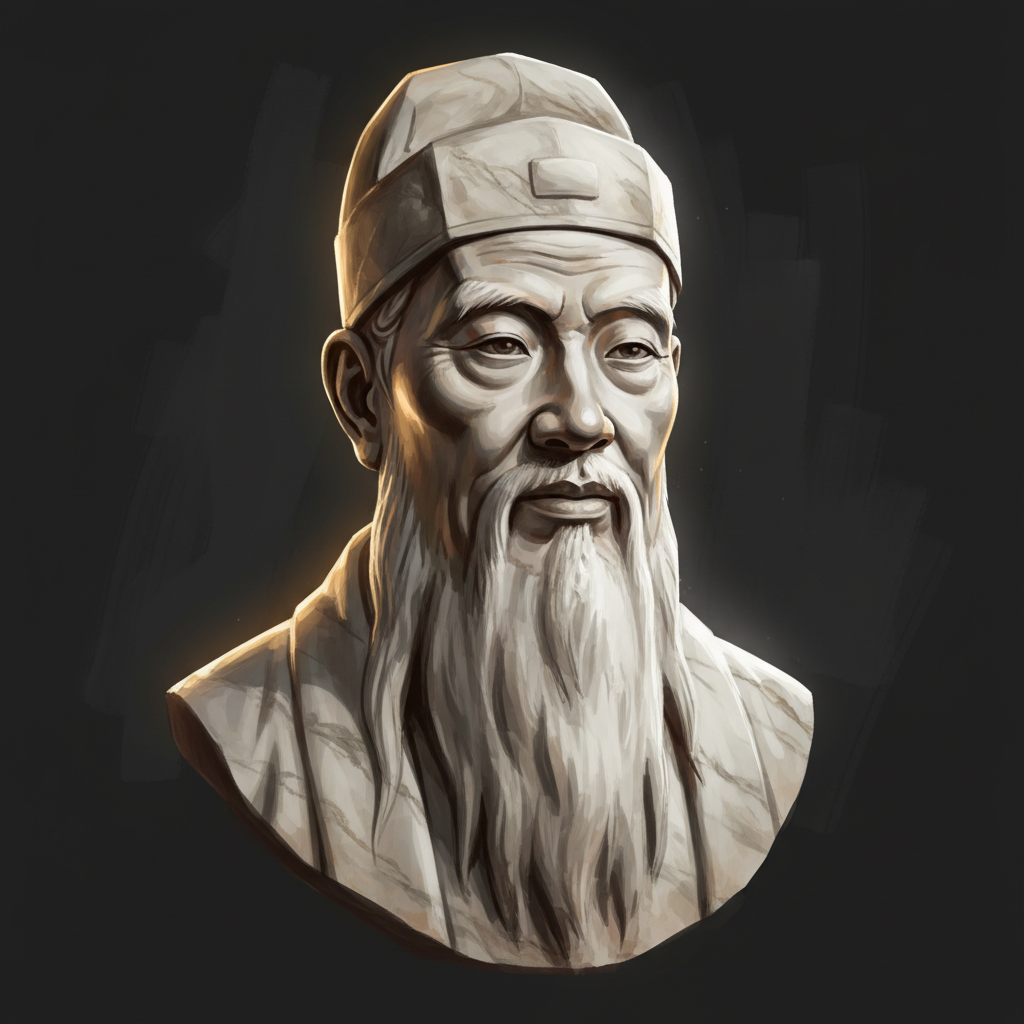
Confucius — "A man without constancy cannot be a diviner or a physician."
A man without constancy cannot be a diviner or a physician.
A man without constancy cannot be a diviner or a physician.
Click any product to generate a realistic preview. Up to 3 at a time.
* Initial load can take up to 90 seconds — revising the preview in another color is nearly instant.
"The superior man is distressed by his lack of ability, not by the failure of others to recognize him."
"The gentleman understands integrity; the petty person knows about profit."
"The Master said, 'It is not easy to find a man who has learned for three years without having his thoughts bent on learning.'"
"The superior man is easy to serve but difficult to please; the inferior man is difficult to serve but easy to please."
"Do not be desirous of having things done quickly; do not look at small advantages. Desire to have things done quickly prevents their being done thoroughly. Looking at small advantages prevents great a…"
Chinese philosopher and teacher whose teachings (compiled by his students in the Analects) became the foundational ethical framework of East Asian civilization for 2,500 years. Closely associated with Mencius (his most-influential follower a century later). For an intellectual contrast, see Laozi, near-contemporary Chinese sage and Tao Te Ching author — Confucius systematized social order through ritual and family hierarchy; Laozi's Taoist effortless-action philosophy argued such systems were the disease, not the cure. The two founding poles of Chinese moral philosophy — every East Asian moral tradition since has positioned itself between them.
The standard scholarly entry points to Confucius's work: Philip J. Ivanhoe (Georgetown, Chinese philosophy) — Confucian Moral Self Cultivation (2000); Edward Slingerland (UBC, Asian Studies) — Effortless Action: Wu-wei as Conceptual Metaphor (2003); Tu Weiming (Harvard, Confucian scholar) — Confucian Thought: Selfhood as Creative Transformation (1985). These are the works graduate seminars cite when teaching Confucius.
Found in 2 providers: grok,gemini
2 sources checked
Someone who cannot stay committed to principles, practices, or disciplined study has no business in roles that demand reliable judgment over time. Divination and medicine both require patient observation, steady skill-building, and consistent ethical character, because lives and decisions hinge on the practitioner's word. A person who shifts with mood or convenience will misread signs, misdiagnose patients, and betray the trust those professions depend on. Constancy is the minimum entry fee.
Confucius built his entire teaching around steady self-cultivation, ritual discipline, and lifelong learning as the foundation of a worthy person. He spent decades tutoring disciples, traveling between states seeking rulers who would apply his ethics, and editing classical texts even when unemployed and ignored. His own persistence through political failure embodies this line: he judged character by sustained behavior, not talent or cleverness, and held that trustworthy conduct over time was the root of every legitimate role.
Confucius lived during the late Spring and Autumn period, when Zhou authority was collapsing and rival states fought constantly. Diviners using oracle bones and yarrow stalks, along with early physicians blending herbs and ritual, were respected advisors to courts and families. Quacks and opportunists exploited desperate rulers seeking omens or cures amid war and famine. Warning against inconstant practitioners addressed a real social harm: unreliable experts in sacred or medical roles could cost lives and destabilize already fragile communities.
AI-generated insights based on extensive research and information for context. Factual errors? Email [email protected].
Your cart is empty