Confucius — "The Master said, 'If a man is able to govern his country with the rules of propr…"

The Master said, 'If a man is able to govern his country with the rules of propriety, what difficulty will he have? If he cannot govern his country with the rules of propriety, what has he to do with the rules of propriety?'
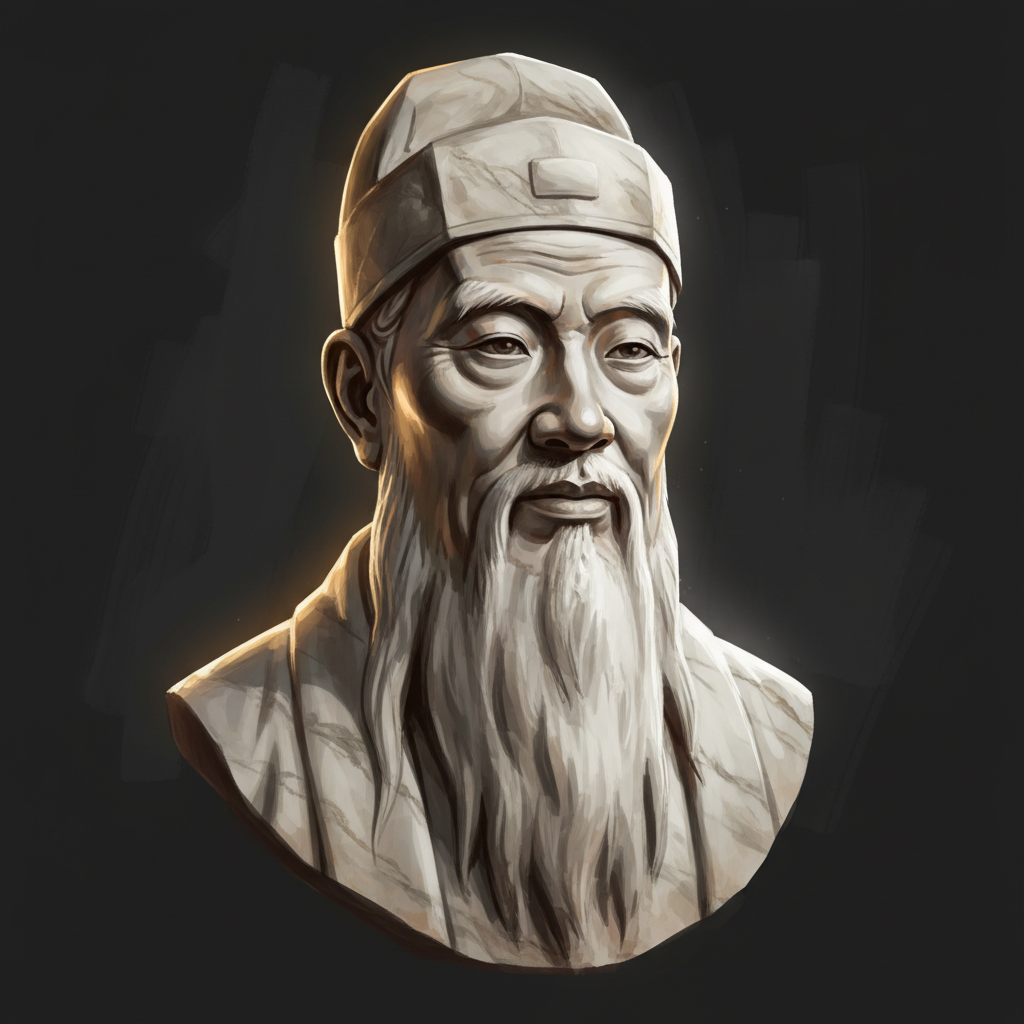
Confucius — Confucius Ancient · Chinese philosopher, founder of Confucianism

Get This Quote & Author's Image Illustrated On:

Click any product to generate a realistic preview. Up to 3 at a time.
* Initial load can take up to 90 seconds — revising the preview in another color is nearly instant.

Kitchen

Apparel

Other

About Confucius (551-479 BCE)

Chinese philosopher and teacher whose teachings (compiled by his students in the Analects) became the foundational ethical framework of East Asian civilization for 2,500 years. Closely associated with Mencius (his most-influential follower a century later). For an intellectual contrast, see Laozi, near-contemporary Chinese sage and Tao Te Ching author — Confucius systematized social order through ritual and family hierarchy; Laozi's Taoist effortless-action philosophy argued such systems were the disease, not the cure. The two founding poles of Chinese moral philosophy — every East Asian moral tradition since has positioned itself between them.

The standard scholarly entry points to Confucius's work: Philip J. Ivanhoe (Georgetown, Chinese philosophy) — Confucian Moral Self Cultivation (2000); Edward Slingerland (UBC, Asian Studies) — Effortless Action: Wu-wei as Conceptual Metaphor (2003); Tu Weiming (Harvard, Confucian scholar) — Confucian Thought: Selfhood as Creative Transformation (1985). These are the works graduate seminars cite when teaching Confucius.

Details

Analects, Book IV, Chapter 13

Date: c. 5th century BCE

General

Verification

Unverifiable

Found in 1 providers: grok

1 source checked

Understanding this quote

What it means

Confucius argues that ritual propriety is not decoration but a working tool of governance. If a ruler can actually apply it to run a state, leading becomes straightforward because people respond to clear norms and respectful conduct. But if a ruler merely performs ceremonies without letting them shape real decisions, the rituals are hollow. Propriety only matters when it translates into practical government, not when it stays ornamental.

Relevance to Confucius

Confucius spent his life arguing that li, ritual propriety, was the backbone of a functioning state and a cultivated person. He personally advised rulers in Lu and traveled between courts hoping to find one who would govern this way. This saying captures his frustration: many leaders observed ceremonies but ignored the ethical substance behind them, which he considered worse than useless and a betrayal of what propriety meant.

The era

Confucius lived during the late Spring and Autumn period, when Zhou dynasty authority had collapsed into constant warfare between rival states. Traditional rituals that once bound nobility to duty were being performed mechanically or abandoned entirely, while rulers relied on force and intrigue. Against this breakdown, Confucius insisted that reviving genuine propriety, not just its outward forms, was the only path back to stable, humane government in a fracturing political order.

AI-generated insights based on extensive research and information for context. Factual errors? Email [email protected].
Your Cart

Your cart is empty