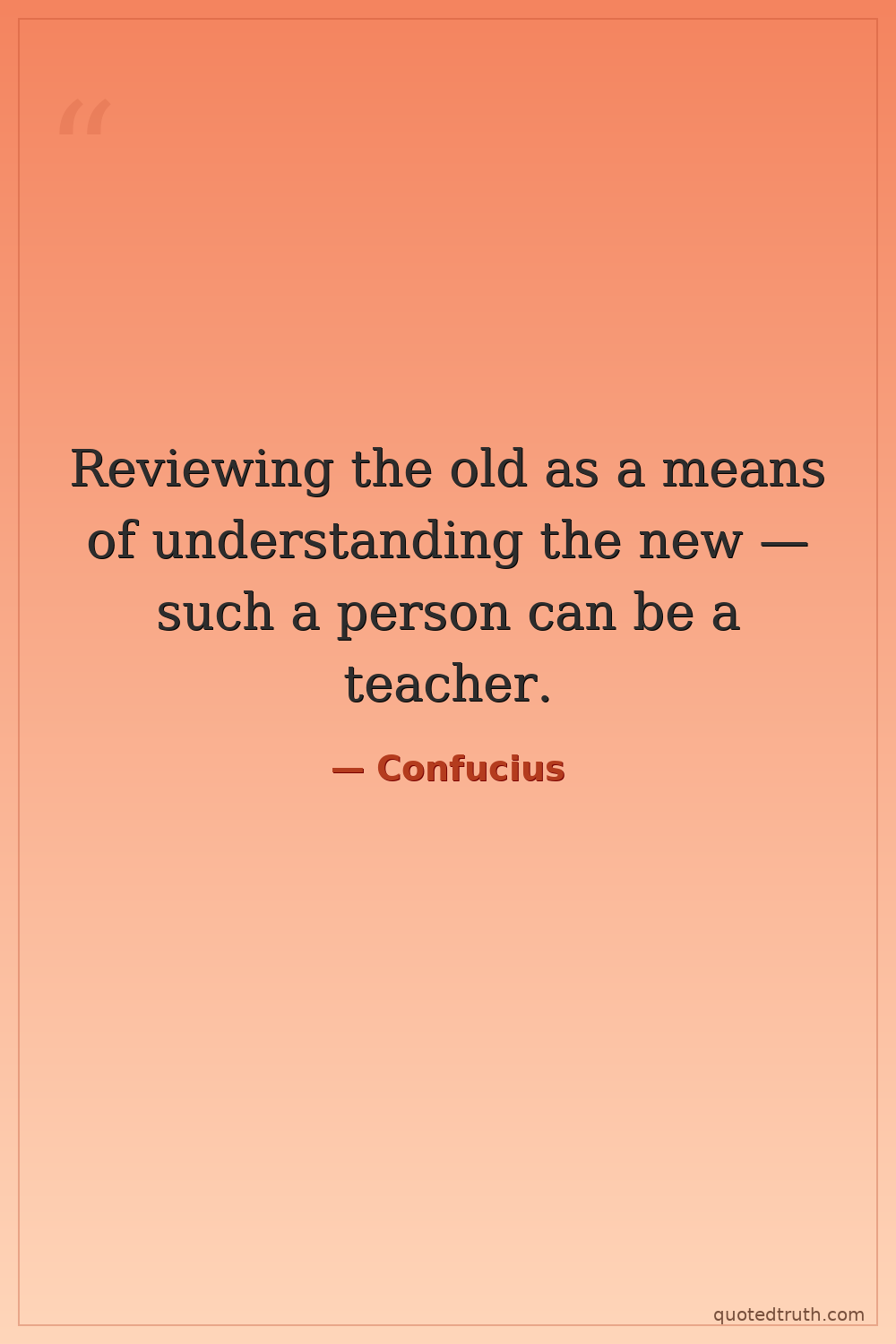
Confucius — "Reviewing the old as a means of understanding the new — such a person can be a t…"
Reviewing the old as a means of understanding the new — such a person can be a teacher.
Reviewing the old as a means of understanding the new — such a person can be a teacher.
Click any product to generate a realistic preview. Up to 3 at a time.
* Initial load can take up to 90 seconds — revising the preview in another color is nearly instant.
"To worship ancestors whom one does not know is to be presumptuous."
"Is humanity far away? Whenever I want the virtue of humanity, it comes at once."
"Humanity is more important for people than water or fire. I have seen people walk through water and fire and die. I have never seen someone tread the path of humanity and perish."
"Is it not pleasant to learn with a constant perseverance and application? Is it not delightful to have friends coming from distant quarters? Is he not a man of complete virtue, who feels no discomposu…"
"The Master said, 'What I want to avoid is fixed ideas, obstinacy, narrow-mindedness, and egoism.'"
Chinese philosopher and teacher whose teachings (compiled by his students in the Analects) became the foundational ethical framework of East Asian civilization for 2,500 years. Closely associated with Mencius (his most-influential follower a century later). For an intellectual contrast, see Laozi, near-contemporary Chinese sage and Tao Te Ching author — Confucius systematized social order through ritual and family hierarchy; Laozi's Taoist effortless-action philosophy argued such systems were the disease, not the cure. The two founding poles of Chinese moral philosophy — every East Asian moral tradition since has positioned itself between them.
The standard scholarly entry points to Confucius's work: Philip J. Ivanhoe (Georgetown, Chinese philosophy) — Confucian Moral Self Cultivation (2000); Edward Slingerland (UBC, Asian Studies) — Effortless Action: Wu-wei as Conceptual Metaphor (2003); Tu Weiming (Harvard, Confucian scholar) — Confucian Thought: Selfhood as Creative Transformation (1985). These are the works graduate seminars cite when teaching Confucius.
Found in 1 providers: grok
1 source checked
Studying the past is how you make sense of the present. Anyone who can take old knowledge, turn it over, and use it to understand something new qualifies to teach others. Real teaching isn't just reciting facts — it's connecting what already exists to what's emerging. If you can't bridge old and new, you're just repeating information, not guiding understanding. Mastery comes from synthesis, not memorization.
Confucius built his entire school around studying ancient texts, rituals, and the Zhou dynasty's early kings, believing their wisdom held answers for his chaotic present. He called himself a transmitter, not an innovator, and spent decades editing the Classics. This saying captures his core teaching method: don't worship the past, mine it. His students were trained to apply old principles to fresh problems, which is why his lineage produced statesmen, not just scholars.
Confucius lived during the Spring and Autumn period (551–479 BCE), when the Zhou dynasty was crumbling, states warred constantly, and old ritual order was collapsing. Many thinkers wanted to abandon tradition entirely. Confucius argued the opposite — that the breakdown came from forgetting ancient wisdom, not following it. In an era of violent reinvention, insisting teachers must bridge old and new was a political stance, defending continuity against rulers who preferred convenient amnesia.
AI-generated insights based on extensive research and information for context. Factual errors? Email [email protected].
Your cart is empty