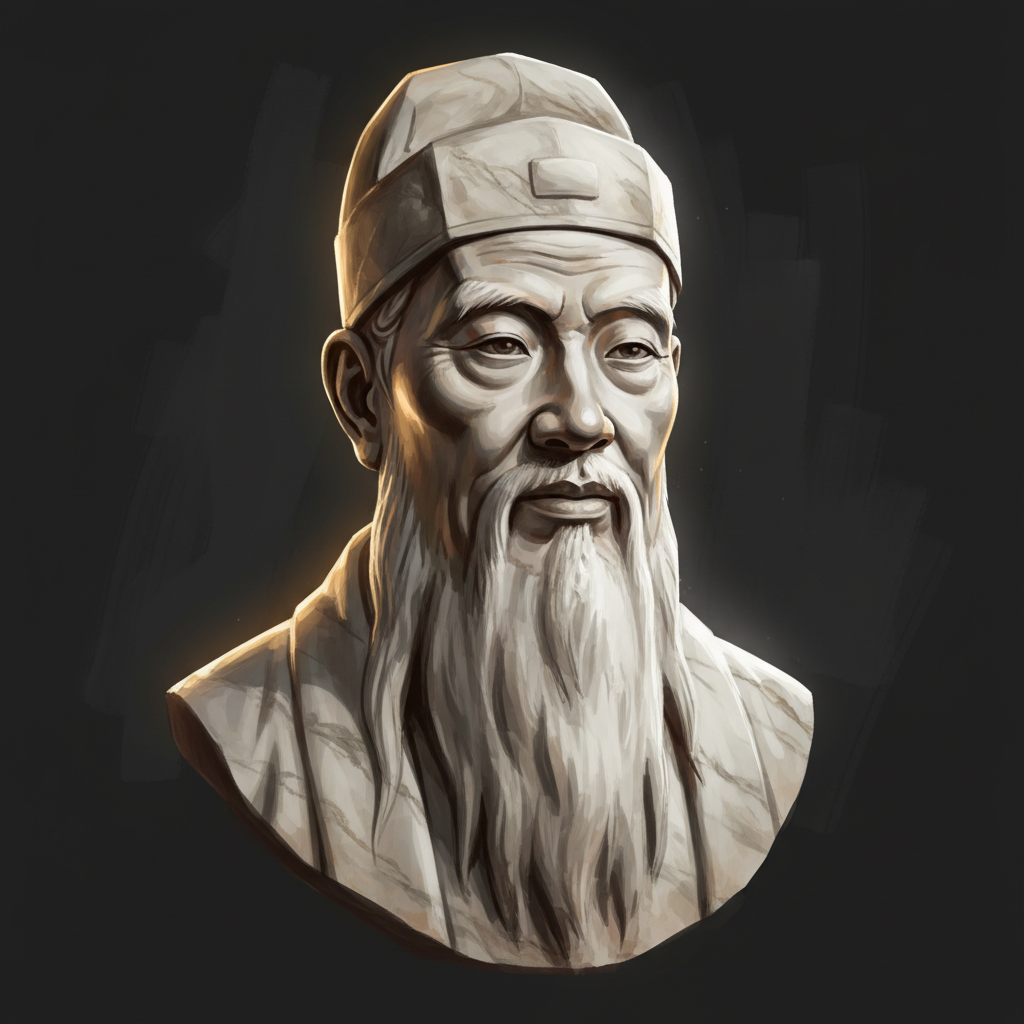
Confucius — "To know what you know and what you do not know, that is true knowledge."
To know what you know and what you do not know, that is true knowledge.
To know what you know and what you do not know, that is true knowledge.
Click any product to generate a realistic preview. Up to 3 at a time.
* Initial load can take up to 90 seconds — revising the preview in another color is nearly instant.
"Respect yourself and others will respect you."
"The noble-minded are calm and steady. Little people are forever fussing and fretting."
"The gentleman seeks to be slow in speech and earnest in action."
"The wise find pleasure in water; the virtuous find pleasure in mountains. The wise are active; the virtuous are tranquil. The wise are joyful; the virtuous are long-lived."
"The Master said, 'He who acts with a constant view to his own advantage will be much murmured against.'"
Chinese philosopher and teacher whose teachings (compiled by his students in the Analects) became the foundational ethical framework of East Asian civilization for 2,500 years. Closely associated with Mencius (his most-influential follower a century later). For an intellectual contrast, see Laozi, near-contemporary Chinese sage and Tao Te Ching author — Confucius systematized social order through ritual and family hierarchy; Laozi's Taoist effortless-action philosophy argued such systems were the disease, not the cure. The two founding poles of Chinese moral philosophy — every East Asian moral tradition since has positioned itself between them.
The standard scholarly entry points to Confucius's work: Philip J. Ivanhoe (Georgetown, Chinese philosophy) — Confucian Moral Self Cultivation (2000); Edward Slingerland (UBC, Asian Studies) — Effortless Action: Wu-wei as Conceptual Metaphor (2003); Tu Weiming (Harvard, Confucian scholar) — Confucian Thought: Selfhood as Creative Transformation (1985). These are the works graduate seminars cite when teaching Confucius.
Found in 3 providers: grok,deepseek,gemini
3 sources checked
Real understanding begins with honest self-assessment of your own mind. Recognize where your grasp is solid and where it falls short, and do not confuse the two. Pretending to understand something you do not blocks learning and leads to poor decisions. Acknowledging gaps opens the door to asking questions, seeking evidence, and correcting mistakes. Intellectual humility, not the appearance of expertise, is what separates genuine knowledge from bluff.
Confucius spent his life as a teacher who prized reflection, humility, and lifelong study over status. He described himself not as wise but as someone eager to learn, and he pushed disciples to examine themselves daily. His teachings on ren (humaneness) and the junzi (exemplary person) rest on honest self-knowledge as the starting point for moral cultivation. This saying distills his core teaching method: admit ignorance, then study to close the gap.
Confucius lived during the late Spring and Autumn period, around 551–479 BCE, as the Zhou dynasty fractured into warring states and rival courts competed for advisors. Noble status was often claimed through pedigree and bluster rather than competence, and rulers surrounded themselves with flatterers. Against this backdrop, Confucius promoted merit, learning, and ritual propriety as the foundation of good government. Urging officials and students to admit what they did not know was a direct challenge to the posturing of his age.
AI-generated insights based on extensive research and information for context. Factual errors? Email [email protected].
Your cart is empty