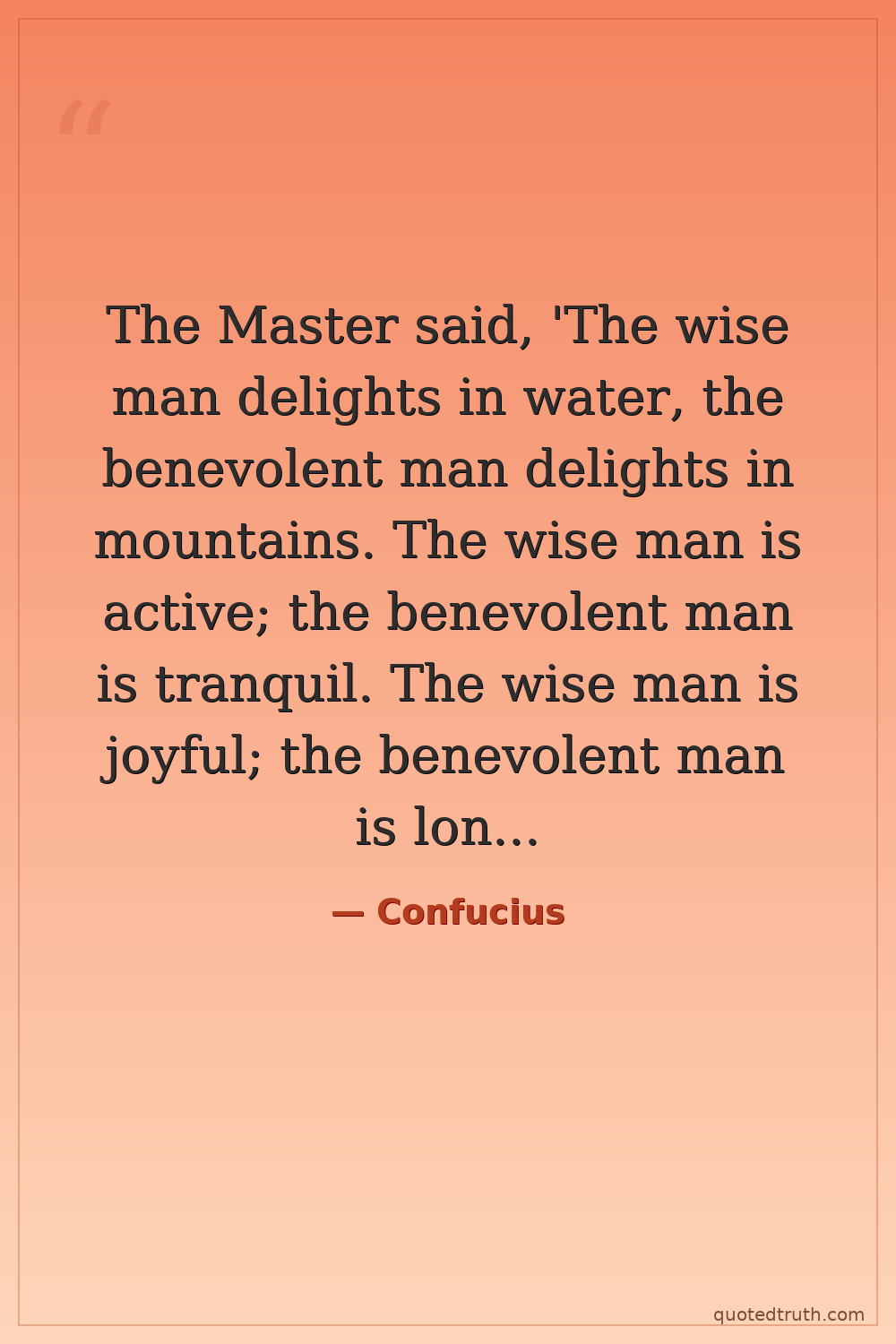
Confucius — "The Master said, 'The wise man delights in water, the benevolent man delights in…"

The Master said, 'The wise man delights in water, the benevolent man delights in mountains. The wise man is active; the benevolent man is tranquil. The wise man is joyful; the benevolent man is long-lived.'
Confucius — Confucius Ancient · Chinese philosopher, founder of Confucianism

Get This Quote & Author's Image Illustrated On:

Click any product to generate a realistic preview. Up to 3 at a time.
* Initial load can take up to 90 seconds — revising the preview in another color is nearly instant.

Kitchen

Apparel

Other

About Confucius (551-479 BCE)

Chinese philosopher and teacher whose teachings (compiled by his students in the Analects) became the foundational ethical framework of East Asian civilization for 2,500 years. Closely associated with Mencius (his most-influential follower a century later). For an intellectual contrast, see Laozi, near-contemporary Chinese sage and Tao Te Ching author — Confucius systematized social order through ritual and family hierarchy; Laozi's Taoist effortless-action philosophy argued such systems were the disease, not the cure. The two founding poles of Chinese moral philosophy — every East Asian moral tradition since has positioned itself between them.

The standard scholarly entry points to Confucius's work: Philip J. Ivanhoe (Georgetown, Chinese philosophy) — Confucian Moral Self Cultivation (2000); Edward Slingerland (UBC, Asian Studies) — Effortless Action: Wu-wei as Conceptual Metaphor (2003); Tu Weiming (Harvard, Confucian scholar) — Confucian Thought: Selfhood as Creative Transformation (1985). These are the works graduate seminars cite when teaching Confucius.

Details

Analects, Book VI, Chapter 23

Date: c. 5th century BCE

General

Verification

Unverifiable

Found in 1 providers: grok

1 source checked

Understanding this quote

What it means

Confucius contrasts two complementary human ideals. Wise people resemble flowing water—curious, adaptive, energetic, and finding happiness in constant movement and discovery. Benevolent people resemble mountains—stable, patient, grounded, and enduring through steady compassion. Neither type is better; they represent different strengths. Wisdom brings lively joy through engagement with change, while goodness brings lasting peace through rootedness. A full life blends both the restless mind and the settled heart.

Relevance to Confucius

Confucius spent his life teaching that moral cultivation required balancing intellectual sharpness with ethical steadiness. As a teacher who traveled between warring states seeking rulers who would adopt his ethics, he embodied the active, water-like wise man, yet he also praised the mountain-like ren (benevolence) he considered the highest virtue. This saying captures his characteristic method: pairing opposites to show that a complete gentleman, the junzi he trained his disciples to become, needs both qualities working together.

The era

Confucius lived during the late Spring and Autumn period (551–479 BCE), when the Zhou dynasty was collapsing into constant warfare between rival states. Social hierarchies were crumbling, rulers were assassinated, and traditional rituals were abandoned. In this chaos, Confucius tried to restore order through personal virtue rather than force. Nature metaphors like water and mountains drew on older Chinese cosmology that saw the natural world as a moral mirror, making his teaching instantly memorable to an agrarian society surrounded by rivers and peaks.

AI-generated insights based on extensive research and information for context. Factual errors? Email [email protected].
Your Cart

Your cart is empty