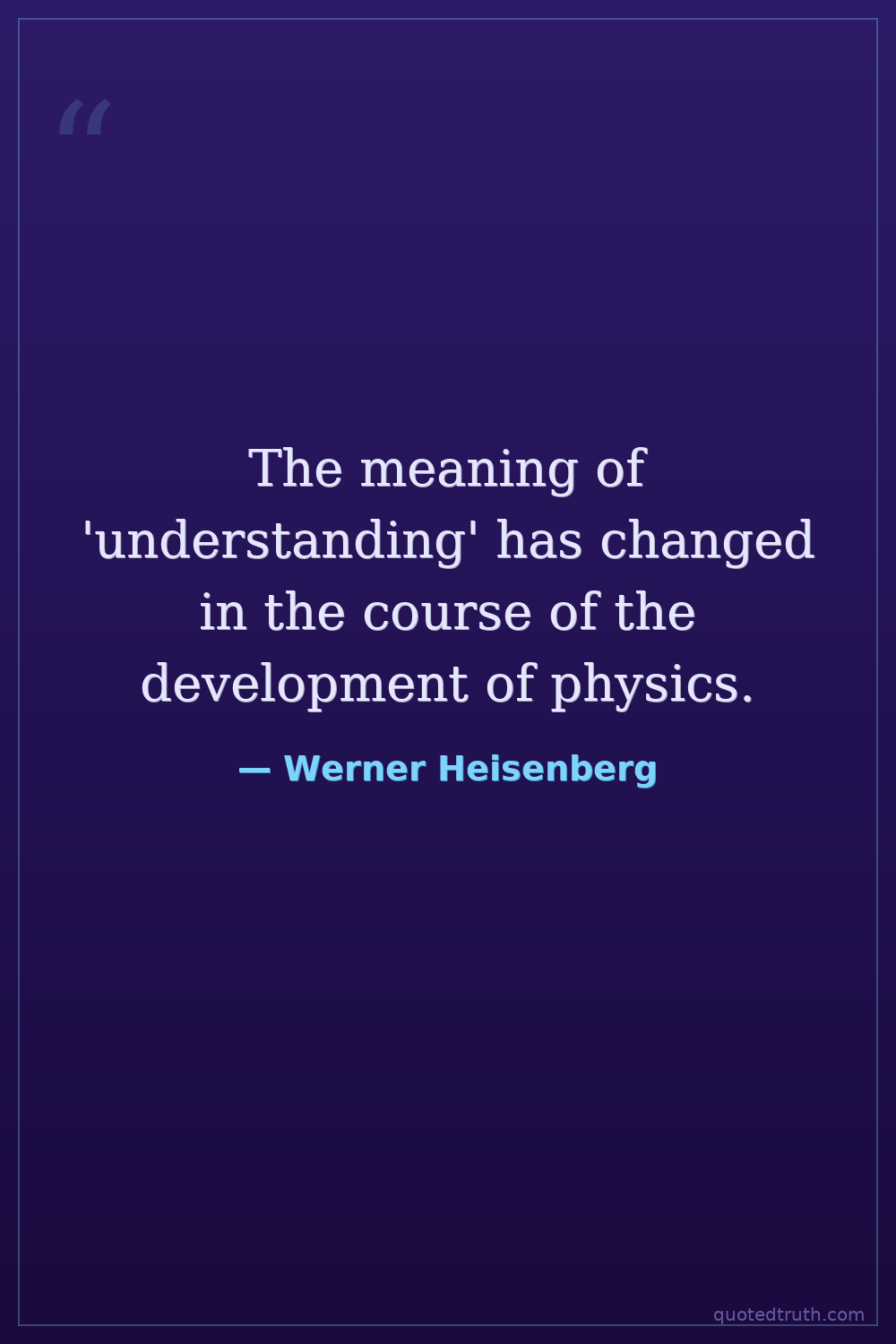
Werner Heisenberg — "The meaning of 'understanding' has changed in the course of the development of p…"
The meaning of 'understanding' has changed in the course of the development of physics.
The meaning of 'understanding' has changed in the course of the development of physics.
Click any product to generate a realistic preview. Up to 3 at a time.
* Initial load can take up to 90 seconds — revising the preview in another color is nearly instant.
"The more I think about the physical aspects of the electron, the more it becomes a puzzle."
"Only a few know, how much one must know to know how little one knows."
"If we want to describe what happens in an atomic event, we must realize that the word 'happens' can apply only to the observation, not to the state of affairs between two observations."
"The decision for a definite result is taken only when the measurement is made."
"If a man is to be a good physicist, he must have an intuitive grasp of the physical reality, which can be acquired only by much experience."
On the evolution of scientific comprehension
Date: 1955 (Physics and Philosophy)
EducationalFound in 1 providers: grok
1 source checked
What it means to truly understand something in physics is not fixed. As science progresses, the standards and methods for grasping nature shift. Earlier, understanding meant picturing things mechanically, like gears or billiard balls. Later, it meant writing equations that predict outcomes, even if the underlying reality defies visualization. Each breakthrough redefines what counts as a satisfying explanation, forcing scientists to abandon old intuitions and accept new, often stranger, frameworks.
Heisenberg lived this shift firsthand. Trained in classical physics, he co-founded quantum mechanics and formulated the uncertainty principle, which showed that position and momentum cannot both be precisely known. He abandoned visualizable atomic orbits for abstract matrices, drawing criticism from Einstein and Schrodinger. His philosophical writings repeatedly wrestled with what 'understanding' means when intuition fails, making this observation a direct reflection of his intellectual journey and methodological convictions.
Heisenberg worked during the 1920s-1970s, when physics underwent its most radical transformation since Newton. Relativity and quantum theory dismantled classical certainties about space, time, causality, and observation. Debates raged at Copenhagen, Solvay, and Gottingen over whether quantum mechanics described reality or merely predictions. World wars, the atomic bomb, and postwar reconstruction framed these discussions. Philosophers and physicists alike asked whether science still explained nature or merely calculated it, making Heisenberg's reflection deeply timely.
AI-generated insights based on extensive research and information for context. Factual errors? Email [email protected].
Your cart is empty