What it means
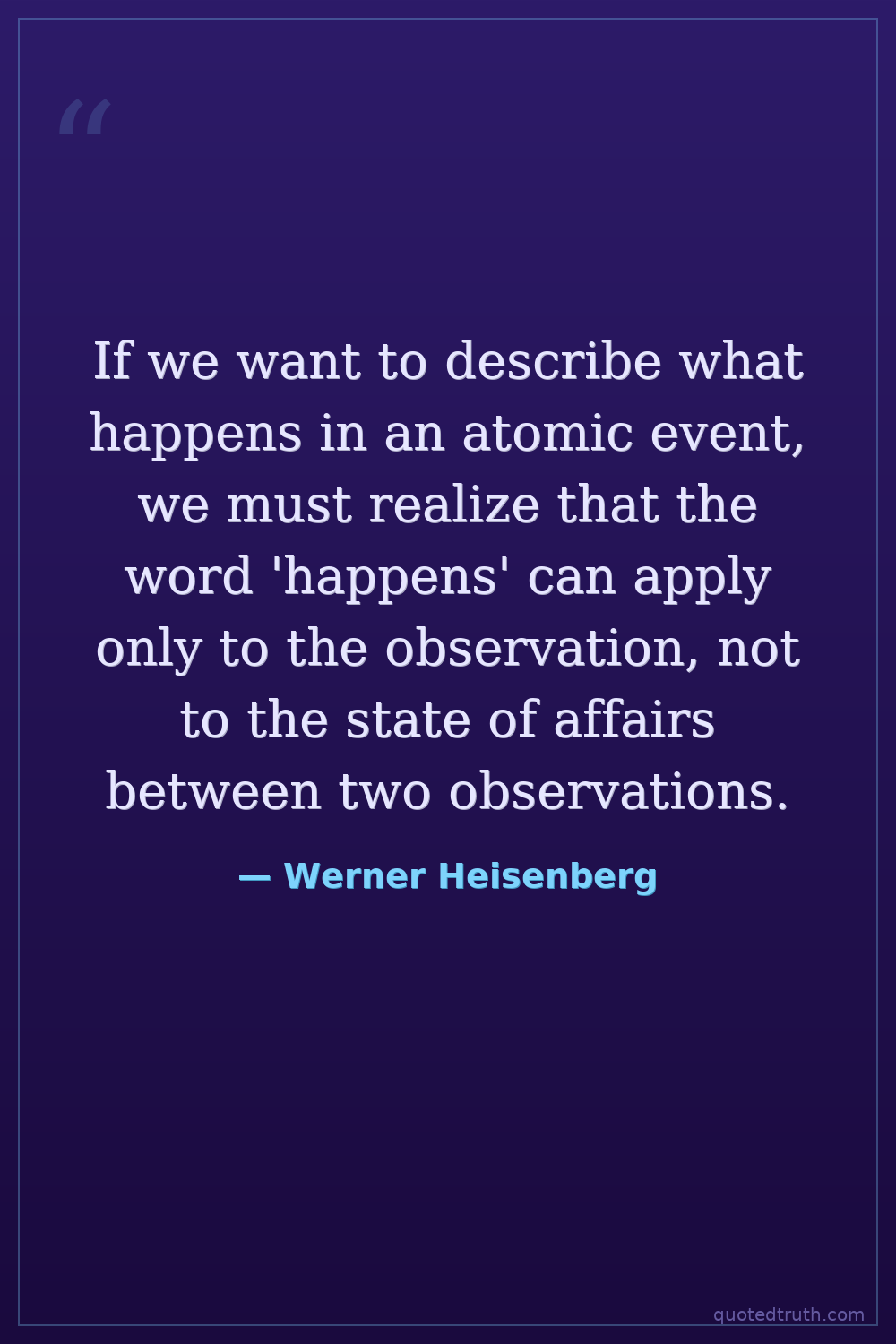
Reality at the atomic scale cannot be described as a continuous story of things happening between measurements. The only moment we can meaningfully say something 'occurred' is when we actually observe or measure it. What a particle is doing in the gap between observations isn't a hidden but real sequence of events we could in principle watch; it's simply outside the language of ordinary happening.
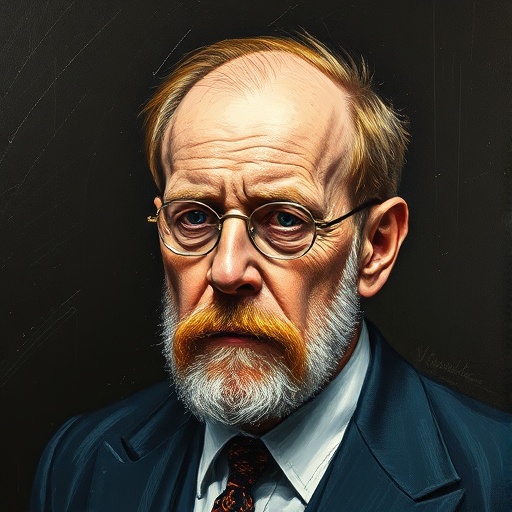
Relevance to Werner Heisenberg
Heisenberg built quantum mechanics around what is actually measurable, rejecting unobservable classical trajectories. His 1927 uncertainty principle showed position and momentum cannot both be sharply defined, and his matrix mechanics encoded only observable transitions. This quote distills his Copenhagen stance, developed with Bohr: physics describes observations, not a hidden film between them. It mirrors his lifelong conviction that meaningful reality is what experiments reveal.
The era
Writing in the mid-twentieth century, Heisenberg worked as classical determinism collapsed under quantum experiments, Einstein's relativity, and Godel's limits on certainty. Two world wars, the atomic bomb, and philosophical movements like logical positivism were forcing thinkers to question what could be known. Against Einstein's insistence that God does not play dice, Heisenberg and Bohr's Copenhagen interpretation reshaped physics and culture, embedding observer-dependence into how modernity understood truth.
AI-generated insights based on extensive research and information for context. Factual errors? Email [email protected].